Color Sequence. 1943. USA. Directed by Dwinell Grant. Restored 16mm print courtesy Anthology Film Archives. 2 mins.
Word Film, Fluxfilm 29. 1966. USA. Directed by Paul Sharits. 16mm print courtesy Anthology Film Archives. English. 4 mins.
Secondary Currents. 1982. USA. Directed by Peter Rose. 16mm print courtesy Canyon Cinema. Nonsense language. 18 mins.
Evil. 27: Selma. 2011. USA. Directed by Tony Cokes. Digital file courtesy Electronic Arts Intermix. English. 9 mins.
Projection Instructions. 1976. USA. Directed by Morgan Fisher. 16mm print courtesy Academy of Motion Picture Arts and Sciences. English. 4 mins.
Underscan. 1974. USA. Directed by Nancy Holt. Digital file courtesy Electronic Arts Intermix. English. 9 mins.
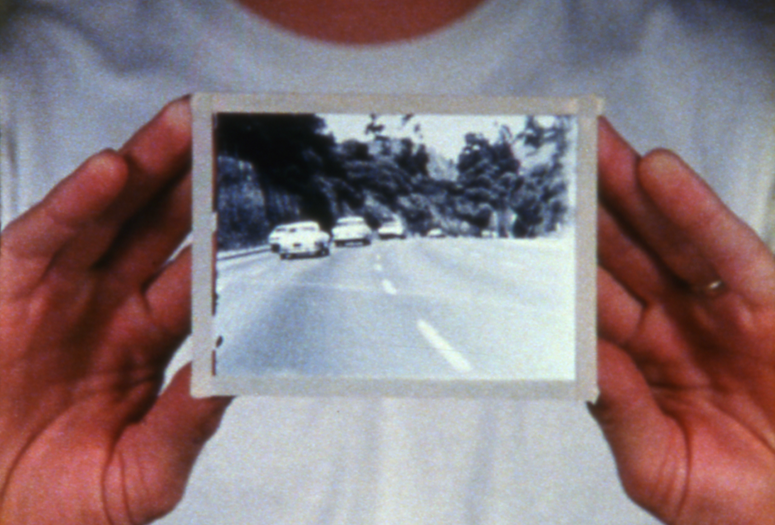
Pasadena Freeway Stills. 1974. USA. Directed by Gary Beydler. 16mm print courtesy Canyon Cinema. 6 mins.
Shelly Winters. 2010. USA. Directed by Luther Price. 16mm print restored by Anthology Film Archives. 8 mins.
Angel Beach. 2001. USA. Directed by Scott Stark. 16mm print courtesy Canyon Cinema. English. 27 mins.
Anthology Film Archives was founded by Jonas Mekas, Jerome Hill, P. Adams Sitney, Peter Kubelka, and Stan Brakhage in 1970 as an ongoing showcase for the highly curated Essential Cinema collection. Since then, it has expanded its programming scope, now showing more than 900 films per year. Jed Rapfogel, Anthology’s head of film programming, is responsible for much of the city’s most adventurous, unique, and intellectually rigorous programming. This selection by Rapfogel is drawn from two different series: Imageless Films and Motion(less) Pictures. Of the former, Rapfogel wrote “If there’s one central element that would seem to be intrinsic and indispensable to any reasonable definition of the cinema it would be the presence of imagery, whether photographed, animated, or generated through more experimental methods such as hand-painting, scratching, collaging, and so on. Nevertheless, throughout the history of the medium, artists have challenged even this seemingly core tenet of the art form by producing works that subvert or entirely dispense with the image, by expanding the definition of the kinds of experience that can be shared within the space of the cinema, or by provocatively defining as “cinema” performances that might seem a thing apart.” And of Motion(Less) Pictures, he wrote: “Experimental films most fully live up to their name when systematically testing the limits of the medium, searching for the cinema’s essence by stripping away some of its most apparently indispensable qualities. And one of the most radical ways filmmakers have tested these limits is by making films using, or even constructed entirely from, still images.”