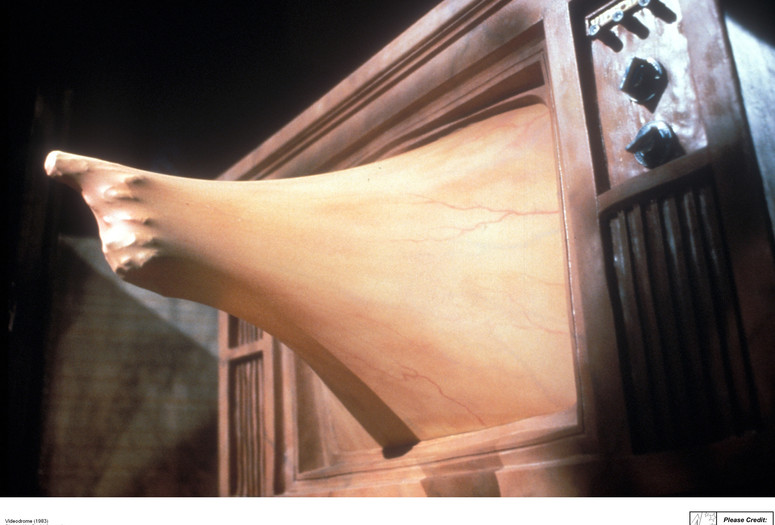
Videodrome. 1983. Canada. Written and directed by David Cronenberg. With James Woods, Debbie Harry, Sonja Smits, Peter Dvorsky. 35mm. 87 min.
Canadian director David Cronenberg was a mainstay of programming at the Museum of the Moving Image under film curator David Schwartz, who presented a complete Cronenberg retrospective in 1992 and a reprise in 2012, along with individual preview screenings of his new films, all with the director in person. Videodrome, the director’s 1983 masterpiece, can be seen as a reflexive and subversive self-portrait, with James Woods’s Max Renn as the head of Civic TV, a UHF station whose programming is a mix of soft-core porn and violence. Cronenberg is playfully responding to critics of his early horror films (Shivers, Rabid, Scanners, and The Brood) while also creating a Marshall McLuhan–inspired investigation into the nature of film and video, and more deeply, of the way our bodies are being transformed by our interactions with technology. Cronenberg’s concerns about the nature of modern society are played out in the most intimate arena and, as always, he asks us to confront our most primal fears and carnal desires. Like Alfred Hitchcock’s Vertigo, this is a tale of sexual obsession that enters the realm of dreamlike subjectivity. Debbie Harry is mesmerizing as Renn’s assured and mysterious temptress Nikki Brand.
The Italian Machine. 1976. Canada. Written and directed by David Cronenberg. With Gary McKeehan, Frank Moore, Hardee T. Lineham. DCP courtesy Library and Archives Canada, with the permission of David Cronenberg. 23 min.
Early in his career, David Cronenberg directed a number of television dramas. Rarely screened, The Italian Machine follows a group of fanatic bikers trying to get their hands on a prized Ducati motorcycle that is in the hands of a wealthy collector.