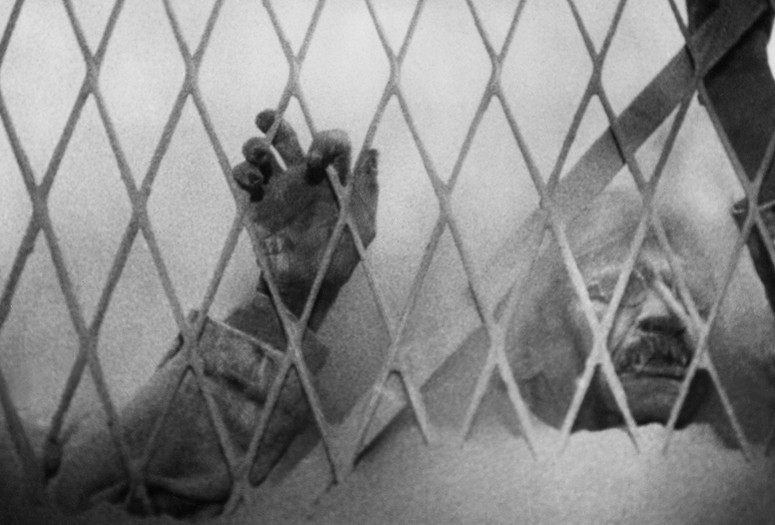
Founded in 1947 by Amos and Marcia Vogel, the pioneering Cinema 16 was a film society that operated in a number of theaters, most notably the 1,600-seat Fashion Industries Auditorium that frequently played two shows per night to sold-out audiences. Other venues included the Paris Theater, the Beekman, and the Murray Hill. Showing “films you can not see elsewhere,” Cinema 16 concentrated on, in Vogel’s words, “documentary and avant garde, non-fiction and offbeat cinema, plus a smattering of otherwise unavailable foreign and American ‘art’ features.” Amos Vogel programmed films in unexpected and revelatory combinations, such as this inspired pairing of three dreamlike, visceral, and very different films, shown together in 1952 in a program that was repeated due to popular demand. The notes below are from Vogel’s 1974 book Film as a Subversive Art.
Fireworks. 1947. USA. Written and directed by Kenneth Anger. With Kenneth Anger. 16mm print courtesy Canyon Cinema with permission from Bryan Butler. English. 15 mins.
An early classic of the homosexual cinema and probably one of the most famous American avant-garde films. A painfully honest, deeply-felt episode of sado-masochist homosexuality, experienced as nightmare and wishdream, in which the protagonist (played by Anger) is brutally attacked and disembowelled by a group of sailors. In the last scene, he opens his fly and “lights” his penis which explodes in firework fashion. Intensity, pain, and poetic imagery transform autobiographical elements into art.
Vampyr. 1932. Denmark. Directed by Carl Dreyer. Screenplay by Christen Jul and Carl Dreyer. With Nicolas de Gunzburg (credited as Julian West), Maurice Schultz, Rena Mandel, Sybille Schmitz. DCP courtesy of the Danish Film Institute, with the permission of Janus Films. Danish with English subtitles. 73 mins.
Form and content are fused in this hallucinatory attempt to force us into the oppressive horrors of a world dominated by vampires. As the hero searches for glimpses of rationality and understanding, even ordinary surroundings are transformed into anxiety-ridden symbols. No one who has seen this film will ever forget these mysterious shadows and chains.
Le Sang des bêtes (Blood of the Beasts). 1949. France. Written and directed by Georges Franju. 35mm print from the Museum of Modern Art. French with English subtitles. 22 mins.
This documentary on the slaughterhouses of Paris is one of the great masterpieces of subversive cinema; here, for once, we are face to face with death, and are neither protected nor cheated. Unlike Hollywood films, when the butcher raises the hammer to stun the horse there is no “cutting away”; the camera, objectively and cruelly, stays with the event, making us its shocked accomplices. As these “killers without hate,” knee-deep in blood and surrounded by steaming excrema and vomit, murder animals in cold indifference before the camera—the number of animals dying but a fraction of a day’s output of slaughterhouses everywhere—we learn to see, and then perhaps to feel what we have not felt before. Violence here is neither fictional nor titillating; it is massive and real. A dream-like quality permeates the intense realism of the images; a surrealist intent akin to Buñuel’s slitting of the eyeball in Un Chien Andalou is discernable in this anti-bourgeois film.