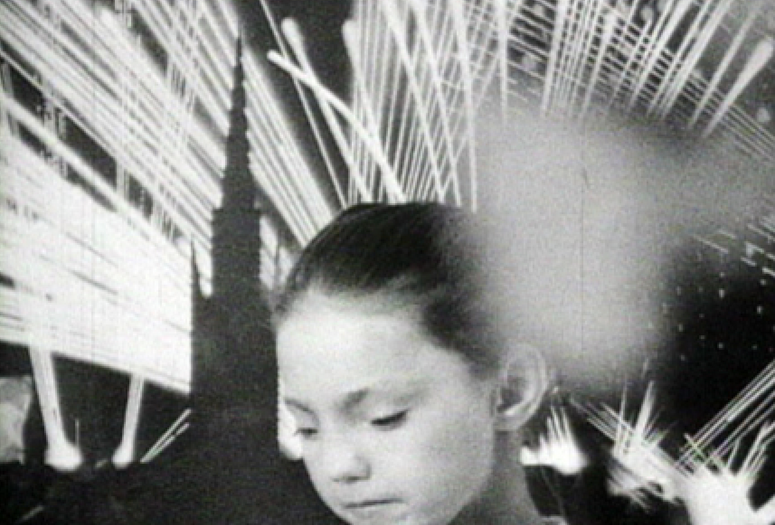
Rosa Barba’s films often depict terrains shaped by time and human intervention: abandoned industrial sites, environmentally scarred vistas, and aerial footage of the southwest United States. “I was interested in trying to understand all these traces that we leave as a society on the landscape,” Barba reflects. “I began to think of it as a sort of archive.” Similarly, the works in this program survey a rich repository of physical and psychic landscapes layered with cultural memory and speculative possibility. Rachel Reupke’s Infrastructure chronicles a voyage along an imagined transportation network through the Alps traversed by way of airport, railway, autobahn, and ferry port. Leslie Thornton’s Peggy and Fred in Hell: The Prologue tracks the journey of two children through a postapocalyptic landscape littered with pop culture detritus, and Shambhavi Kaul’s Night Noon lingers on eroded terrains and undulating dunes to render a gripping portrait of the Mojave Desert’s Death Valley. Barba also nods to how rich legacies of literary and musical experimentation have informed her work through a presentation of Blind Huber, a film by Kevin Jerome Everson that interprets Nick Flynn’s poetry on the life of 18th-century French beekeeper Francois Huber, as well as The Magic Sun, a music film by Phill Niblock showcasing Sun Ra performing with members of his Solar Arkestra through abstracted, high-contrast close-ups.
Peggy and Fred in Hell: The Prologue. 1984. USA. Directed by Leslie Thornton. Video (black and white, sound). 20 min.
Infrastructure. 2002. UK. Directed by Rachel Reupke. Video (black and white, sound). 14 min.
Blind Huber. 2005. USA. Directed by Kevin Jerome Everson. 16mm film transferred to video (black and white, sound). 2 min.
The Magic Sun. 1966. USA. Directed by Phill Niblock. 17 min.
Night Noon. 2014. USA. Directed by Shambhavi Kaul. 16mm film transferred to video (color, sound). 12 min.
Program approx. 65 min.