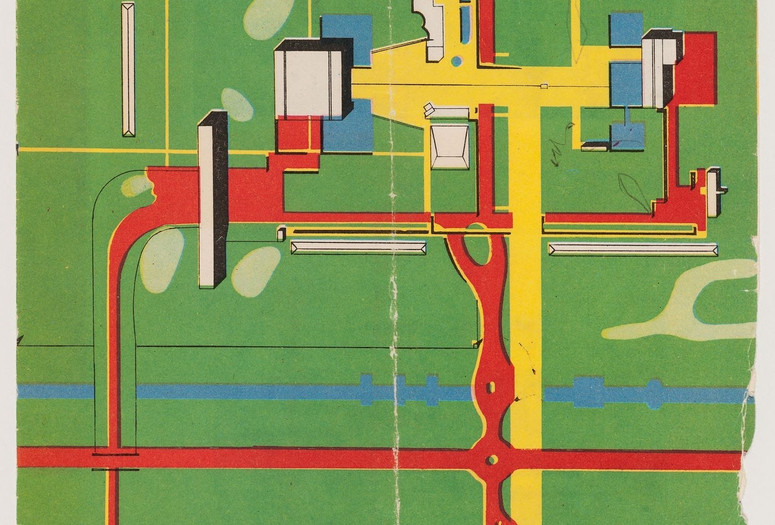
When Jawaharlal Nehru, India’s first Prime Minister, commissioned the pioneering Swiss architect and modernist urban planner Le Corbusier to build the new capital city of Chandigarh in Punjab in 1951, India was still reeling from the bloody violence and refugee crisis of Partition a few years earlier. Nehru wanted a modern city for the newly Independent nation, a future-looking landscape, and Le Corbusier responded by “giving India the architecture of modern times.” India, in turn, gave Le Corbusier the largest project of his legendary career.
Over 70 years later this public program, convened by MoMA Scholar in Residence Saloni Mathur, will gather two architectural historians—Maristella Casciato and Vikramaditya Prakash—along with Martino Stierli, MoMA’s chief curator of Architecture and Design—to reevaluate this epochal landmark in the history of modernism. The postcolonial experiment that is Chandigarh will be reconsidered in terms of the pressing challenges of the present, in particular climate change, globalization, the politics of heritage, and the continued inequities between the global North and South.
Participants
Maristella Casciato is senior curator and head of architectural collections at the Getty Research Institute. She is the author of Le Corbusier, Album Punjab, 1951 (2024).
Saloni Mathur is a 2024–25 MoMA Scholar in Residence and a professor of art history at University of California, Los Angeles.
Vikramaditya Prakash is a professor of architecture at the University of Washington, Seattle, and the author of, most recently, Le Corbusier’s Chandigarh Revisited: Preservation as Future Modernism (2023) and One Continuous Line: Art, Architecture and Urbanism of Aditya Prakash (2020).
Martino Stierli is the Philip Johnson Chief Curator of Architecture and Design at MoMA.
The MoMA Scholar in Residence program is supported by the Ford Foundation.