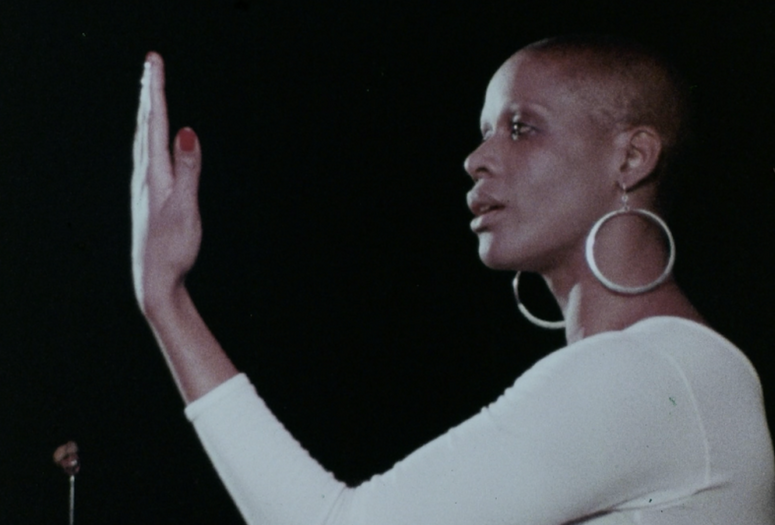
Unwilling to compromise her artistic voice or her political activism, Sarah Maldoror did not endear herself to African government funding agencies, and throughout her career she struggled to make the kind of films she felt called upon to make. “Clearly [African governments], after seeing my work, weren’t going to say, ’Great filmmaker, let her come make films,’” she would observe. “Politically. I was a marked woman. So in order to keep making art, I went to France.” This diverse selection of short pieces, made with constrained means but great imaginativeness, speaks to Maldoror’s commitment to the margins and the marginalized. This was particularly true of her short pieces on the working-class, Communist-run Parisian suburb of Saint-Denis, where migrants, many of them African, made their home. Program 105 min.
Un senegalais en Normandie (A Senegalese Man in Normandy). 1986. France. Directed by Sarah Maldoror. DCP. In French; English subtitles. 13 min.
The Senegalese man of the film’s title is Léopold Sédar Senghor, the poet and first president of Senegal, who is remembered by his neighbors in Normandy.
Portrait d’une femme africaine (Portrait of an African Woman). 1985. France. Directed by Sarah Maldoror. DCP. In French; English subtitles. 6 min.
In this segment on immigrant cultures for the television program Mosaïque, a young Senegalese woman who cooks in a workers’ hostel dreams of traveling throughout France and getting to know her adopted country, taking issue with the cliché of the impoverished and helpless immigrant.
Le cimetière du Père Lachaise (Père Lachaise Cemetery). 1979. France. Directed by Sarah Maldoror. DCP. In French; English subtitles. 5 min.
As Sarah Maldoror’s camera wends its way among the tombstones and cats of Paris’ famed Père Lachaise cemetery, poems including Paul Éluard’s “Liberté” are recited.
Abbaye royale de St-Denis (The Basilica of Saint-Denis). 1980. France. Directed by Sarah Maldoror. DCP. In French; English subtitles. 6 min.
Celebrating the anonymous craftsmen who built a Gothic basilica in Paris, just down the street from where she lived, Sarah Maldoror observes the handhewn stone architecture of the cathedral and its famed necropolis, the final resting place of kings and queens for nearly a millennium, from the 10th century until their desecration during the French Revolution.
L’architecture d’inspiration étrangère à Paris (Foreign-Inspired Architecture in Paris). 1979. France. Directed by Sarah Maldoror. DCP. In French; English subtitles. 3 min.
Sarah Maldoror finds inspiration in the hidden corners of Paris, where architecture was shaped by foreign styles and influences.
Wielopole: mise en scene du Polonais kantor (Wielopole, Wielopole As Staged by Kantor). 1980. France. Directed by Sarah Maldoror. DCP. In French; English subtitles. 3 min.
First staged in Krakow and the Gdansk shipyards in 1980, where Poland’s Solidarity movement was born, and here performed at the Théâtre des Bouffes du Nord in Paris, Wielopole, Wielopole by the theater company Cricot 2 merges themes of Christ’s Passion and fascism with the Polish director Tadeuz Kantor’s own childhood memories.
Ouverture du Théâtre Noir de Paris (Opening of the Theater Noir in Paris). 1980. France. Directed by Sarah Maldoror. DCP. In French; English subtitles. 6 min.
Sarah Maldoror documents the opening of the Théâtre Noir de Paris, a Négritude-inspired theater company and cultural association dedicated to artists and performers from Africa and the French Antilles.
Claudel à Reims (Claudel in Reims). 1984. France. Directed by Sarah Maldoror. DCP. In French; English subtitles. 5min.
Sarah Maldoror observes a stage production of Paul Claudel’s The Hostage at the Théâtre de la Comédie in Reims.
Portrait of Christiane Diop. 1984. France. Directed by Sarah Maldoror. DCP. In French; English subtitles. 6 min.
This profile of Christiane Diop, who became the first Black woman to run a major publishing house in Paris when she served as editor-in-chief of the influential imprint Présence africaine, features an interview with Sophie Mondesir, a French illustrator of West Indian-Guadeloupean origin.
Écrivain public (Public Writer). 1985. France. Directed by Sarah Maldoror. DCP. In French; English subtitles. 3 min.
Sarah Maldoror interviews women of different nationalities who serve as “public” writers, linking French administrative bodies with people who cannot speak or write French.
La littérature tunisienne à la Bibliothèque national de France (Tunisian Literature at the French National Library). 1986. France. Directed by Sarah Maldoror. DCP. In French; English subtitles. 3 min.
Commemorating the 1986 Tunis-Paris exhibition Privileged Spaces and Times: French-Speaking Intellectual Production in Tunisia, Sarah Maldoror’s film points the way toward a more polyvocal understanding of the role of France’s National Library worldwide.
Point virgule (journal jeunes) (Point Virgule, Youth Journal). 1986. France. Directed by Sarah Maldoror. DCP. In French; English subtitles. 4 min.
In this short piece, fledgling editors, reporters, and illustrators describe their work on Point Virgule, a newspaper by and for young people, including publishing articles on racism.
Première rencontre internationale des femmes noires (First International Conference for Black Women). 1986. France. Directed by Sarah Maldoror. DCP. In French; English subtitles. 2 min.
In this report on an annual conference known as RIFEN, Black women from around the world gather to discuss points of common interest and need, including community leadership and shared experiences of migration and transplantation.
Les oiseaux mains (Birds in the Hands). 2005. France. Directed by Sarah Maldoror. Animation by Baudoin. DCP. In French; English subtitles. 1 min.
Sarah Maldoror’s only animated film, made for the nonprofit organization Secours Populaire Français, is dedicated to fighting poverty and discrimination.