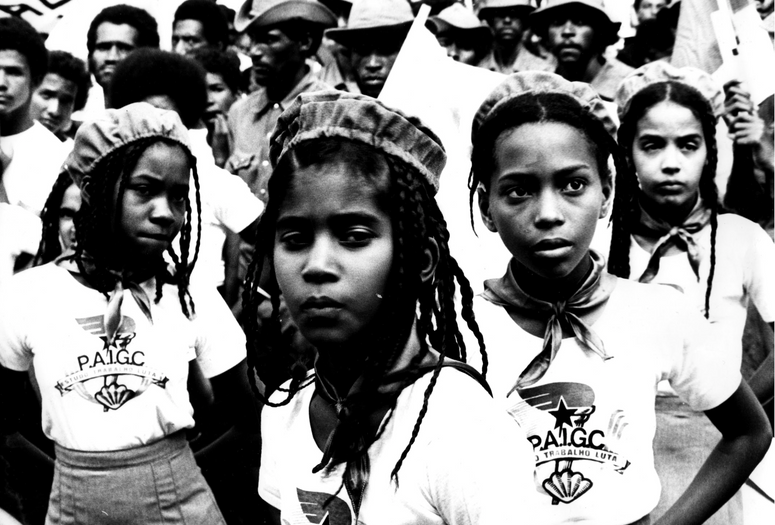
When Sarah Maldoror discovered the islands of Cape Verde after the nation gained independence from Portugal in 1978, she set about making a number of films about their wild volcanic beauty and their people. Together forming a loose trilogy, these works capture the tradition of carnival as a form of political and social resistance, and are a precious record of a unified Guinea-Bissau and Cape Verde before the 1980 coup d’état that drove the nations apart. Program 59 min.
Fogo, île de feu (Fogo, Island of Fire). 1978. France/Cape Verde. Directed by Sarah Maldoror. DCP. In French; English subtitles. 23 min.
Each May Day, on the arid and wind-battered volcanic island of Fogo in Cape Verde, local inhabitants celebrate a legend involving courtly jousts and popular horse races passed down from Portuguese colonizers.
À Bissau le carnaval (Carnival in Bissau). 1977. France/Guinea-Bissau. Directed by Sarah Maldoror. DCP. In French; English subtitles. 13 min.
Since Guinea-Bissau gained its independence in 1974 after five centuries of Portuguese colonization, the people of the country have celebrated their annual carnival in Bissau, the country’s capital. Fabricating an imaginary world, their festivities transform in subtle and syncretic ways the traditions of the Portuguese in an effort to upend the power structures of colonial domination.
Carnaval dans le Sahel (Carnival in the Sahel). 1978. France/Cape Verde. Directed by Sarah Maldoror. DCP. No dialogue. 23 min.
As she observes local villagers in the port town of Mindelo preparing for carnival, Sarah Maldoror captures through sound and movement the stirrings and secret codes of resistance among the Cape Verdean people.