Enjoy a fun-filled program of short films celebrating sound, from artful imaginings of how music looks, to the sounds of our emotions, to a unique quest for the perfect sound. Between the films, join a discussion about what you saw, then try suggested follow-up activities in the Museum’s galleries.
This program was developed in collaboration with Maria-Christina Villaseñor, guest curator and New York International Children’s Film Festival Director of Programming.
What Is Music? 2013. USA. Directed by Christian Robinson. This animated short, captured via stop-motion and iPhone, uses paper cutouts and collage to accompany kids’ thoughts on music. 4 min.
Poum Poum! 2021. France. Directed by Damien Tran. This musical animated film celebrates the simple joy of hitting drums, scribbling on paper, splashing paint, and crashing cymbals. 6 min.
The Day I Beat the Sky. 2016. France. Directed by Hughes Valin. A boy must use his gift for rhythms and sounds to face his greatest fear: a storm. 3 min.
Sientje. 1997. Netherlands. Directed by Christa Moesker. Sientje is a girl who is really, really angry. 4 min.
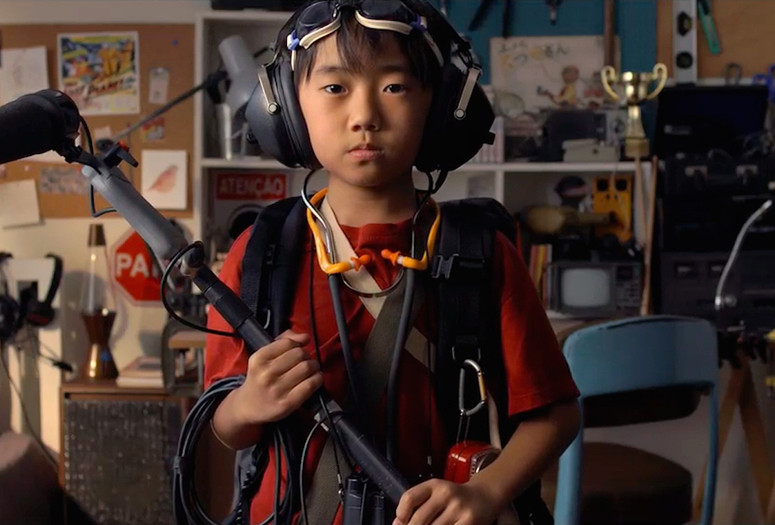
The Best Sound in the World. 2015. Brazil. Directed by Pedro Paulo De Andrade. While some people collect cars or stamps, Vinicius collects sounds. On a quest to find “the best sound in the world,” Vinicius seeks high and low with his tape recorder in tow. But how will he know the best sound when he finally finds it? In Portuguese with English subtitles.* 13 min.
*Subtitles will be read aloud
Online registration is required. The program is free for children and adults and includes free admission to the Museum.
Questions? Contact [email protected] or 212-708-9805.
Accessibility

The Cullman Education and Research Building entrance has a power-assist door.
Seating options include chairs with backs and armrests. Gallery stools, wheelchairs, and rollators are available by request at all Museum entrances, on a first-come, first-served basis.
Accessible family and all-gender restrooms are located in the mezzanine.

Guide dogs and other trained service animals are always welcome.


American Sign Language (ASL) interpretation and live captioning (CART) are available for public programs upon request with two weeks’ advance notice. MoMA will make every effort to provide accommodation for requests made with less than two weeks’ notice. Please contact [email protected] to make a request for these services.

In order to serve visitors with hearing loss, Bartos Theater has induction hearing loops for sound amplification. During scheduled programs, visitors can turn their hearing aid or cochlear implant to T-coil mode to hear enhanced sound effortlessly. The loop system does not work with hearing aids without telecoil technology.
For more information on accessibility at MoMA, please visit moma.org/visit/accessibility. For accessibility questions or accommodation requests, please email [email protected] or call 212-708-9805.
Enjoy live-action and animated short films, engage in discussions about what you saw, and try out follow-up activities in the Museum’s galleries.
Tickets for this program are included with Museum admission (free for ages 16 and under). MoMA members, SNAP/EBT, and Cool Culture pass holders receive free admission. For a full list of discounted admission, visit this page.
Reserving tickets in advance is recommended. Scroll down to the event listings for information about specific screenings.
For questions or accommodation requests, email [email protected] or call (212) 708-9805.
Accessibility
The Cullman Education and Research Building entrance has a power-assist door.
Seating options include chairs with backs and armrests. Gallery stools, wheelchairs, and rollators are available by request at all Museum entrances, on a first-come, first-served basis.
Accessible family and all-gender restrooms are located in the mezzanine.
American Sign Language (ASL) interpretation and live captioning (CART) are available for public programs upon request with two weeks’ advance notice. MoMA will make every effort to provide accommodation for requests made with less than two weeks’ notice. Please contact [email protected] to make a request for these services.
In order to serve visitors with hearing loss, Bartos Theater has induction hearing loops for sound amplification. During scheduled programs, visitors can turn their hearing aid or cochlear implant to T-coil mode to hear enhanced sound effortlessly. The loop system does not work with hearing aids without telecoil technology.
Learn more about accessibility at MoMA. For questions or accommodation requests, email [email protected] or call 212-708-9805.
The Adobe Foundation is proud to support equity, learning, and creativity at MoMA.
Family Programs are made possible by the Samuel and Ronnie Heyman Family Endowment Fund.
Major support is provided by the William Randolph Hearst Endowment Fund, the Emily Fisher Landau Educator Fund, the Charles A. Cuomo Education Endowment Fund, and by the Annual Education Fund.