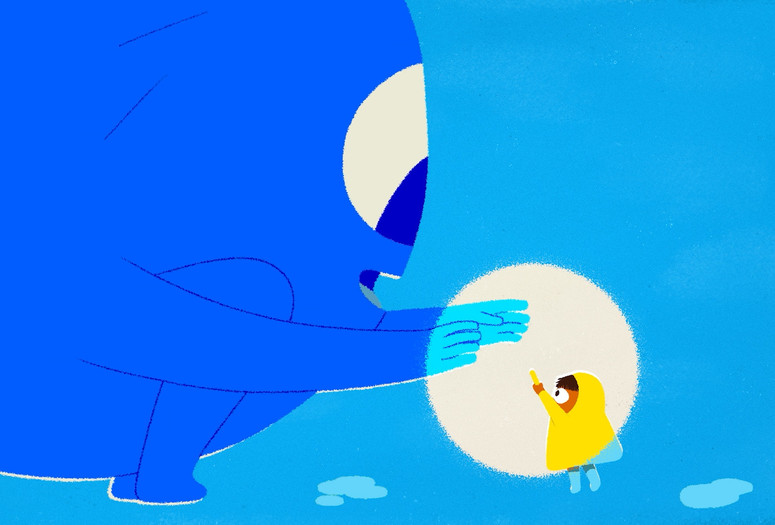
Join us for five short films that capture the magic of color, connection, creativity, and the transformative power of seeing the world differently. Engage in discussions about what you saw between the films, and try suggested follow-up activities in the Museum’s galleries
This program was developed in collaboration with Maria-Christina Villaseñor, guest curator and New York International Children’s Film Festival director of programming.
Pass the Ball. 2022. Canada/international collaboration. Nathan Boey and Int’l Artists’ Collaboration. For this short film, animators were given instructions to create a three-second animation of a ball. The ball was then “passed” to someone in another country, and the next animator picked up the ball where it was left off.
Luce and the Rock. 2022. Belgium/France/Netherlands. Directed by Britt Raes. One day, out of nowhere, a giant rock lies in the middle of the peaceful little village where Luce lives. The villagers can’t even open the door to their houses anymore! Luce is angry, but then gets curious about why the rock is there. 13 min.
Boogie Doodle. 1941. Canada. Directed by Norman McLaren. Made without the use of a camera, Boogie Doodle is a rhythmic, brightly colored film experiment in which the “boogie” music is played by Albert Ammons and the “doodle” is drawn by Norman McLaren. 3 min.
Being Ernest. 2017. UK. Directed by Victoria Fistes. In this short film, the filmmakers try to show life from the perspective of a nine-year-old child who is blind, illustrating how he experiences colors, dreams, and memories. 5 min.
Sky Color. 2012. USA. Directed by Gary Goldberger, John Lechner, Peter H. Reynolds. When Marisol sets out to create a sky for the class mural, she discovers the blue missing from her paints. This story celebrates the creative process and what it means to be an artist. Based on the book by Peter H. Reynolds. 7 min.
Online registration is required. The program is free for children and adults and includes free admission to the Museum.
Questions? Contact [email protected] or 212-708-9805.
Accessibility

The Cullman Education and Research Building entrance has a power-assist door.
Seating options include chairs with backs and armrests. Gallery stools, wheelchairs, and rollators are available by request at all Museum entrances, on a first-come, first-served basis.
Accessible family and all-gender restrooms are located in the mezzanine.

Guide dogs and other trained service animals are always welcome.


American Sign Language (ASL) interpretation and live captioning (CART) are available for public programs upon request with two weeks’ advance notice. MoMA will make every effort to provide accommodation for requests made with less than two weeks’ notice. Please contact [email protected] to make a request for these services.

In order to serve visitors with hearing loss, Bartos Theater has induction hearing loops for sound amplification. During scheduled programs, visitors can turn their hearing aid or cochlear implant to T-coil mode to hear enhanced sound effortlessly. The loop system does not work with hearing aids without telecoil technology.
For more information on accessibility at MoMA, please visit moma.org/visit/accessibility. For accessibility questions or accommodation requests, please email [email protected] or call 212-708-9805.
The Adobe Foundation is proud to support equity, learning, and creativity at MoMA.
Family Programs are made possible by the Samuel and Ronnie Heyman Family Endowment Fund.
Major support is provided by the William Randolph Hearst Endowment Fund, the Emily Fisher Landau Educator Fund, the Charles A. Cuomo Education Endowment Fund, and by the Annual Education Fund.