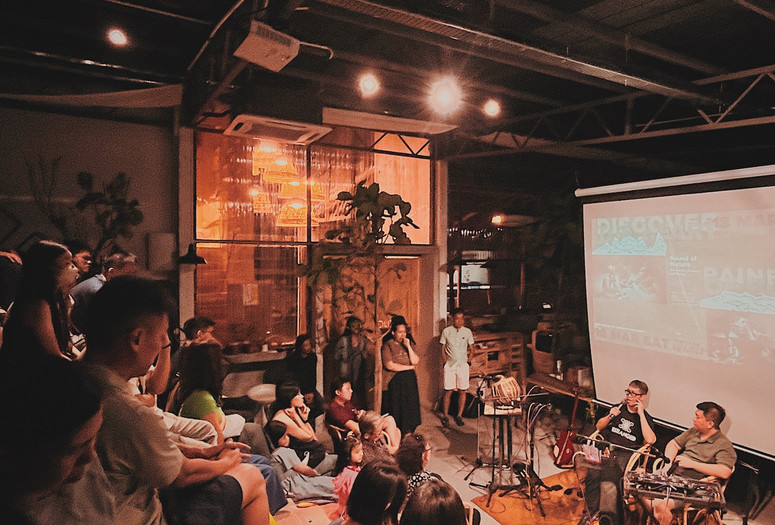
DocTalks is a series dedicated to ongoing investigations conducted by doctoral, postdoctoral, or early-career researchers about the expansive entanglement of architecture with the natural environment. These sessions are meant to create an intercollegiate cohort of scholars that workshop writing, share research findings, and experiment with methodological tools while engaging with the vision and investigations of the Ambasz Institute.
These Doc Talk sessions are intended for scholars or architecture history and theory, but scholars in related fields and the general public are welcome to attend.
Stage 1: The Search for Shared Materials Ecologies to Build Arts Collectives in Malaysia
Speaker
Clarissa Lim Kye Lee, The Chinese University of Hong Kong
Malaysian arts collectives sit in between a globalized call to enter the international art world and attending to the public on the ground (Becker, 2008). Often engaging in community arts practice, collectives tend to their neighbors by offering shared civic spaces, a limited resource in many urban contexts. Typically housed in underused, as-found spaces, a design process begins by looking for affordable materials, craftspeople, and collective building for their community arts practice.
This paper begins by interrogating how we build arts collectives with civic space function using shared material resources. By being generous with time and space, the arts collectives are a testament to exploring relational modes of shared materials and lands, also known as tanah. A theoretical framework developed by Jatiwangi Art Factory, tanah refers to the shared soil and lands around us, but also building with and in relationship social relations. Art collectives have been sharing whispers, gossip, and developing forms of tanah where there is a material lack. By developing a series of maps and interviews, this paper elucidates the first stage of any architectural project for an arts collective. To begin interrogating the sets of relationships between artisanal crafts people, material resources and a flexible time frame, a relational material practice is necessary (Latour and Yaneva, 2017).
Tracing the human and non-human actors, this paper presents how tanah is practiced. By identifying how materials like hard timber are salvaged, given time to be crafted and treated by local artisans, before landing on site to prepare for construction, tanah elucidates a material ecology. By supplementing typical material procurement practices with place-based networks of relations, arts collectives reinvigorate everyday commons of material cultures and develop a new stage one for many architectural projects.
Clarissa Kim Kye Lee is a cultural worker based in between Hong Kong and Kuala Lumpur via Penang. She is currently a PhD candidate at the School of Architecture and received the Hong Kong PhD Fellowship Scheme and the CUHK Vice-Chancellor’s PhD Scholarship. She has been selected as the 2022–23 Emerging Curator at the Canadian Centre for Architecture. Working in the interstices of visual culture, arts, and architecture, her research reveals the urban influence of arts collectives in Malaysia.
Respondent
Natalie Donat-Cattin, ETH Zurich
This series was made possible through a generous gift from Emilio Ambasz. The Emilio Ambasz Institute for the Joint Study of the Built and the Natural Environment is a platform for fostering dialogue, promoting conversation, and facilitating research about the relationship between the built and natural environment, with the aim of making the interaction between architecture and ecology visible and accessible to the wider public while highlighting the urgent need for an ecological recalibration.