Not on view
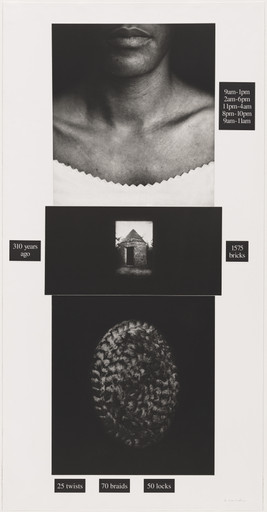
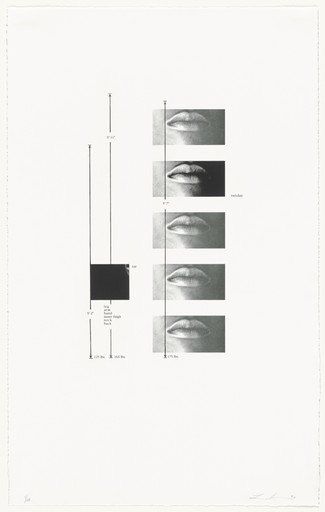
Among the subjects of Simpson's art is the experience of African American women in contemporary American society, a topic that encompasses issues of race and gender. Since 1990 African American hairstyles, which, over the centuries, have taken on social and political implications, have been some of her motifs. Depicted here is a diverse group of wigs in an orderly presentation that suggests a lineup of scientific specimens. Many types of styles are represented, from the short, fuzzy-textured Afro at the upper left to a wig of long, silky blond hair near the upper right. Text panels interspersed among the wigs record Simpson's wide-ranging commentary on their use by women, entertainers, and transvestites. The wig's potential as an instrument for conformity, metamorphosis, and concealment is thereby underscored.
Simpson has used the traditional format of the print portfolio in which a sequence of images produces a cumulative, narrative effect. The images have a tactile, suggestive quality as they isolate hair as an important aspect of self-image that affects a deeper sense of overall reality.
The Museum of Modern Art, MoMA Highlights, New York: The Museum of Modern Art, revised 2004, originally published 1999, p. 334.
Gallery label from 2022
To make this work, Simpson photographed a variety of wigs—from long braids to waves to moustaches—that she had purchased at Fulton Mall in Brooklyn. She then lithographed the images on felt and incorporated small text panels that relate historical accounts and anecdotes ranging in topic from slavery to drag. As the artist explained: “The wearer of the wigs can either become someone else or become closer to the person that one sees oneself to be . . . embracing or cutting across a particular stereotype, or, in terms of gender, blurring the lines between masculinity and femininity.”
2022
Explore more
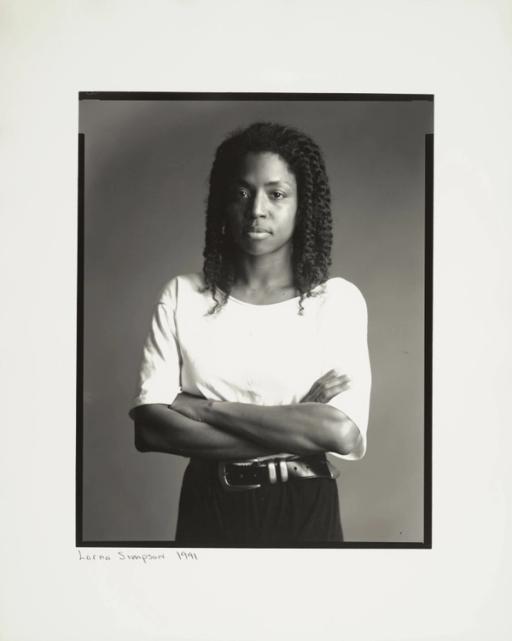
Lorna Simpson
American, born 1960 37 works onlineIn the late 1980s, Lorna Simpson burst onto the art scene with photographs of unidentified Black figures accompanied by text.
Learn more →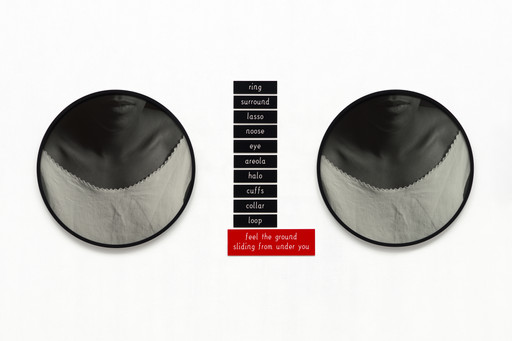


Audio
Audio from the playlist Kids
Audio from the playlist 1980–Today: Works from the Collection
From MoMA Design Store


Installation views
We have identified this work in the following photos from our exhibition history.
Licensing
Artwork or archival images
If you would like to reproduce an image of a work of art in MoMA's collection, or an image of a MoMA publication or archival material (including installation views, checklists, and press releases), please contact Art Resource (publication in North America) or Scala Archives (publication in all other geographic locations).
Audio and film clips
MoMA licenses archival audio and select out of copyright film clips from our film collection. At this time, MoMA produced video cannot be licensed by MoMA/Scala. All requests to license archival audio or out of copyright film clips should be addressed to Scala Archives at [email protected]. Motion picture film stills cannot be licensed by MoMA/Scala. For access to motion picture film stills for research purposes, please contact the Film Study Center at [email protected]. For more information about film loans and our Circulating Film and Video Library, please visit Circulating Film and Video Library.
Text from a publication or the archives
If you would like to reproduce text from a MoMA publication, please email [email protected]. If you would like to publish text from MoMA's archival materials, please fill out this permission form and send to [email protected].
Feedback
This record is a work in progress. If you have additional information or spotted an error, please fill out this feedback form.