To help promote MoMA’s Tim Burton retrospective, we asked Burton himself to animate the MoMA logo for a thirty-second video that would be used to promote the exhibition on television, at the Museum, and online. Tim quickly came up with a concept utilizing stop-motion animation, and he asked Allison Abbate, his producer on Corpse Bride (2005) and the upcoming full-length version of Frankenweenie, if she could help pull things together.


Posts tagged ‘film’

November 13, 2009
|
Behind the Scenes,
Collection & Exhibitions,
Design,
Film
The Making of Tim Burton’s MoMA Animation
November 10, 2009
|
An Auteurist History of Film
Giovanni Pastrone’s Cabiria
These notes accompany the screening of Giovanni Pastrone’s Cabiria on November 11, 12, and 13 in Theater 3.
H. G. Wells published The Time Machine in 1895, simultaneous with the birth of the movies. By sending out their cadre of globetrotting cameramen, the Lumière brothers quickly opened up the world of the present (replete with all its regional oddities and exoticism) to film audiences. Wells mastered the speculative future in the tradition of Jules Verne, but perhaps even more intriguing for filmgoers was the possibility film offered to travel back in time and retrieve the distant past.
D. W. Griffith had dabbled in this (with his In Prehistoric Days, 1913, for example), but the real heavy lifting was done by the Italians. This is appropriate, since the thousand-year history of the Roman Republic and Empire was unrivaled in its impact on the contemporary world; Italy practically owned history. This was accentuated for visual artists by the poignant beauty of surviving ruins and statuary, both in Rome and spread over three continents. Italy’s heritage contributed mightily to the seeming authenticity of its celluloid spectacles.
November 3, 2009
|
An Auteurist History of Film
D. W. Griffith Leaves Biograph
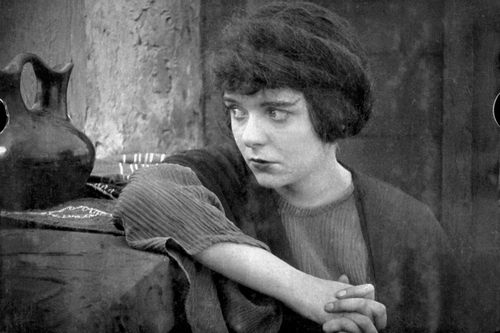
Blanche Sweet in Judith of Bethulia. 1914. USA. Directed by D. W. Griffith. Acquired from the artist
These notes accompany the D. W. Griffith Leaves Biograph program, which screens on November 4, 5, and 6 in Theater 3 as part of the two-year </em>An Auteurist History of Film</a> exhibition.</span></p>
1915 marked the publication of poet Vachel Lindsay’s The Art of the Moving Picture, the first serious attempt in English to come to grips with the medium that had outgrown penny arcades and nickelodeons and was now threatening to appear in venues that would rival cathedrals. In the preceding year, as extraordinary European films like Benjamin Christensen’s The Mysterious X (released as Sealed Orders in the U.S.) and Giovanni Pastrone’s Cabiria were arriving on American shores, D. W. Griffith had been tearing at the seams of his constraining Biograph contract. As with so many early commentaries on the movies, Lindsay struggled to find the language that would do justice to his thoughts. (One thinks of a young Eugene O’Neill groping for words, or of Griffith himself, trying to articulate something previously undefined and unrecognized.) In fact, in his enthusiasm for film, indicative of the heady atmosphere of the times, Lindsay waxed positively Biblical, informing filmmakers: “All of you who are taking the work as a sacred trust, I bid you God-speed…. You will be God’s thoroughbreds…. It has come then, this new weapon of men, and the face of the whole earth changes. In after centuries its beginning will be indeed remembered. It has come, this new weapon of men, and by faith and a study of the signs we proclaim that it will go on and on in immemorial wonder.”
October 28, 2009
|
An Auteurist History of Film
An Auteurist History of Film: "Two Danish Innovators"
Charles Silver, a curator in MoMA’s Department of Film, presents a series of writings to supplement the film exhibition An Auteurist History of Film. The following post accompanies the “Two Danish Innovators” program, which screens on October 28, 29, and 30 in Theater 3.
Der Student von Prag (The Student of Prague) has been called “the first real auteur film.” Actually, it appears now to have been a collaborative effort between director Stellan Rye (1880–1914), cameraman Guido Seeber (1879–1940), and star Paul Wegener (1874–1948), whom the same critic (Klaus Kreimeier) dubbed “the first modern German film actor.” Although the Danish Rye died fighting for Germany early in the First World War I, Seeber went on to photograph the 1914 version of The Golem and G. W. Pabst’s The Joyless Street and Secrets of a Soul. Wegener, a Max Reinhardt protégé, acted in or directed (or both) The Golem and its more famous 1920 remake, along with several Ernst Lubitsch films, Rex Ingram’s The Magician, and numerous films for the Nazis. In 1926, Henrik Galeen took Hanns Heinz Ewers’s story for The Student of Prague and remade it with the great Conrad Veidt as Der Student. Ewers was later the chronicler of Nazi icon Horst Wessel, who was made famous by Wegener’s 1933 film performance.
Rye’s film was a clear forerunner of the German Expressionist style and psyche, making it all the more a pity that he died so young, a tragedy that perhaps rivals Jean Vigo’s death at twenty-nine. Although shot in naturalistic locations in Prague, Rye’s imaginative facility with the camera evoked the Faust legend, E. T. A. Hoffman, and Edgar Allan Poe. If Rye had lived a normal lifespan, he might have been confronted with the choice between his native Denmark and his proto-Nazi compatriots and collaborators.
October 21, 2009
|
An Auteurist History of Film
An Auteurist History of Film: "The Scandinavian Connection"
Charles Silver, a curator in MoMA’s Department of Film, presents a series of writings to supplement the film exhibition An Auteurist History of Film. The following post accompanies the "The Scandinavian Connection" program, which screens on October 21, 22, and 23 in Theater 3.
Although Urban Gad (1879–1947) made a few films in Germany in the 1920s, during the golden age of Expressionism, his career had petered out by 1927. He clearly was not playing in the same league as Murnau, Lang, Pabst, Leni, Wiene, etc., and though an argument could be made that he anticipated some trends in Expressionism and that his use of eroticism was ahead of his time, his most significant contribution was the discovery of Asta Nielsen (1883–1972). Working in Germany, mostly with her then-husband Gad, Die Asta developed a restrained style of film acting, comparable to American counterparts like Lillian Gish and Mae Marsh. (To fully appreciate the achievement of these women, one should check out the staginess of Sarah Bernhardt’s film appearances from this period, although an elderly Eleanora Duse in Cenere managed quite well.) The actress performed Strindberg, Ibsen, Wedekind, and a cross-dressing Hamlet, but her most familiar role to Museum audiences would be in G. W. Pabst’s The Joyless Street (1925), the film that precipitated Greta Garbo’s coming to America. After appearing in just one talkie, she began a forty-year retirement (later to be topped by Garbo’s half-century “reclusion”), but it should be noted that at the age of seventy she undertook a second career, becoming a gifted collagist.
October 14, 2009
|
An Auteurist History of Film
An Auteurist History of Film: “D. W. Griffith at Biograph”
Charles Silver, a curator in MoMA’s Department of Film, presents a series of writings to supplement the film exhibition An Auteurist History of Film. The following post accompanies the "D. W. Griffith at Biograph" program, which screens on October 15 in Theater 3 and on October 16 and 17 in Theater 2.
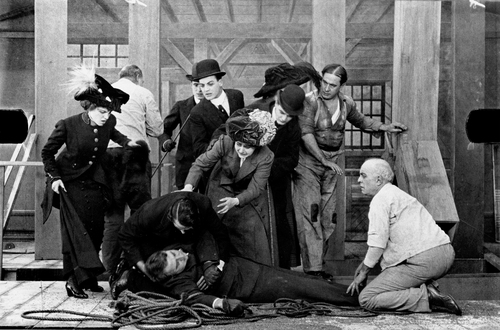
A Corner in Wheat. 1909. USA. Directed by D. W. Griffith. 35mm print, black and white, silent, approx. 15 min. Gift of Actinograph Corp. Preserved with funding from The Lillian Gish Trust for Film Preservation
Henri Matisse said, “My purpose is to render my emotion… I think only of rendering my emotion.”
Film history textbooks dutifully catalog the elements of cinematic grammar and expressiveness that D. W. Griffith invented or refined in his five years at Biograph (in collaboration with his cinematographer G. W. “Billy” Bitzer [1872–1944], who worked at the Museum Film Library late in his life, providing invaluable information on the Biograph films and preparing a posthumous autobiography)—a virtually endless list that includes close-ups, fades, masking, parallel editing, the moving camera or dolly shot, backlighting, changing camera angles, restrained histrionics through the cultivation of a stock company of professional film actors, “spectacle,” etc. Yet the salient point is that all of these essentially manipulative techniques served a larger purpose. Griffith’s great genius was his intuitive understanding of the inherent power of the movies to render emotion, to evoke feeling. No medium, before or since, has so thoroughly facilitated art’s capacity to touch that raw nerve, the primal and authentic human essence, and Griffith was the first filmmaker to fully grasp and exploit this fact. Fashions and conventions come and go, but at their best Griffith’s films—like all great art—are deeply felt expressions of what we are, of what it is like to be human.
October 6, 2009
|
An Auteurist History of Film
An Auteurist History of Film: “Georges Méliès and His Rivals”
Charles Silver, a curator in MoMA’s Department of Film, presents a series of writings to supplement the film exhibition An Auteurist History of Film. The following post accompanies the "Georges Méliès and His Rivals", which screens on October 7, 8, and 9 in Theater 3.
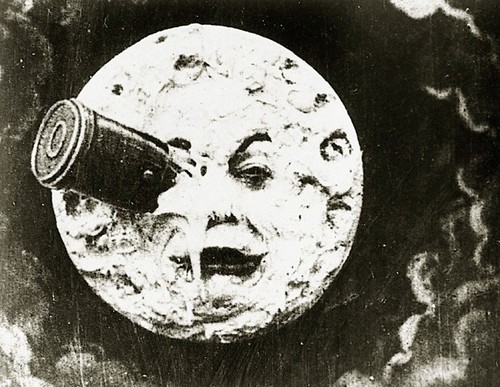
Le Voyage dans la lune (A Trip to the Moon). 1902. France. Directed by George Méliès
I see Georges Méliès as a link in a continuum that runs from Jules Verne through film artists like Walt Disney and Tim Burton. Verne actually survived until 1905, enabling him to be well aware of Méliès in his heyday, and it can be hoped that the younger filmmaker found a way of expressing his gratitude to the older novelist for inspiring some of his best work. Méliès (1861–1938) died just a few weeks after Disney released the first of his epic fairy tales, Snow White and the Seven Dwarfs. (For the record, Uncle Walt was around for the first eight years of Tim Burton’s life. We are, of course, highlighting Burton’s career in a major exhibition beginning next month, and my colleague Jenny He’s description, “a director of fables, fairy tales, and fantasies,” could as easily be applied to Méliès as to Burton.) One should also take note of Karel Zeman (1910–1989), the Czech animator/director whose feature films like The Fabulous World of Jules Verne (1957) and Baron Munchhausen (1962) explicitly evoke Méliès’s style and subject matter.
September 30, 2009
|
An Auteurist History of Film
An Auteurist History of Film: “Lesser-Known Pioneers of Cinema”
Charles Silver, a curator in MoMA’s Department of Film, presents a series of writings to supplement the film exhibition An Auteurist History of Film. The following post accompanies the "Lesser-Known Pioneers of Cinema" program, which screens on September 30 and October 1 in Theater 3 and October 2 in Theater 2.
A great number of films were made before D. W. Griffith came along in 1908, and a great number of these have been lost. So piecing together the puzzle of this early period is always going to be unsatisfactory. Still, enough survives to try to give some credit to at least a few of the worthy pioneers.
Ferdinand Zecca (1864–1947) would turn out to be a rival of Georges Méliès (whose work will be screened next week). Much of his work was “derivative” (stolen), and he finally found his true calling as head of Pathé, a career path that included a distribution stint in New Jersey. In a matter of months, Alice Guy (after 1907, Alice Guy-Blaché) (1873–1968) went from being a secretary at Gaumont to becoming the world’s first female director. At one point she was, in effect, the production head of that venerable studio—the only studio from the period that’s still in existence today. Coming to America, Alice and her husband Herbert Blaché established their own studio, Solax, in Flushing, Queens. She continued to make films for various studios after Solax (like Edison, Biograph, Thanhouser, and others before it) failed. Following her divorce in 1922 she returned to France where she had been all but forgotten. After failing to get work, she lived out her long life mostly unknown, although she did receive the Legion of Honor in 1953. She finally died in Mahwah, New Jersey, at age ninety-five. Frankly, little is known of her films (MoMA has hardly any in its collection), but this will soon be remedied by an exhibition of restored films to be exhibited at the Whitney Museum beginning on November 6.
September 22, 2009
|
An Auteurist History of Film
An Auteurist History of Film: “A Portrait of Edwin S. Porter”
Charles Silver, a curator in MoMA’s Department of Film, presents a series of writings to supplement the film exhibition An Auteurist History of Film. The following post accompanies the "A Portrait of Edwin S. Porter" program, which screens September 23, 24, and 25 in MoMA’s Celeste Bartos Theater (Theater 3).
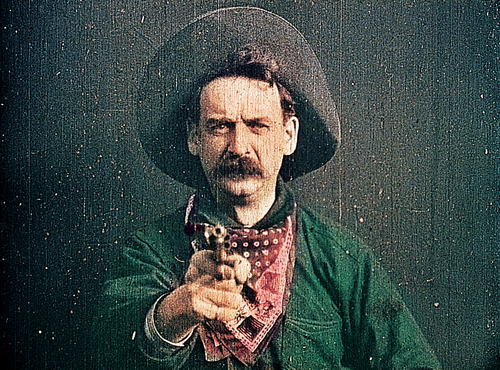
The Great Train Robbery. 1903. USA. 35mm print, black-and-white with color tinting, silent, approx. 11 min. Acquired from Don Malkames. Preserved with funding from the National Endowment for the Arts
Charles Musser, director of Before the Nickelodeon and now a distinguished professor of film, has ties with The Museum of Modern Art going back to his undergraduate days. His The Emergence of Cinema and Eileen Bowser’s The Transformation of Cinema (both in the Scribner series A History of the American Cinema) have become standard works on this period. Eileen, for many years a curator in MoMA’s Department of Film, is now retired. Blanche Sweet, a good personal and professional friend who died in 1986, stars in several of the D. W. Griffith films coming up in succeeding weeks.
As Musser’s film explains, Edwin S. Porter was a kind of jack-of-all-trades who accidentally stumbled into being the first director of note in American film. Although it is questionable that he ever saw himself as an artist, his presence in the early days of the medium, when truly interesting things were happening, makes it unfair to totally dismiss him. His later career lasted until 1916 and included some twenty features, mostly codirected with others (further diluting any possible auteurist claims). Among these were the now infamous The Count of Monte Cristo, starring James O’Neill (the film version of the stage role that figures so prominently in his son Eugene’s great Long Day’s Journey into Night), and the Mary Pickford vehicle Tess of the Storm Country.
September 14, 2009
|
An Auteurist History of Film
An Auteurist History of Film: “Actualities and Glimmerings of More”
Charles Silver, a curator in MoMA’s Department of Film, presents a series of writings to supplement the film exhibition An Auteurist History of Film. The following post accompanies the “Actualities and Glimmerings of More”, which screens September 16, 17, and 18 in MoMA’s Celeste Bartos Theater (Theater 3).
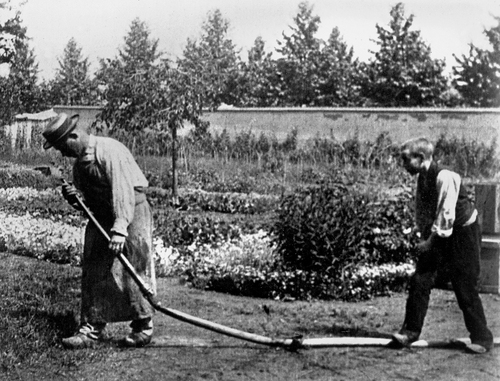
The Waterer Watered (aka The Sprinkler Sprinkled, or Watering the Flowers). 1895. France. Directed by Louis Lumière. 35mm print, black-and-white, silent, approx. 45 sec. Acquired from the artist
The Lumière brothers, Louis (1864–1948) and Auguste (1862–1954), are probably the closest we will ever come to identifying the first auteurs. Their role as “directors” largely consisted of finding a subject that interested them, plunking their camera (Cinematographe) down, and turning it on. This ultra-simple method was soon discarded by others as antiquated, although Andy Warhol brought it back (to considerable acclaim in some circles) some seventy years later. By sending film crews around the world to photograph the commonplace and the exotic, the Lumières effectively shrank the globe in ways never before deemed possible.
One of the things that intrigues me in seeing the people in these films—now 115 years removed from us—is that some of them, the middle-aged ones at least, may have shaken Abraham Lincoln’s hand; some of the elderly may have seen Napoleon marching through Paris. And yet, here they are, looking and moving much as we do, denizens of a world almost as strange to us as ours would be to them. They have achieved some level of immortality, and they embody one of the best arguments for film preservation: keeping our past alive.
If you are interested in reproducing images from The Museum of Modern Art web site, please visit the Image Permissions page (www.moma.org/permissions). For additional information about using content from MoMA.org, please visit About this Site (www.moma.org/site).
© Copyright 2016 The Museum of Modern Art
Welcome to MoMA.org. To take full advantage of all the site’s features, including the option to save works in the collection, please upgrade your browser to Firefox,
Google Chrome, Safari, or Internet Explorer 9.
See our help page for more information.
To take full advantage of all of the features on MoMA.org, please upgrade your browser to Firefox, Google Chrome,
Safari, or Internet Explorer 9.