
MoMA
Posts tagged ‘film’
April 20, 2010  |  An Auteurist History of Film
Dziga Vertov
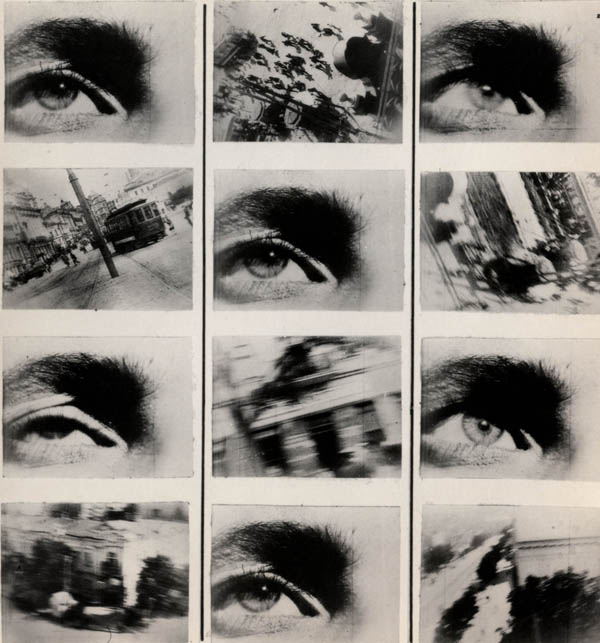
The Man with the Movie Camera. 1929. USSR. Directed by Dziga Vertov

The Man with the Movie Camera. 1929. USSR. Directed by Dziga Vertov

These notes accompany the Dziga Vertov program, screening April 21, 22, and 23 in Theater 3.

Dziga Vertov (1896–1954) presents some unusual problems with regard to his inclusion in this series. If we define an “auteur” as a filmmaker with a vision who places the stamp of his personality on his work, that presumes that there is a discernible personality or way of looking at the world. While no one could possibly miss the fact that from a technical standpoint, Vertov was a great innovator and expander of the medium (a rival to D. W. Griffith, F. W. Murnau, Sergei Eisenstein, or Alfred Hitchcock), there is reason to question who this guy really was. We do know he was born Denis Arkadievitch Kaufman in what is now Poland (then part of the Czarist empire) and was the elder brother to two other distinguished filmmakers, Mikhail (cameraman on several Vertov films and later a director) and Boris Kaufman (cinematographer for Jean Vigo, Abel Gance, Elia Kazan, and Sidney Lumet).
April 19, 2010  |  Collection & Exhibitions, Design, Film
3D Burton: Shadows and Reflections

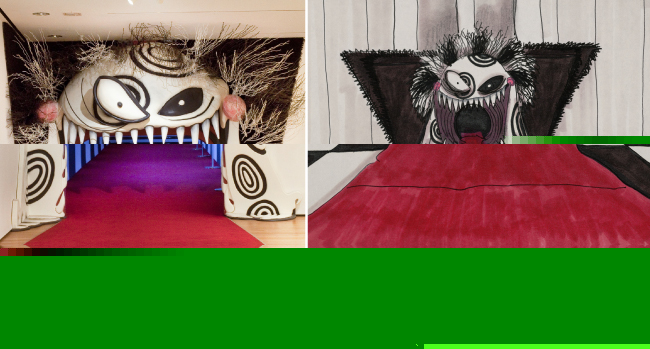
Three-dimensional rendering of the entrance to Tim Burton (left) by TwoSeven, Inc., based on an untitled drawing (right) by Tim Burton for the unrealized project Trick or Treat (1980)

Tim Burton was one of the most challenging exhibitions our graphic design department has had the pleasure of fully developing. It explores a wide spectrum of Tim Burton’s creative work, including drawings, paintings, photographs, moving images, concept art, storyboards, puppets, maquettes, costumes, and cinematic ephemera. For the exhibition graphic design, our goal was to take all these diverse visual references and distill them into a simple graphic treatment that celebrated Burton’s work.

April 13, 2010  |  An Auteurist History of Film
The French Avant-Garde of the 1920s

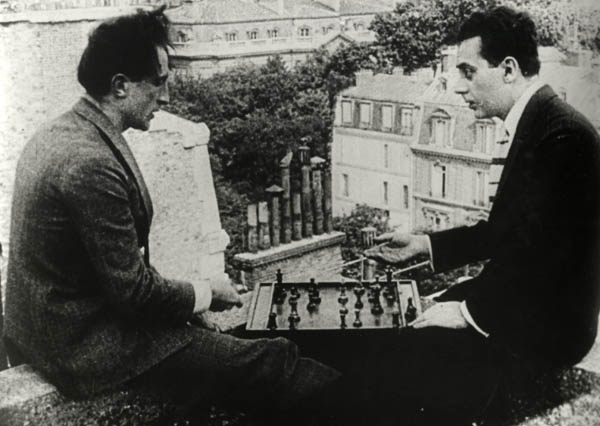
Entr’acte. 1924. France. Directed by René Clair

Entr’acte. 1924. France. Directed by René Clair

These notes accompany the French Avant-Garde of the 1920s program, screening April 14, 15, and 16 in Theater 3.

Charles Sheeler comes to mind as one of the few American artists who dabbled in film in the 1920s. Whereas in Germany the mainstream Expressionist cinema was itself avant-garde, and in Italy the society became surreal following Mussolini’s rise to power in 1922, France presented a unique instance of a free interplay of filmmakers with other visual artists. This program is an attempt to capture some of this interaction and to suggest how it might have benefited French culture. It also suggests that a society where the movies were totally dominated neither by commerce nor by the state provided an appealing model. It was certainly beneficial to Iris Barry, the founder of The Museum of Modern Art Film Library, to be able to cite names like Man Ray, Duchamp, Léger, and Dalí in establishing the high aspirations and legitimacy of film when appealing for funds from patrons who might look askance at Douglas Fairbanks, Charles Chaplin, or Walt Disney. (It was left for us future generations to make cogent arguments for Otto Preminger, Clint Eastwood, and John Waters.)

April 7, 2010  |  Collection & Exhibitions, Film
Crude Elegance: Stop-motion Animation and Tim Burton

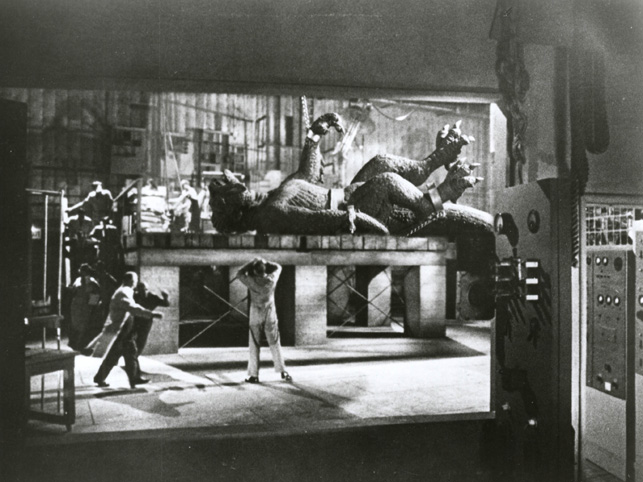
20 Million Miles to Earth. 1957. USA. Directed by Nathan Juran. Film Stills Archive, The Museum of Modern Art, New York

It was love at first sight for Tim Burton and stop-motion animation. At an early age, Burton was drawn to films such as Nathan Juran’s 20 Million Miles to Earth (1957) and Don Chaffey’s Jason and the Argonauts (1963), which featured innovative animation by special effects master Ray Harryhausen. Burton responded to the sense of wonder the technique conjured in its audiences and was inspired to create his own stop-motion animated films, such as a 1971 super-8mm short featuring cavemen and dinosaur figures (on view in the MoMA gallery exhibition) that invokes When Dinosaurs Ruled the Earth (1970, directed by Val Guest, and animated by Jim Danforth).

April 6, 2010  |  An Auteurist History of Film
Carl Theodor Dreyer’s The Passion of Joan of Arc
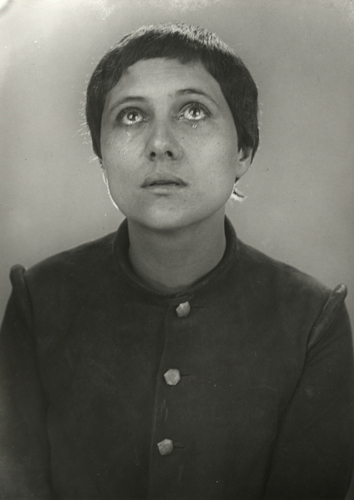
The Passion of Joan of Arc. 1928. France. Directed by Carl Theodor Dreyer

The Passion of Joan of Arc. 1928. France. Directed by Carl Theodor Dreyer

These notes accompany the screening of </i>The Passion of Joan of Arc, April 8, 9, and 10 in Theater 3.</p>

Carl Theodor Dreyer (1889–1968) made eight quality but unspectacular features between 1919 and 1926. In the ensuing four decades, he made only six more films—one of which he disowned. Yet he is always near the top of any informed list of the greatest film artists.

Dreyer spent much of his life as a journalist, film critic, and manager of a cinema in Denmark. He was not psychologically adept at raising funds for his projects or lending them a commercial appeal; he appears to have been as somber and uncompromising as his characters. (I once upset one of my curatorial colleagues by even suggesting that there might be a tiny bit of tongue-in-cheek humor in his 1932 horror film, Vampyr.) La Passion de Jeanne d’Arc (The Passion of Joan of Arc) (1928) has been acclaimed for over eighty years, but it was a financial flop, and even I recognize that it is entirely humorless.

March 30, 2010  |  An Auteurist History of Film
Frank Borzage’s Street Angel

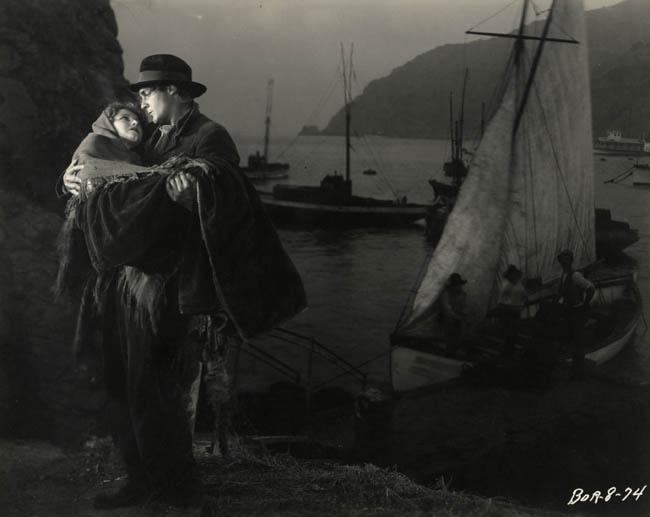
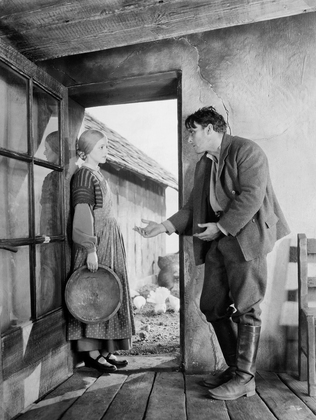
Street Angel. 1928. USA. Directed by Frank Borzage

Street Angel. 1928. USA. Directed by Frank Borzage. Gift of Twentieth Century-Fox. Preserved with funding from the Louis B. Mayer Foundation

These notes accompany the screening of </i>Street Angel, March 31 and April 1 and 2 in Theater 3.</p>

From the opening shot of Street Angel (1928), it is evident that Frank Borzage (1893–1962) had been enraptured by watching F. W. Murnau shoot Sunrise the preceding year at the Fox studio. Through atmospheric light and shadow, the camera prowls around elaborate Neapolitan sets in long, complicated takes. Borzage had won the first Oscar for best director for Seventh Heaven in 1927, but he evidently realized that Murnau and his team had brought something new to Hollywood, and his career over the next thirty years never cast off Murnau’s spell.

March 23, 2010  |  An Auteurist History of Film
F. W. Murnau’s Sunrise: A Song of Two Humans
Sunrise: A Song of Two Humans. 1927. USA. Directed by F. W. Murnau. Acquired from Twentieth Century-Fox. Preserved with funding from Celeste Bartos

Sunrise: A Song of Two Humans. 1927. USA. Directed by F. W. Murnau. Acquired from Twentieth Century-Fox. Preserved with funding from Celeste Bartos

These notes accompany the screening of Sunrise: A Song of Two Humans, which screens on March 24, 25, and 26 in Theater 3.

After the international success of Der Letzte Mann (The Last Laugh), the film cognoscenti could legitimately argue that F. W. Murnau (1888–1931) deserved to be recognized as the most important filmmaker in the world; D. W. Griffith was coming off several interesting but unprofitable films and was about to lose his independence, Erich von Stroheim was fighting to salvage Greed, and Charles Chaplin had yet to make The Gold Rush. Sergei Eisenstein and Josef von Sternberg were still on the horizon. Murnau followed up with two additional Emil Jannings vehicles, adapted from Molière (Tartüff) and Goethe (Faust). Both films continued to utilize the vast resources of the Ufa studio, and the latter film was especially spectacular. The eminent film historian, Lotte Eisner, wrote “No other director…ever succeeded in conjuring up the supernatural as masterfully as this.” Hollywood took note.

March 16, 2010  |  An Auteurist History of Film
Buster’s Best
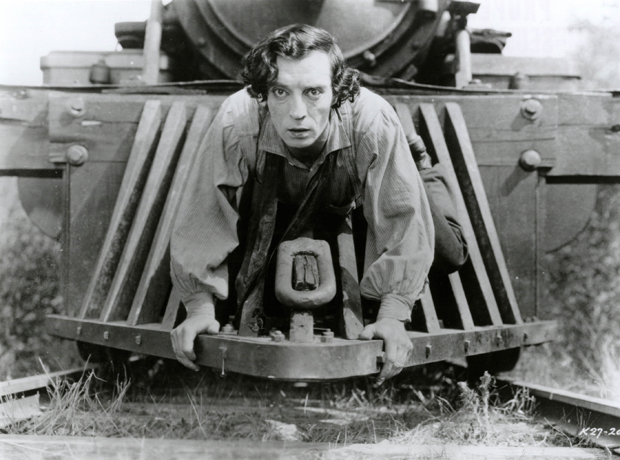
The General. 1926. USA. Directed by Buster Keaton, Clyde Bruckman

The General. 1926. USA. Directed by Buster Keaton, Clyde Bruckman

These notes accompany the Buster’s Best program, which screens on March 17, 18, and 19 in Theater 3.

The career of Buster Keaton (1895–1966) is both one of the cinema’s glories and one of its greatest tragedies. If one measures auteurism by a director’s ability to visualize an alternative personal universe on film, then Keaton ranks near the top. Buster’s vision of a world where machinery and Nature perpetually challenge human ingenuity and survival is made credible by his uniquely precise mastery of both the mechanics of his art form and the musculature of his own body—and his establishment of a link between the two. In a sense, he was a bionic man a half-century before Lee Majors.

March 10, 2010  |  Collection & Exhibitions, Film
Arthur Freed, Vincente Minnelli…Tim Burton?

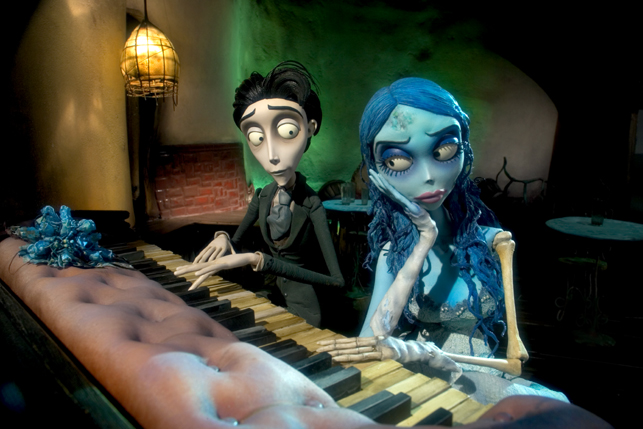
Corpse Bride. 2005. USA/Great Britain. Directed by Tim Burton and Mike Johnson. Photo courtesy of Warner Bros. Pictures

This year’s Academy Awards telecast paid tribute to horror films—a genre cited by the presenters as often neglected by the Academy—with a clip reel that featured select masterworks of cinema by directors such as Alfred Hitchcock, Stanley Kubrick, and Roman Polanski. As I watched the montage, I caught glimpses from Beetlejuice (1988), Edward Scissorhands (1990), and Sleepy Hollow (1999). Although I found their inclusion to be a bit incongruous among films like The Exorcist, Carrie, Friday the 13th, Nightmare on Elm Street, Scream, The Ring, and The Blair Witch Project, it nevertheless reaffirmed the popular perception of Tim Burton as a dark, gothic, and macabre filmmaker. Certainly, with Tim’s affinity for skeletons, graveyards, severed heads, and iron maidens—some of the recurrent motifs in his work—the classification of his films into the horror genre would surprise few. However, I propose another genre to be considered when examining Tim’s oeuvre: the musical film.

March 9, 2010  |  An Auteurist History of Film
The Documentary Expands
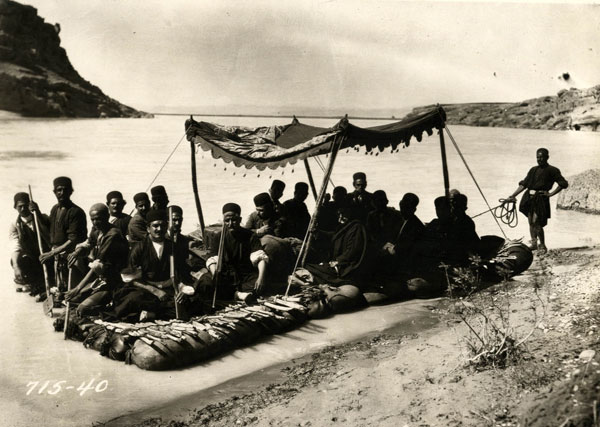
Grass: A Nation’s Battle for Life. 1925. USA. Directed by Merian C. Cooper, Ernest B. Schoedsack

Grass: A Nation’s Battle for Life. 1925. USA. Directed by Merian C. Cooper, Ernest B. Schoedsack

These notes accompany The Documentary Expands, which screens on March 10, 11, and 12 in Theater 3.

Calling Merian C. Cooper (1893–1973) and Ernest B. Schoedsack (1893–1979) auteurs may seem like fudging a little bit, but I don’t think it is. Yet the doubt creeps in on two levels. First, while film is undeniably a collaborative medium, the auteur theory argues that there is a singular dominant creator. The bond between these guys, however, seems so seamless in their films as to be almost unique. The other reason for hedging is that they first made their collaborative mark in documentary film, a form that presupposes that the director cannot mold his material as freely as can the maker of narrative films. (It has become obvious in subsequent decades that even the most “pure” cinéma vérité is subject to manipulation at the hands of masters like Jean Rouch or Fred Wiseman.) And it is, of course, true that immediately after Grass, Cooper and Schoedsack began to move away from authentic actuality.