

MoMA
Posts tagged ‘auteurist’
September 22, 2009  |  An Auteurist History of Film
An Auteurist History of Film: “A Portrait of Edwin S. Porter”

Charles Silver, a curator in MoMA’s Department of Film, presents a series of writings to supplement the film exhibition An Auteurist History of Film. The following post accompanies the "A Portrait of Edwin S. Porter" program, which screens September 23, 24, and 25 in MoMA’s Celeste Bartos Theater (Theater 3).
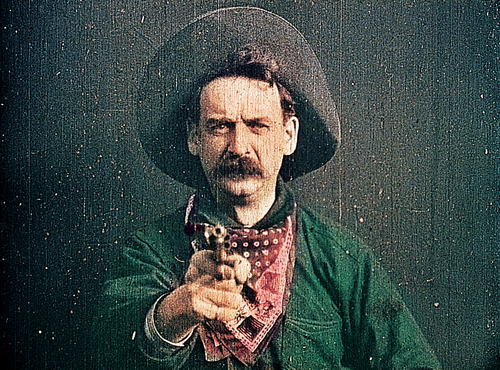
<i>The Great Train Robbery</i>. 1903. USA. 35mm print, black-and-white with color tinting, silent, approx. 11 min. Acquired from Don Malkames. Preserved with funding from the National Endowment for the Arts

The Great Train Robbery. 1903. USA. 35mm print, black-and-white with color tinting, silent, approx. 11 min. Acquired from Don Malkames. Preserved with funding from the National Endowment for the Arts

Charles Musser, director of Before the Nickelodeon and now a distinguished professor of film, has ties with The Museum of Modern Art going back to his undergraduate days. His The Emergence of Cinema and Eileen Bowser’s The Transformation of Cinema (both in the Scribner series A History of the American Cinema) have become standard works on this period. Eileen, for many years a curator in MoMA’s Department of Film, is now retired. Blanche Sweet, a good personal and professional friend who died in 1986, stars in several of the D. W. Griffith films coming up in succeeding weeks.

As Musser’s film explains, Edwin S. Porter was a kind of jack-of-all-trades who accidentally stumbled into being the first director of note in American film. Although it is questionable that he ever saw himself as an artist, his presence in the early days of the medium, when truly interesting things were happening, makes it unfair to totally dismiss him. His later career lasted until 1916 and included some twenty features, mostly codirected with others (further diluting any possible auteurist claims). Among these were the now infamous The Count of Monte Cristo, starring James O’Neill (the film version of the stage role that figures so prominently in his son Eugene’s great Long Day’s Journey into Night), and the Mary Pickford vehicle Tess of the Storm Country.
September 14, 2009  |  An Auteurist History of Film
An Auteurist History of Film: “Actualities and Glimmerings of More”

Charles Silver, a curator in MoMA’s Department of Film, presents a series of writings to supplement the film exhibition An Auteurist History of Film. The following post accompanies the “Actualities and Glimmerings of More”, which screens September 16, 17, and 18 in MoMA’s Celeste Bartos Theater (Theater 3).

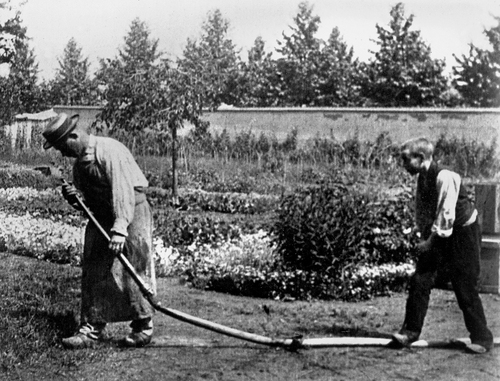
<i>The Waterer Watered</i> (aka <i>The Sprinkler Sprinkled,</i> or <i>Watering the Flowers</i>). 1895. France. Directed by Louis Lumière. 35mm print, black-and-white, silent, approx. 45 sec. Acquired from the artist

The Waterer Watered (aka The Sprinkler Sprinkled, or Watering the Flowers). 1895. France. Directed by Louis Lumière. 35mm print, black-and-white, silent, approx. 45 sec. Acquired from the artist

The Lumière brothers, Louis (1864–1948) and Auguste (1862–1954), are probably the closest we will ever come to identifying the first auteurs. Their role as “directors” largely consisted of finding a subject that interested them, plunking their camera (Cinematographe) down, and turning it on. This ultra-simple method was soon discarded by others as antiquated, although Andy Warhol brought it back (to considerable acclaim in some circles) some seventy years later. By sending film crews around the world to photograph the commonplace and the exotic, the Lumières effectively shrank the globe in ways never before deemed possible.

One of the things that intrigues me in seeing the people in these films—now 115 years removed from us—is that some of them, the middle-aged ones at least, may have shaken Abraham Lincoln’s hand; some of the elderly may have seen Napoleon marching through Paris. And yet, here they are, looking and moving much as we do, denizens of a world almost as strange to us as ours would be to them. They have achieved some level of immortality, and they embody one of the best arguments for film preservation: keeping our past alive.

September 7, 2009  |  An Auteurist History of Film
An Auteurist History of Film: “Pre-Cinema”

Charles Silver, a curator in MoMA’s Department of Film, presents a series of writings to supplement the film exhibition An Auteurist History of Film. The following post accompanies the "Pre-Cinema" program, which screens September 9, 10, and 11 in MoMA’s Celeste Bartos Theater (Theater 3).

The intricacies of the auteur theory can be pretty convoluted and burdensome to anyone who just wants to see a good movie, but permit me to elucidate just a little. The Cahiers du cinema folks (André Bazin, François Truffaut, Jean-Luc Godard, and others) were ostensibly reacting to the French cinema’s “tradition of quality,” which since World War II and even before had been churning out craftsmanlike but impersonal films. In the service of these attacks, Hollywood was invoked as a model system in which “auteurs” like John Ford, Howard Hawks, and Raoul Walsh could produce films that were not only commercially viable but also expressed the distinctive personality of the director. Little attention was paid to the impersonal craftsman responsible for most Hollywood films, but the theory attained legitimacy by focusing on a broad view of certain directors’ careers where discernible patterns, themes, and visual style could be cited, much as one would with a writer or painter. Andrew Sarris (to whom this series is dedicated) Anglicized and popularized the theory in the pages of The Village Voice. Despite fierce opposition that survives in some circles to this day, the auteur theory has become the prevailing approach to film criticism.

I am not sure what prompted the Naval Photographic Center to undertake Origins of the Motion Picture in the lull between Korea and Vietnam. This little film (based on Martin Quigley Jr.’s book Magic Shadows), however, is surprisingly informative in sketching eight centuries of invention into a mere twenty-one minutes. Museum regulars will recall several illustrated lectures in recent years by David Francis of the Magic Lantern Society. For serious scholars, the MoMA Library holds the Merritt Crawford papers on microfilm. Merritt Crawford was an early twentieth-century scholar who corresponded with many of the key nineteenth-century innovators.