
In this video interview, Franklin Evans discusses his installation timecompressionmachine (2010), in which he covered the floor and walls of the gallery with unstretched canvas, screens made of painted strips of tape, and old newsprint and press releases from gallery exhibitions. Composed of numerous overlapping parts, the installation gives the sense of a work in progress. Additionally, the ephemeral nature of the installation, which exists solely for the duration of Greater New York 2010, is highlighted by Evans’s use of materials that are typically considered disposable. As the artist puts it, his environments suggest “the not-quite-finished, the in-transition, the nearly-emerging, the slowly-evolving, the near-end, and the move-towards-erasure.”


Posts in ‘MoMA PS1’
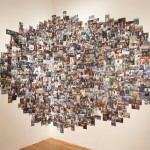
Deana Lawson: Assembled Histories
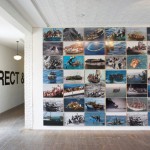
In this video interview, artist Deana Lawson talks about her photography-based work, including her thought-provoking piece in the Greater New York 2010 exhibition—Assemblage (2010), an installation consisting of hundreds of four-by-six-inch glossy photographs T-pinned to the walls of one of MoMA PS1’s third-floor galleries.
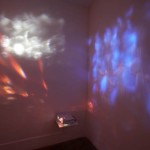
Conrad Ventur: This Is My Life
In this video interview, Brooklyn-based artist Conrad Ventur talks about his work, in particular his installation for the Greater New York exhibition at MoMA PS1, This Is My Life (Shirley Bassey) (2009). In this work, Ventur uses footage of Welsh singer Dame Shirley Bassey singing her 1968 hit song “This Is My Life” at various points during her decades-long career.
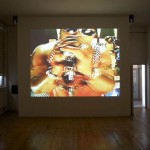
Rashaad Newsome: The Conductor
In the video above, Rashaad Newsome talks about his captivating video installation The Conductor (Fortuna Imperatrix Mundi) (2008), currently on view at MoMA PS1 as part of the the Greater New York 2010 exhibition.
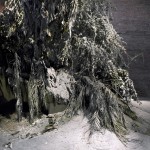
Preserving a Forest at MoMA PS1
David Brooks’s work takes the fragile dynamics of ecosystems as its subject, creating sculptures and installations that consider the relationship between built and natural environments. One powerful example—his massive site-specific installation Preserved Forest—is currently on view as part of the Greater New York 2010 exhibition at MoMA PS1.
Greater New York 2010: Artists Present
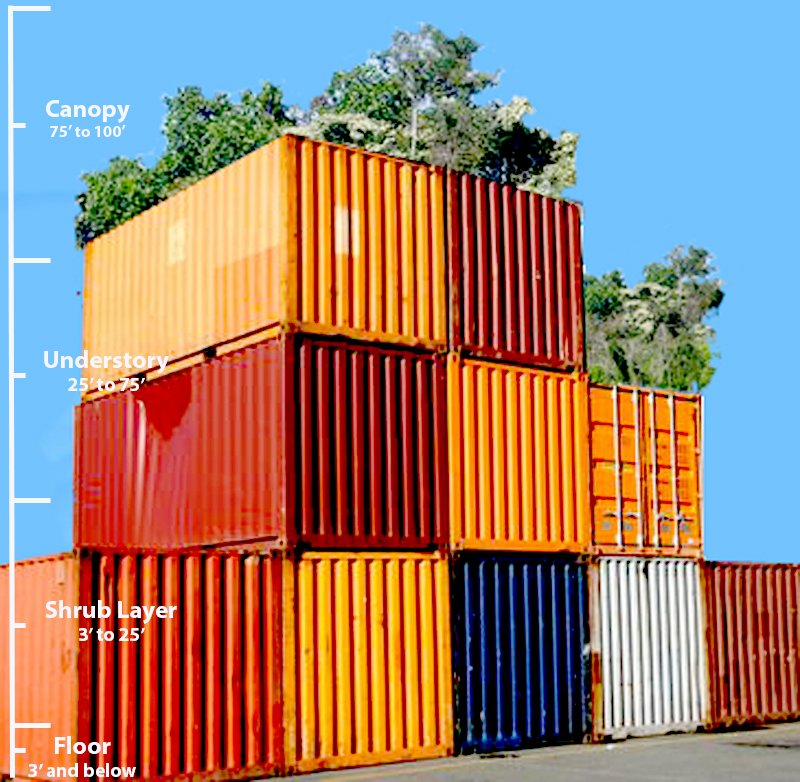
David Brooks. Terra Incognitae—Rainforest Canopy (Cronos version) (installation at the Sculpture Center through July 27, 2010). 2010. Photo courtesy of the artist
How much can you say about a work of art in twenty-five seconds? That’s the challenge we posed to ten artists whose work is featured in Greater New York 2010, on view through October 18, 2010, at MoMA PS1. Last Wednesday, we invited five of these artists to join us at MoMA for the first session of Greater New York 2010: Artists Present, a two-part public program wherein artists in the show are invited to give the public a behind-the-scenes look at their work and their creative processes using a twenty-image PowerPoint presentation. The catch? Each image is only onscreen for twenty-five seconds, and the artists don’t have control of the slideshow! It’s almost like art speed-dating!
Xaviera Simmons: Image Builder
In this video, mixed-media artist Xaviera Simmons talks about her work and her striking new photo installation, Superunknown (Alive In The), currently on view in Greater New York, MoMA PS1‘s quinquennial showcase of works made in the past five years by artists and collectives living and working in the metropolitan New York area.

100 Years: A History of Performance Art
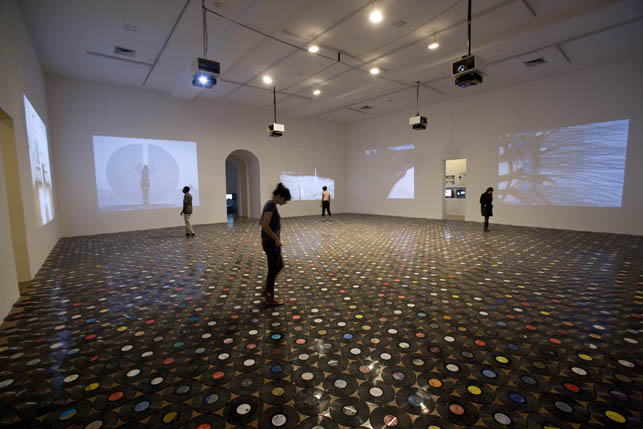
Installation view of 100 Years at P.S.1. Photo by Matthew Septimus
Performance art is in the middle of an extraordinary resurgence in popularity right now, with groundbreaking performance exhibitions at several institutions in the New York area, including the recent Tino Sehgal show at the Guggenheim Museum, the current Tania Bruguera exhibition at the Neuberger Museum, and of course, The Museum of Modern Art’s Marina Abramović exhibition, The Artist is Present. Performance programming is on the rise at biennials and art fairs around the world, and departments devoted to performance art—such as those at MoMA, Tate Modern, and Centre Georges Pompidou—are increasingly being incorporated into the contemporary art museum.
There is no better way to understand this remarkable material, and the reasons behind its current boom, than to visit 100 Years (version #2, ps1, nov 2009), an exhibition on view now through the end of April at P.S.1 Contemporary Art Center in Queens.
W: The Further Adventures

Kermit and W. From premiere episode of Sesame Street, December 10, 1969. Sesame Street Unpaved
As one of our contributions to the exhibition 1969 at P.S.1, Matthew Day Jackson and I pay tribute to Sesame Street. In the show’s first episode, broadcast on November 10, 1969, Kermit the Frog tries to deliver a lecture on the letter W. He’s foiled first by Cookie Monster, who devours Kermit’s prop, then by the W itself, which comes to life and attacks him. Kermit is in 1969, gone grey to reflect other presences in the show. W lurks nearby as well.
W is a shifty sort of letter. To pronounce it we say “double-u,” but the pronunciation conspicuously lacks the /w/ sound it alleges to represent. To write it we mash two V’s together; it possesses no independent shape of its own.
W’s history is similarly suspect. The Latin alphabet, which evolved from a variant of the Greek alphabet circa the seventh century BC, did not originally feature the letter. In the Middle Ages scribes began knitting two V’s together in a ligature in order to represent sounds in Germanic languages not found in medieval Latin.
The Bruce High Quality Foundation Intervenes in 1969
[youtube]http://www.youtube.com/watch?v=4d-lJalQw5E[/youtube]
One of the most interesting aspects of organizing exhibitions at P.S.1 is the focus on living artists. For the current 1969 exhibition—which explores a wide range of art in MoMA’s collection made during this turbulent year—we invited a younger group of artists to create interventions in the galleries that reflect and even disrupt the collection show. We included The Bruce High Quality Foundation as their work is rooted in artistic practices that emerged in the late ’60s, especially Bruce Nauman’s studio performances and Joseph Beuys’s conflation of art and broader society. Additionally, the collaborative nature of the Foundation resonates with many of the collective actions of the period. In keeping with their anonymous mode of operations, the Foundation secretly enacted this masked showdown with the 1969 artworks while the exhibition was being installed.
If you are interested in reproducing images from The Museum of Modern Art web site, please visit the Image Permissions page (www.moma.org/permissions). For additional information about using content from MoMA.org, please visit About this Site (www.moma.org/site).
© Copyright 2016 The Museum of Modern Art