Fabric illustrated book with 35 compositions: 32 fabric collages, 2 with hand additions, and 3 lithographs (including cover)
Not on view
Although she is best known for her sculptures, drawings, and prints, Bourgeois also made illustrated books (a format that she herself collected) from the late 1940s onward, incorporating her own texts and those of other authors. Fabric had deep personal associations for her, as she had spent her childhood living upstairs from her parents’ tapestry restoration workshop and then for years employed textiles in her sculptures and as the support for her prints and drawings. She had long used art as a means of exploring and exorcising her personal history, but this volume is unusually intimate: it is composed entirely of pieces of textiles she had worn or had saved since the 1920s, including nightgowns, scarves, hand towels, and table napkins from her wedding trousseau, monogrammed with her initials.
The pages of the volume display a variety of techniques—from appliqué and quilting to embroidery and weaving—and echo many of the forms that occupied the artist throughout her career, including totemic stacked towers, concentric circles and squares, tightly woven grids, and round organic shapes. The book incorporates two of her own texts: “I had a flashback of something that never existed” and “The return of the repressed,” lines which are in keeping with the terse yet loaded prose she began publishing in the late 1940s.
MoMA Highlights: 375 Works from The Museum of Modern Art, New York (New York: The Museum of Modern Art, 2019)
Gallery label from Mind and Matter: Alternative Abstractions, 1940s to Now , May 5–August 16, 2010.
Bourgeois has made illustrated books, a format that she herself collects, since the late 1940s, incorporating her own texts and those of other authors. This editioned fabric volume is modeled after a unique book she made in 2002 using textiles she had saved throughout her life, including scraps of nightgowns, scarves, and hand towels from her wedding trousseau, monogrammed with her initials. Bourgeois spent her childhood around fabric—her family had a tapestry restoration business—and she has used the material for years in sculptures and as the support for prints and drawings.
Mind and Matter: Alternative Abstractions, 1940s to Now, May 5–August 16, 2010.
Gallery label from Louise Bourgeois: An Unfolding Portrait , Sept. 24, 2017-Jan. 28, 2018.
This is Bourgeois's first book of fabric collages. The pages are composed of linen hand towels saved from her trousseau. Many contain the embroidered monogram LBG (Louise Bourgeois Goldwater), as seen on the cover. Bourgeois later issued an editioned version of this book in twenty-five examples.
Louise Bourgeois: An Unfolding Portrait, Sept. 24, 2017-Jan. 28, 2018.
Explore more
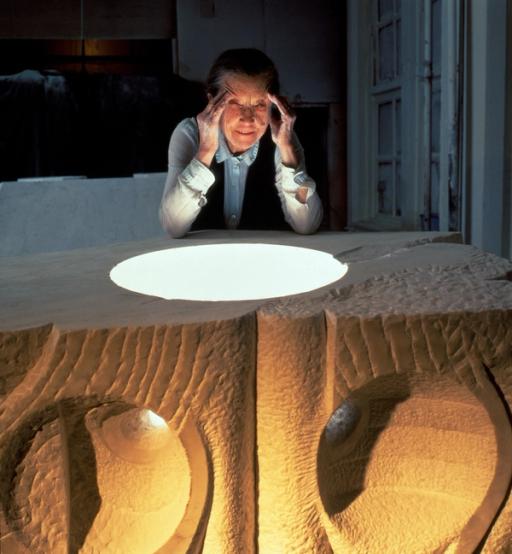
Louise Bourgeois
American, born France. 1911–2010 3040 works onlineBorn in Paris in 1911, Louise Bourgeois was raised by parents who ran a tapestry restoration business. A gifted student, she also helped out in the workshop by drawing missing elements in the scenes depicted on the tapestries.
Learn more →
From MoMA Design Store


Licensing
Artwork or archival images
If you would like to reproduce an image of a work of art in MoMA's collection, or an image of a MoMA publication or archival material (including installation views, checklists, and press releases), please contact Art Resource (publication in North America) or Scala Archives (publication in all other geographic locations).
Audio and film clips
MoMA licenses archival audio and select out of copyright film clips from our film collection. At this time, MoMA produced video cannot be licensed by MoMA/Scala. All requests to license archival audio or out of copyright film clips should be addressed to Scala Archives at [email protected]. Motion picture film stills cannot be licensed by MoMA/Scala. For access to motion picture film stills for research purposes, please contact the Film Study Center at [email protected]. For more information about film loans and our Circulating Film and Video Library, please visit Circulating Film and Video Library.
Text from a publication or the archives
If you would like to reproduce text from a MoMA publication, please email [email protected]. If you would like to publish text from MoMA's archival materials, please fill out this permission form and send to [email protected].
Feedback
This record is a work in progress. If you have additional information or spotted an error, please fill out this feedback form.