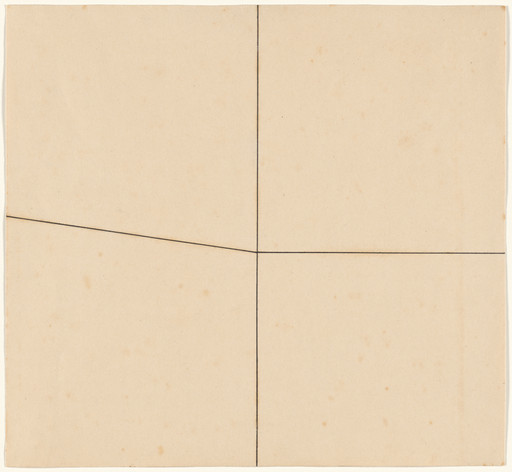
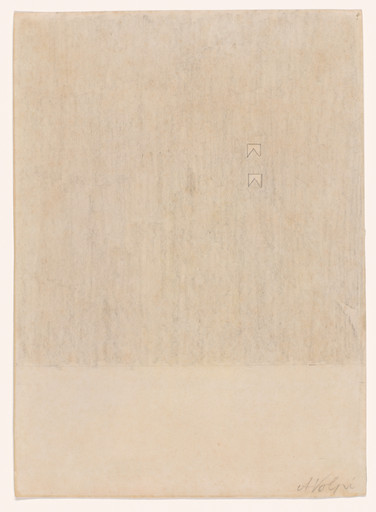
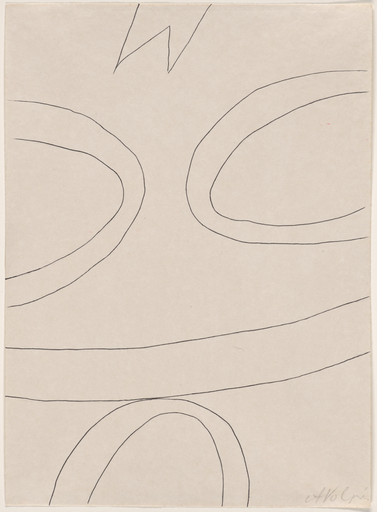
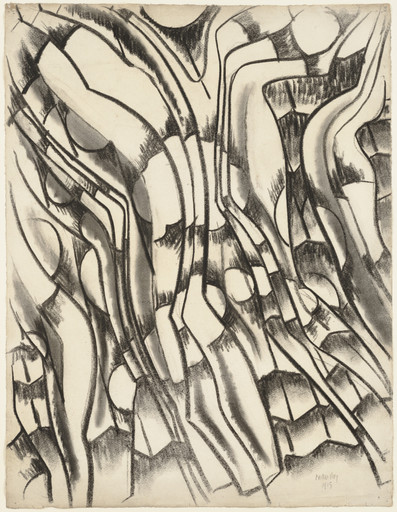
Volpi was a self–taught artist whose intuition contributed to the development of the Brazilian avant–garde. During the second half of the 1950s, nonobjective, Concrete artists in Sao Paulo regarded Volpi's work as a point of reference for their vanguard project. A working–class artist, Volpi created elegant works that demonstrate an innate sense of what is essential; his oeuvre leans toward purity and reduction. Windows and banners are recurring motifs in his work, drawn from daily life and transformed into a completely abstract artistic vocabulary that intuitively anticipated by many years the use of primary colors and repetition that was the hallmark of Neo–Concrete artists in the 1960s. Drawing was a key element of Volpi's process, although autonomous drawings are rare in his production. The provenance of Volpi's drawings in MoMA's collection is significant—all of them belonged to Willys de Castro, one of the most important Neo–Concrete artists in Brazil and the person who linked Volpi and the Neo–Concretist movement.
New Perspectives in Latin American Art, 1930–2006: Selections from a Decade of Acquisitions, November 21, 2007–February25, 2008.
Explore more
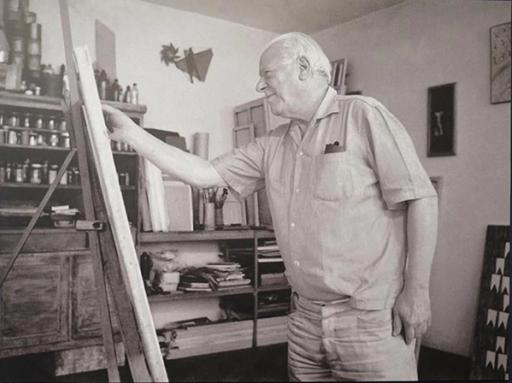
Alfredo Volpi
Brazilian, born Italy. 1896–1988 9 works onlineThe Italian-born Brazilian artist Alfredo Volpi is full of constructive contradictions. He was self-taught, yet revered by the insider members of one of midcentury’s major avant-garde movements.
Learn more →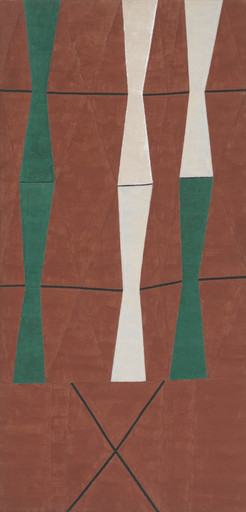


From MoMA Design Store


Licensing
Artwork or archival images
If you would like to reproduce an image of a work of art in MoMA's collection, or an image of a MoMA publication or archival material (including installation views, checklists, and press releases), please contact Art Resource (publication in North America) or Scala Archives (publication in all other geographic locations).
Audio and film clips
MoMA licenses archival audio and select out of copyright film clips from our film collection. At this time, MoMA produced video cannot be licensed by MoMA/Scala. All requests to license archival audio or out of copyright film clips should be addressed to Scala Archives at [email protected]. Motion picture film stills cannot be licensed by MoMA/Scala. For access to motion picture film stills for research purposes, please contact the Film Study Center at [email protected]. For more information about film loans and our Circulating Film and Video Library, please visit Circulating Film and Video Library.
Text from a publication or the archives
If you would like to reproduce text from a MoMA publication, please email [email protected]. If you would like to publish text from MoMA's archival materials, please fill out this permission form and send to [email protected].
Feedback
This record is a work in progress. If you have additional information or spotted an error, please fill out this feedback form.