To underscore and simultaneously call into question photography’s evidentiary function, many artists use existing images backed by the authority of the institutions that house them, such as libraries, archives, or news outlets. Under the name of The Atlas Group, a fictional foundation and archive, Walid Raad explores questions about the authority and authenticity of officially disseminated information on the recent, violent history of Lebanon.
Seeing Through Photographs online course, Coursera, 2016
Publication excerpt from MoMA Highlights: 375 Works from The Museum of Modern Art, New York (New York: The Museum of Modern Art, 2019)
The Atlas Group is a fictional nonprofit research organization Raad founded in 1999. It presents itself to the public as a real collective with a mission to research and document the contemporary history of Lebanon, in particular the civil wars between 1975 and 1991. In the guise of The Atlas Group, Raad collects and fabricates photographs, videotapes, notebooks, and films and presents them in exhibitions, video screenings, and lectures.
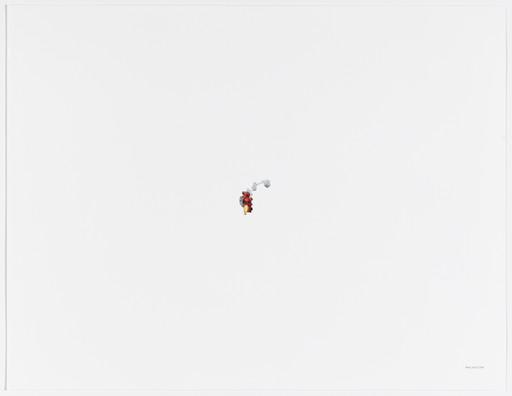
This work assembles one hundred photographs of car engines taken by amateur and professional photographers. During the civil wars, approximately 245 car bombs exploded in Lebanon, detonated by groups across the political and religious spectrums. The only part of the car that remained intact after the blast was the engine, and newspaper reports of car bombs consistently included photographs of engines and the police officers, politicians, and onlookers who gathered in the aftermath of the explosion. Raad compiled the photographs from newspaper archives in Lebanon, scanned their fronts and backs, and printed them with the date of the explosion, the name of the photographer (when known), and an English translation of the notations on the backs of the pictures. From a complex political issue he has extracted and clarified one aspect: the photo opportunity. This is just one lens through which Raad examines the ways in which the economic, political, and social history of Lebanon has been recorded, recalled, and understood.
MoMA Highlights: 375 Works from The Museum of Modern Art, New York (New York: The Museum of Modern Art, 2019)
Publication excerpt from The Museum of Modern Art, MoMA Highlights since 1980 , New York: The Museum of Modern Art, p. 160.
The Atlas Group is a fictional non–profit research organization Raad founded in 1999. It presents itself to the public as a real collective with a mission to research and document the contemporary history of Lebanon, in particular the civil wars between 1975 and 1991. In the guise of The Atlas Group, Raad collects and fabricates photographs, videotapes, notebooks, and films and presents the findings in the form of exhibitions, video screenings, and lectures.
This work assembles one hundred photographs of car engines taken by amateur and professional photographers. During the civil wars, approximately 245 car bombs exploded in Lebanon, detonated by groups across the political and religious spectrum. The only part of the car that remained intact after the blast was the engine, and newspaper reports of car bombs consistently included photographs of engines and the police officers, politicians, and onlookers who gathered in the aftermath of the explosion. Raad collected the photographs from newspaper archives in Lebanon, scanned their fronts and backs, and printed them with the date of the explosion, the name of the photographer (when known), and an English translation of the notations on the backs of the pictures. From a complex political issue he extracts and clarifies one aspect: the photo opportunity. This is just one lens through which Raad examines the ways in which the economic, political, and social history of Lebanon has been recorded, recalled, and understood.
The Museum of Modern Art, MoMA Highlights since 1980, New York: The Museum of Modern Art, p. 160.
Explore more
Institutional critique
A form of conceptual art, which emerged in the late 1960s, centered on the critique of museums, galleries, private collections, and other art institutions.
Learn more →
![Marcel Broodthaers. At your supplier (Vinegar of Eagles) ( Chez votre fournisseur [Le Vinaigre des Aigles] )](https://www.moma.org/media/W1siZiIsIjMyNDI0NSJdLFsicCIsImNvbnZlcnQiLCItcXVhbGl0eSA5MCAtcmVzaXplIDUxMng1MTJcdTAwM2UiXV0.jpg?sha=3d3e6638b1662764)

Audio
Audio from the playlist Walid Raad
From MoMA Design Store


Installation views
We have identified this work in the following photos from our exhibition history.
Licensing
Artwork or archival images
If you would like to reproduce an image of a work of art in MoMA's collection, or an image of a MoMA publication or archival material (including installation views, checklists, and press releases), please contact Art Resource (publication in North America) or Scala Archives (publication in all other geographic locations).
Audio and film clips
MoMA licenses archival audio and select out of copyright film clips from our film collection. At this time, MoMA produced video cannot be licensed by MoMA/Scala. All requests to license archival audio or out of copyright film clips should be addressed to Scala Archives at [email protected]. Motion picture film stills cannot be licensed by MoMA/Scala. For access to motion picture film stills for research purposes, please contact the Film Study Center at [email protected]. For more information about film loans and our Circulating Film and Video Library, please visit Circulating Film and Video Library.
Text from a publication or the archives
If you would like to reproduce text from a MoMA publication, please email [email protected]. If you would like to publish text from MoMA's archival materials, please fill out this permission form and send to [email protected].
Feedback
This record is a work in progress. If you have additional information or spotted an error, please fill out this feedback form.