Ink and graphite on paper
Not on view
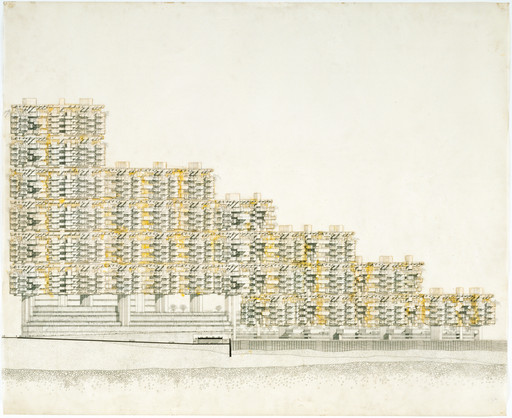
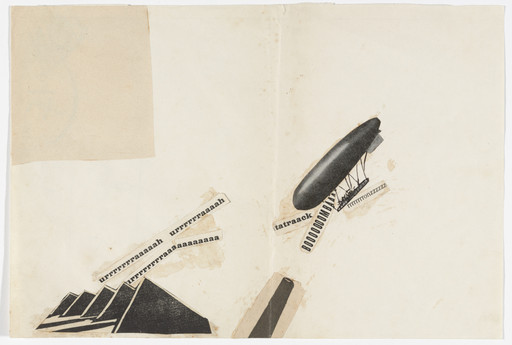
The Lower Manhattan Expressway, which would link New Jersey to Brooklyn, Queens, and Long Island via the Holland Tunnel and the Manhattan and Williamsburg bridges, was conceived of by the influential (and controversial) New York City urban planner Robert Moses in the 1940s. After years of public debate, in 1967 the Ford Foundation commissioned Rudolph to produce a speculative study of the proposed expressway. Designed to leave the city’s infrastructure intact, Rudolph’s proposed Y-shaped corridor suggested a new approach to city building, in which transportation networks could bind rather than divide communities. At key points in the transportation corridor are multilevel, stacking pedestrian plazas, people movers, and parking—all above and below existing bridge and rail systems. Tall, stepped-back residential buildings provide light, air, and views, flanking the corridor at these gateways.
At the time, Rudolph was particularly keen to explore how large, modular, prefabricated elements could serve as building units for the city. The iterative nature of his design for the Lower Manhattan Expressway proposal demonstrates how additional sections could be added as deemed necessary without disrupting the city’s existing fabric: Rudolph’s scheme appears to fit seamlessly around the Williamsburg Bridge (at center), and his illustration even accounts for atmospheric urban details like boats on the East River.
MoMA Highlights: 375 Works from The Museum of Modern Art, New York (New York: The Museum of Modern Art, 2019)
Publication excerpt from an essay by Bevin Cline and Tina di Carlo, in Terence Riley, ed., The Changing of the Avant-Garde: Visionary Architectural Drawings from the Howard Gilman Collection , New York: The Museum of Modern Art, 2002, p. 71.
In the late 1960s, an expressway running across lower Manhattan, linking New Jersey to Brooklyn, Queens, and Long Island via the Holland Tunnel and the Manhattan and Williamsburg bridges, was under discussion. Paul Rudolph's proposed Y-shaped corridor was designed to leave the city's infrastructure intact, and suggested a new approach to city building, which claimed that transportation networks could bind rather than divide communities. At key points in the "transportation corridor" (central hub, bridge or tunnel entries) there were multilevel, stacking pedestrian plazas, people movers, and parking—all above and below existing bridge and rail systems. Tall, stepped-back residential buildings would provide light, air, and views, flanking the corridor at these gateways, and in conjunction with new building types, could become generators of urban space.
an essay by Bevin Cline and Tina di Carlo, in Terence Riley, ed., The Changing of the Avant-Garde: Visionary Architectural Drawings from the Howard Gilman Collection, New York: The Museum of Modern Art, 2002, p. 71.
Explore more

From MoMA Design Store


Installation views
We have identified this work in the following photos from our exhibition history.
Licensing
Artwork or archival images
If you would like to reproduce an image of a work of art in MoMA's collection, or an image of a MoMA publication or archival material (including installation views, checklists, and press releases), please contact Art Resource (publication in North America) or Scala Archives (publication in all other geographic locations).
Audio and film clips
MoMA licenses archival audio and select out of copyright film clips from our film collection. At this time, MoMA produced video cannot be licensed by MoMA/Scala. All requests to license archival audio or out of copyright film clips should be addressed to Scala Archives at [email protected]. Motion picture film stills cannot be licensed by MoMA/Scala. For access to motion picture film stills for research purposes, please contact the Film Study Center at [email protected]. For more information about film loans and our Circulating Film and Video Library, please visit Circulating Film and Video Library.
Text from a publication or the archives
If you would like to reproduce text from a MoMA publication, please email [email protected]. If you would like to publish text from MoMA's archival materials, please fill out this permission form and send to [email protected].
Feedback
This record is a work in progress. If you have additional information or spotted an error, please fill out this feedback form.