Lilly Reich
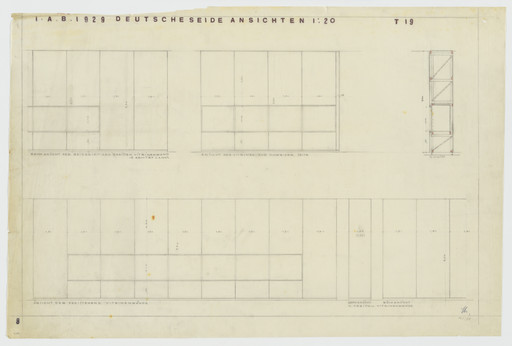
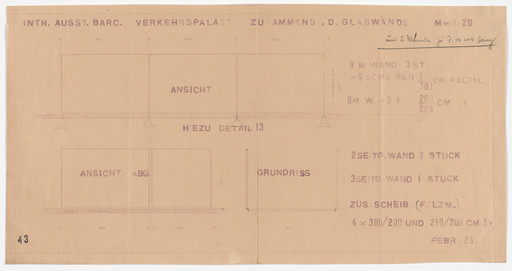
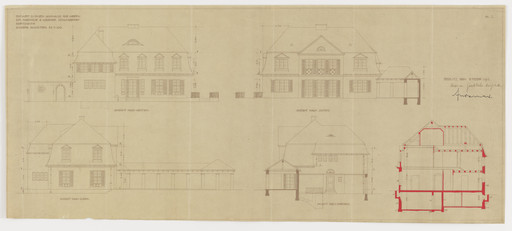
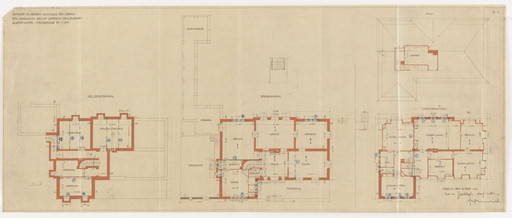
The Dwelling of Our Time, German Building Exhibition, Berlin, Germany (Elevation, section, and plan of turnable wallpaper racks at Wertheim stall)
1931
Pencil on tracing paper
Not on view
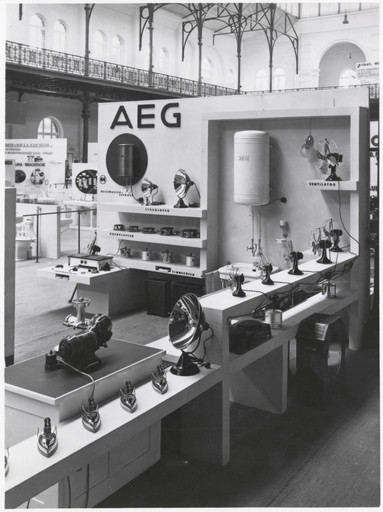
Lilly Reich believed that all creative design was tied to the materials and uses of the object and to the techniques with which it was made. Her work as a designer of exhibitions, of clothing and furniture, and of buildings in the Germany of the 1920s and '30s adhered to this essential criterion. Her most important role was unequivocably as an exhibition designer: for over twenty-five years, her distinctive installations allowed the materials and the content of the display to act as its primary determining features.
Reich had no formal training in design or architecture, but she learned dressmaking and various craft techniques early on, and her talent in these areas was soon recognized by a circle of women in the avant-garde design field. By 1911 Reich had earned commissions for a department store display and for the interior design and furnishings of a youth center. The event that made this career a life-long pursuit came in 1912, when she joined the Deutsche Werkbund, an organization that promoted German design through exhibitions and educational programs. Her commitment to and distinguished work for the Werkbund were deservedly rewarded in 1920, when she became the first woman elected to the board of directors.
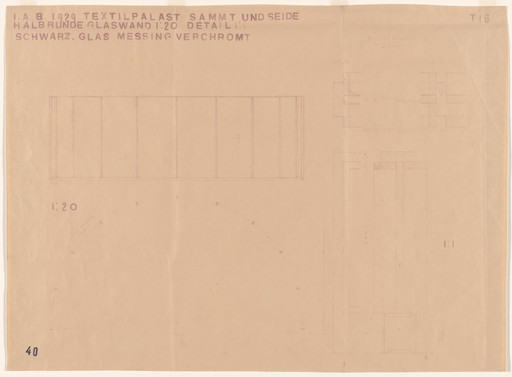
In 1927 Reich began a collaboration with Ludwig Mies van der Rohe that would last until the late 1930s. She always retained her own professional office, even when working with Mies on such large-scale and consequential projects as The Dwelling in Our Time. Reich participated in this exhibition as both designer and architect, and she was responsible for five full-scale installations: two apartments, a single-family house, and exhibits of exterior and interior finishing materials and furnishings. The precise and austere drawings shown on these pages, each stamped "Atelier L. Reich", show the plan and elevation for a textile exhibit and a technical detail of a rack for a display of wallpapers. Clearly representing Reich's working process, the drawings are a construction tool rather than an end in themselves. The plan and elevation drawing for the textile exhibit also reveals the graceful, free-flowing spaces that Reich could create using only the materials of the exhibit themselves as partitions between the different sections of the display. The fabrics on show seem to hold themselves up, with few visible signs of underlying support. This minimalist aesthetic discloses Reich's unwavering and enduring commitment to modernist principles of function and simplicity.
Matilda McQuaid, ed., Envisioning Architecture: Drawings from The Museum of Modern Art, New York: The Museum of Modern Art, 2002, p. 76.
Explore more
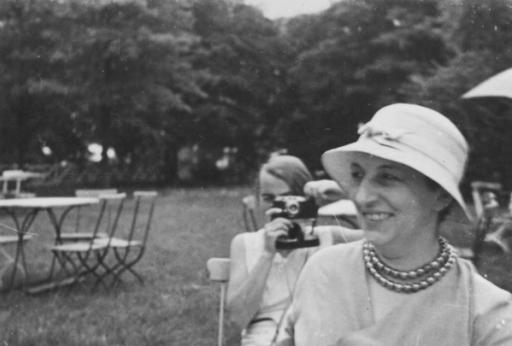
Lilly Reich
German, 1885–1947 84 works onlineIn 1909 the German Werkbund, an organization dedicated to improving society by promoting the highest standards of design and manufacture, declared that women were “unequal to the demanding design tasks of architecture.
Learn more →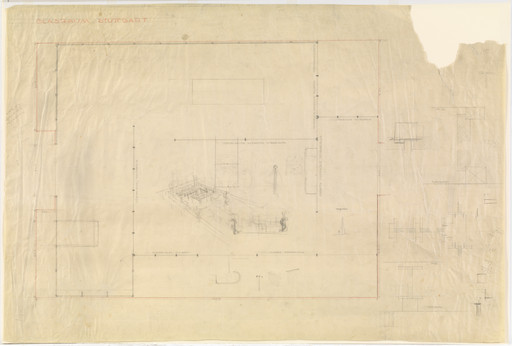



From MoMA Design Store


Licensing
Artwork or archival images
If you would like to reproduce an image of a work of art in MoMA's collection, or an image of a MoMA publication or archival material (including installation views, checklists, and press releases), please contact Art Resource (publication in North America) or Scala Archives (publication in all other geographic locations).
Audio and film clips
MoMA licenses archival audio and select out of copyright film clips from our film collection. At this time, MoMA produced video cannot be licensed by MoMA/Scala. All requests to license archival audio or out of copyright film clips should be addressed to Scala Archives at [email protected]. Motion picture film stills cannot be licensed by MoMA/Scala. For access to motion picture film stills for research purposes, please contact the Film Study Center at [email protected]. For more information about film loans and our Circulating Film and Video Library, please visit Circulating Film and Video Library.
Text from a publication or the archives
If you would like to reproduce text from a MoMA publication, please email [email protected]. If you would like to publish text from MoMA's archival materials, please fill out this permission form and send to [email protected].
Feedback
This record is a work in progress. If you have additional information or spotted an error, please fill out this feedback form.