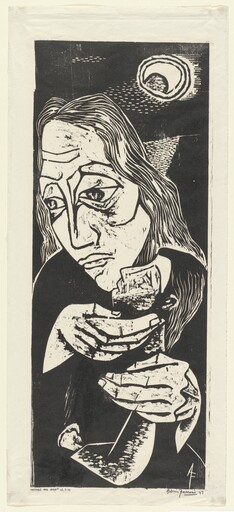
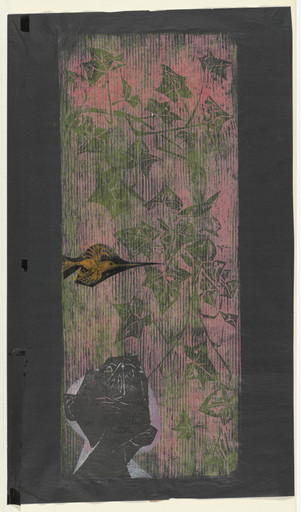
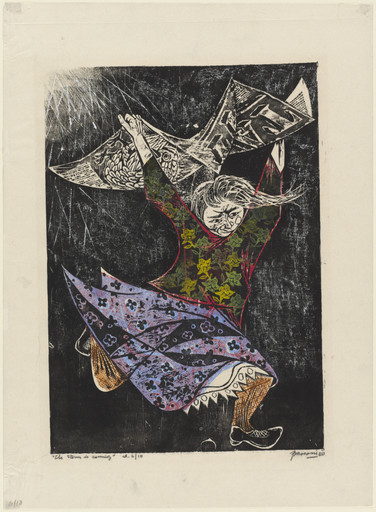
One of the foremost woodcut and book artists since the 1940s, Antonio Frasconi is best known for combining realist and symbolic imagery to address political and social issues. His work also includes such subjects as bestiaries, lyrical landscapes, and illustrations for children's stories and other literary works. Fascinated by the political prints of Mexican artist José Guadalupe Posada, Frasconi began his seven-decade career as a satirical cartoonist. Raised in Uruguay, he has lived in the United States since 1945, when he received a scholarship from the Art Students League in New York. An admirer of German Expressionist and Japanese woodcuts, he did much to sustain interest in the medium at mid-century and, of the three thousand prints he has made, most were executed using this technique.
For his books, numbering more than one hundred, Frasconi makes full use of page sequencing to create visual narratives into which he often incorporates fragments of text with fonts he has designed himself. An indefatigable craftsman, he does his own printing, but has also reproduced some books photomechanically so they can be distributed more broadly through inexpensive trade editions. Viet Nam! alternates woodcuts of war-torn victims with relief halftone prints of sleek B52 bombers, both based on newspaper photographs. The interleaving of white, red, black, and translucent papers, sometimes left blank or repeating previous pages, creates a cinematic rhythm.
In Los Desaparecidos, Frasconi pays homage to citizens of Latin America who, because of their suspected dissent, "disappeared" during the period of military dictatorships there. Here he exploits the raw immediacy of wood grain and experiments with scale to achieve powerfully confrontational effects. Political themes, like those explored here, have been a passion for Frasconi. He even taught a course in the use of art as social statement during his long tenure as a professor at the State University of New York at Purchase.
an essay by Jennifer Roberts, in Deborah Wye, Artists and Prints: Masterworks from The Museum of Modern Art, New York: The Museum of Modern Art, 2004, p. 216.
Explore more
Picturing History
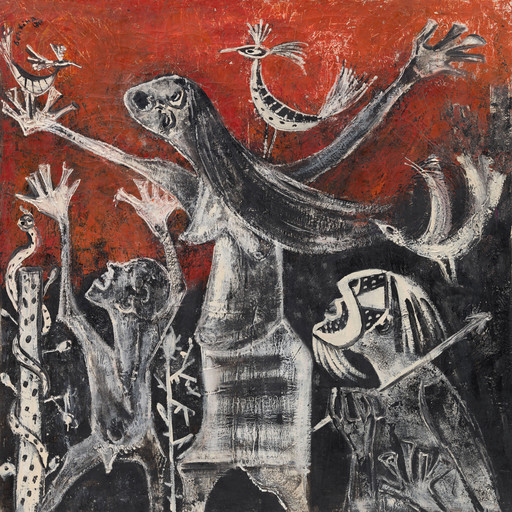
Gallery 420Her response to this omission was to create American People Series #20: Die. For the mural-sized painting, Ringgold depicted contemporary events using a figurative visual language—at a time when the art world celebrated abstraction.
Learn more →



From MoMA Design Store


Licensing
Artwork or archival images
If you would like to reproduce an image of a work of art in MoMA's collection, or an image of a MoMA publication or archival material (including installation views, checklists, and press releases), please contact Art Resource (publication in North America) or Scala Archives (publication in all other geographic locations).
Audio and film clips
MoMA licenses archival audio and select out of copyright film clips from our film collection. At this time, MoMA produced video cannot be licensed by MoMA/Scala. All requests to license archival audio or out of copyright film clips should be addressed to Scala Archives at [email protected]. Motion picture film stills cannot be licensed by MoMA/Scala. For access to motion picture film stills for research purposes, please contact the Film Study Center at [email protected]. For more information about film loans and our Circulating Film and Video Library, please visit Circulating Film and Video Library.
Text from a publication or the archives
If you would like to reproduce text from a MoMA publication, please email [email protected]. If you would like to publish text from MoMA's archival materials, please fill out this permission form and send to [email protected].
Feedback
This record is a work in progress. If you have additional information or spotted an error, please fill out this feedback form.