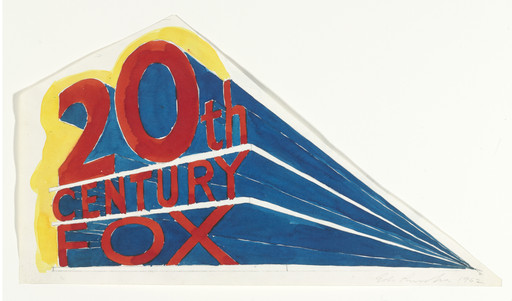
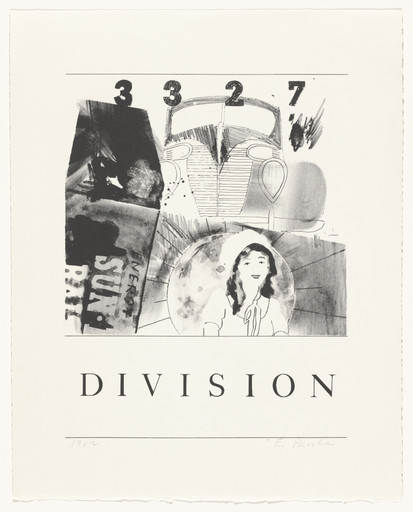
An influential Los Angeles painter, printmaker, and photographer, Edward Ruscha developed a vibrant signature style of combining words, images, objects, and landscapes in deadpan ways—sometimes humorous, sometimes sinister—that associated him first with Pop art in the 1960s and then with Conceptual art in the 1970s. Trained as a commercial illustrator, Ruscha had an early interest in comic books, graphic design, typography, and serial imagery that led him to produce a now landmark series of inexpensive, large-edition artist's books comprising black-and-white photographic essays on commonplace architecture and objects. In the late 1960s and early 1970s, he began focusing on traditional printmaking, which has remained a consistent and vital part of his artistic practice. Working in screenprint, lithography, etching, and sometimes utilizing unconventional organic substances instead of inks, Ruscha has completed more than three hundred prints and some twenty artist's books to date.
The gasoline station is Ruscha's most iconic image. He began experimenting with the subject in his first artist's book, Twentysix Gasoline Stations (1963), which reproduces a series of banal photographs the artist took while driving on Route 66 between Los Angeles and his hometown of Oklahoma City. That year, converting an otherwise ordinary locale into a dramatic, even mysterious symbol of the American vernacular landscape, Ruscha created a monumental painting titled Standard Station, Amarillo, Texas, based on one of the photographs but with a radically foreshortened composition. A few years later he made this print, further exploring the nuances of his emblematic image. Using the medium of screenprint, Ruscha was able to achieve areas of solid, flat color, as well as sinuously blended colors made with the "split fountain" technique, one of the first fine-art applications of this commercial process that combines differently colored inks. Reusing the screens from the print, Ruscha continued to experiment with Standard Station, and eventually varied colors and compositions to create three additional printed versions.
an essay by Judith Hecker, in Deborah Wye, Artists and Prints: Masterworks from The Museum of Modern Art, New York: The Museum of Modern Art, 2004, p. 172.
Explore more
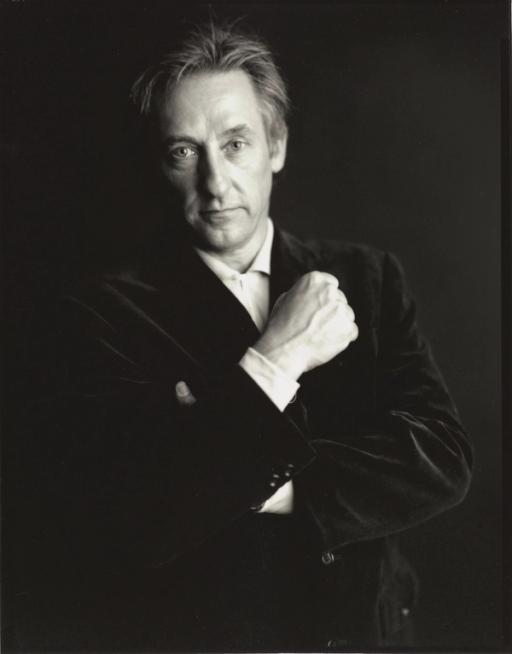
Edward Ruscha
American, born 1937 255 works onlineOnce, when asked about the abundance of text in his work, Ed Ruscha explained, “I just happened to paint words like someone else paints flowers.
Learn more →
Screenprint
A stencil-based printmaking technique in which the first step is to stretch and attach a woven fabric (originally made of silk, but now more commonly of synthetic material) tightly over a wooden frame to create a screen.
Learn more →

Silkscreen
A stencil-based printmaking technique in which the first step is to stretch and attach a woven fabric (originally made of silk, but now more commonly of synthetic material) tightly over a wooden frame to create a screen.
Learn more →
From MoMA Design Store


Installation views
We have identified this work in the following photos from our exhibition history.
Licensing
Artwork or archival images
If you would like to reproduce an image of a work of art in MoMA's collection, or an image of a MoMA publication or archival material (including installation views, checklists, and press releases), please contact Art Resource (publication in North America) or Scala Archives (publication in all other geographic locations).
Audio and film clips
MoMA licenses archival audio and select out of copyright film clips from our film collection. At this time, MoMA produced video cannot be licensed by MoMA/Scala. All requests to license archival audio or out of copyright film clips should be addressed to Scala Archives at [email protected]. Motion picture film stills cannot be licensed by MoMA/Scala. For access to motion picture film stills for research purposes, please contact the Film Study Center at [email protected]. For more information about film loans and our Circulating Film and Video Library, please visit Circulating Film and Video Library.
Text from a publication or the archives
If you would like to reproduce text from a MoMA publication, please email [email protected]. If you would like to publish text from MoMA's archival materials, please fill out this permission form and send to [email protected].
Feedback
This record is a work in progress. If you have additional information or spotted an error, please fill out this feedback form.