Ink and charcoal on paper
Not on view
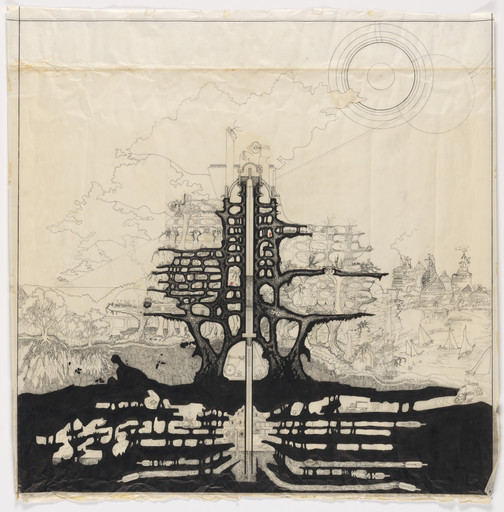
James Wines, a founding member in 1970 of the SITE (Sculpture In The Environment) architectural group, described the Highrise of Homes project as a "vertical community" to "accommodate people's conflicting desires to enjoy the cultural advantages of an urban center, without sacrificing the private home identity and garden space associated with suburbia." The plan calls for a steel-and-concrete, eight-to-ten-story, U-shaped building frame erected in a densely populated urban area. The developer would sell lots within this frame, each lot the site for a house and garden in a style chosen by the purchaser. The result would be a distinct villagelike community on each floor, with interior streets. A central mechanical core would serve these homes and gardens, while shops, offices, and other facilities on the ground and middle floors would provide for the residents' needs.
Whereas urban skyscrapers are normally made up of identical, stacked, boxlike units, the Highrise of Homes would allow flexibility and individual choice. The wide variety of house styles, gardens, hedges, and fences described in this intricate rendering provides a sense of the personal identity and human connection that are generally erased by the austere and repetitive elements of architectural formalism. Placing the sociological and psychological needs of the inhabitant over the aesthetic sensibilities of the architect, Wines produces a merge of suburb and city, a collage of architectures collectively created by its inhabitants and by the art of chance. Developers considered Battery Park City, New York, as a possible location for the project, but it was never built.
an essay by Bevin Cline, in Matilda McQuaid, ed., Envisioning Architecture: Drawings from The Museum of Modern Art, New York: The Museum of Modern Art, 2002, p. 220.
Explore more

James Wines
American, born 1932 21 works onlineJames Wines, founder of the architecture and environmental design studio SITE , has spent much of his career challenging the notion that architecture is an act of formal invention.
Learn more →



From MoMA Design Store


Installation views
We have identified this work in the following photos from our exhibition history.
Licensing
Artwork or archival images
If you would like to reproduce an image of a work of art in MoMA's collection, or an image of a MoMA publication or archival material (including installation views, checklists, and press releases), please contact Art Resource (publication in North America) or Scala Archives (publication in all other geographic locations).
Audio and film clips
MoMA licenses archival audio and select out of copyright film clips from our film collection. At this time, MoMA produced video cannot be licensed by MoMA/Scala. All requests to license archival audio or out of copyright film clips should be addressed to Scala Archives at [email protected]. Motion picture film stills cannot be licensed by MoMA/Scala. For access to motion picture film stills for research purposes, please contact the Film Study Center at [email protected]. For more information about film loans and our Circulating Film and Video Library, please visit Circulating Film and Video Library.
Text from a publication or the archives
If you would like to reproduce text from a MoMA publication, please email [email protected]. If you would like to publish text from MoMA's archival materials, please fill out this permission form and send to [email protected].
Feedback
This record is a work in progress. If you have additional information or spotted an error, please fill out this feedback form.