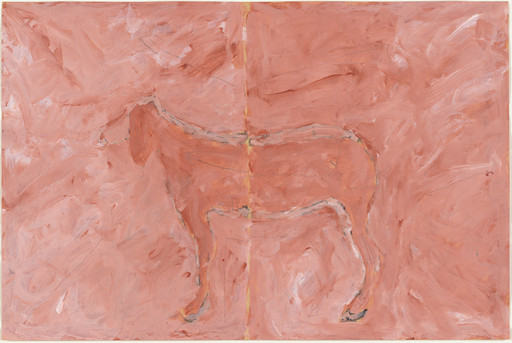
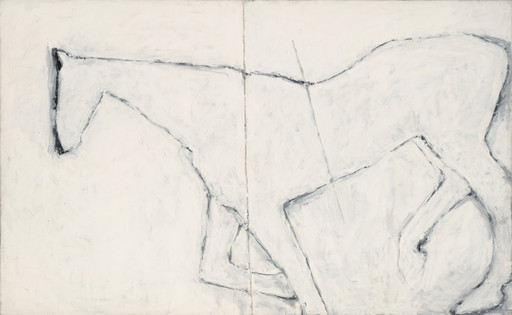
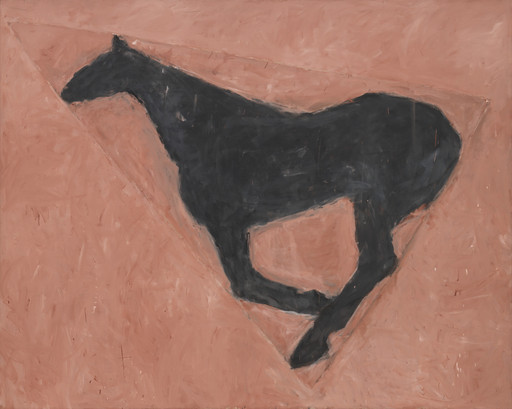
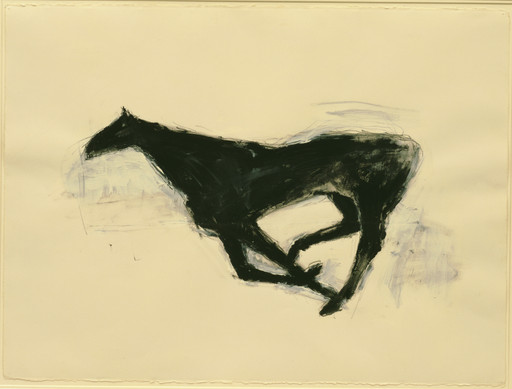
Susan Rothenberg emerged in the mid-1970s as an essential link between the abstract and Minimalist painting of the 1950s and 1960s and the new figuration and expressionism that would emerge in the next two decades. Her artistic abilities had always been encouraged and, at an early age, she took art classes at the local museum in Buffalo, New York. She later studied sculpture and painting at Cornell University. Moving to New York City in 1969, Rothenberg became part of SoHo's community of artists, and occasionally worked as a part-time performer in productions by artist Joan Jonas. In 1973 she began making paintings of a single horse, a form that would occupy her for the next several years and become an early hallmark of her work. Progressively, she began to disassemble the horse image, depicting only parts of its anatomy. She eventually shifted her focus to disembodied aspects of the human figure. With loosely depicted forms floating unanchored on dark grounds, her work continues to navigate between figuration and abstraction, and she remains a creator of mysterious and ambiguous images.
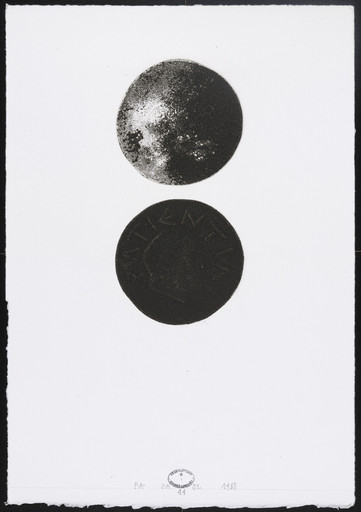
Rothenberg pursued similar concerns in printmaking, an activity she began in the late 1970s. Since that time, she has made approximately seventy prints, including lithographs, screenprints, woodcuts, and intaglios. She feels most comfortable working in a reductive way, erasing and scraping to create an image from a black ground. Mezzotint, the intaglio technique used in Boneman, is particularly suited to this method of working. Although she occasionally opts for color, her work is most often executed in a palette of black, white, and gray. In Boneman, a mysterious drumming figure seems to emerge from a dreamlike darkness. Color is provided only by her choice of a wood veneer paper on which she has printed this monochromatic image.
an essay by Sarah Suzuki, in Deborah Wye, Artists and Prints: Masterworks from The Museum of Modern Art, New York: The Museum of Modern Art, 2004, p. 228.
Explore more
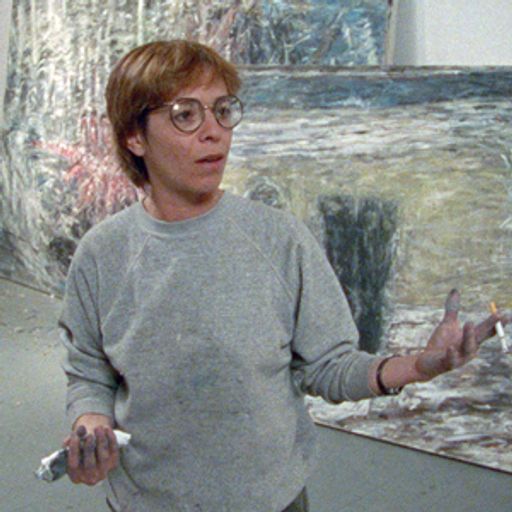
Susan Rothenberg
American, 1945–2020 44 works onlineBorn in Buffalo, New York, in 1945, Susan Rothenberg became interested in art at an early age, inspired by her grandfather, a house painter, and trips to Buffalo’s Albright-Knox Art Gallery.
Learn more →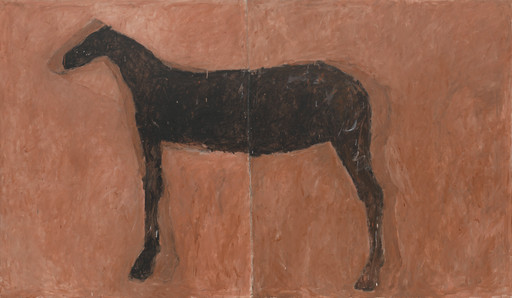
Mezzotint
An intaglio printmaking technique that creates soft, velvety gradations of tone. The term comes from the Italian mezzotinto, meaning “half tint.
Learn more →
![Ikkō Narahara [奈良原一高]. I Continue Sleeping](https://www.moma.org/media/W1siZiIsIjIyMjg4NiJdLFsicCIsImNvbnZlcnQiLCItcXVhbGl0eSA5MCAtcmVzaXplIDUxMng1MTJcdTAwM2UiXV0.jpg?sha=f6691b77cd40ed6a)
From MoMA Design Store


Installation views
We have identified this work in the following photos from our exhibition history.
Licensing
Artwork or archival images
If you would like to reproduce an image of a work of art in MoMA's collection, or an image of a MoMA publication or archival material (including installation views, checklists, and press releases), please contact Art Resource (publication in North America) or Scala Archives (publication in all other geographic locations).
Audio and film clips
MoMA licenses archival audio and select out of copyright film clips from our film collection. At this time, MoMA produced video cannot be licensed by MoMA/Scala. All requests to license archival audio or out of copyright film clips should be addressed to Scala Archives at [email protected]. Motion picture film stills cannot be licensed by MoMA/Scala. For access to motion picture film stills for research purposes, please contact the Film Study Center at [email protected]. For more information about film loans and our Circulating Film and Video Library, please visit Circulating Film and Video Library.
Text from a publication or the archives
If you would like to reproduce text from a MoMA publication, please email [email protected]. If you would like to publish text from MoMA's archival materials, please fill out this permission form and send to [email protected].
Feedback
This record is a work in progress. If you have additional information or spotted an error, please fill out this feedback form.