Not on view
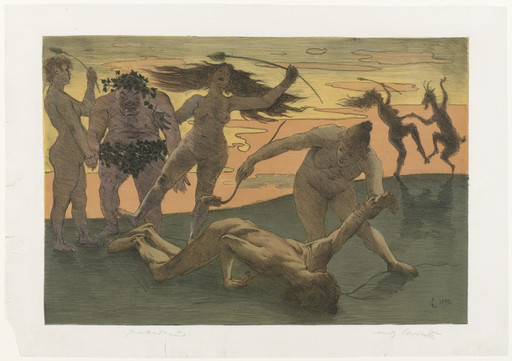
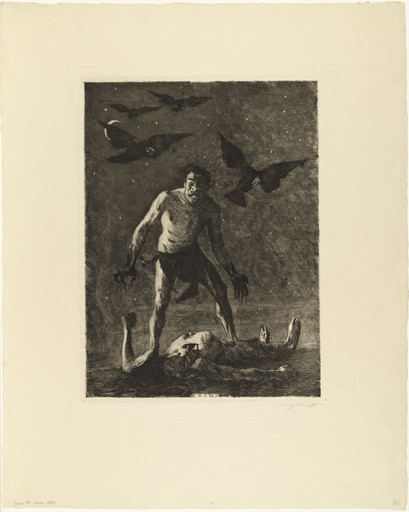
Lovis Corinth began work on Antike Legende (Classical legends) during the last few months of World War I. In twelve drypoints, he transformed mythological gods for the new age, reworking prints and paintings from earlier in his career in a new, Expressionist style and in light of new circumstances. The sensual and voluptuous images belie the deep malaise he felt as the political situation in Germany deteriorated. Privately, he complained that the political landscape "was becoming more and more ridiculous" and that it "crippled everything," including progress on this portfolio, a commission for Julius Meier-Graefe's Marées-Gesellschaft.
Corinth alluded to World War I and the misery it brought to Germany in Die Schmiede des Vulkan (The forge of Vulcan). In Die Spiegel der Venus (The mirror of Venus), the goddess of love transforms a weapon—the shield of Mars—into a tool for reflecting her own beauty. Corinth delighted in depicting luscious nudes. He revered Peter Paul Rubens, the Flemish master of ecstatic flesh, whose painting Perseus and Andromeda he copied for this portfolio. Corinth believed that art was ultimately more important than day-to-day realities: "True art has no practical, utilitarian aftertaste," he noted in a 1920 essay. "It exists solely for itself. Egotistical like a god, it stands before us in all its radiance and allows itself to be admired by its true devotees."
Heather Hess, German Expressionist Digital Archive Project, German Expressionism: Works from the Collection. 2011.
Explore more


From MoMA Design Store


Licensing
Artwork or archival images
If you would like to reproduce an image of a work of art in MoMA's collection, or an image of a MoMA publication or archival material (including installation views, checklists, and press releases), please contact Art Resource (publication in North America) or Scala Archives (publication in all other geographic locations).
Audio and film clips
MoMA licenses archival audio and select out of copyright film clips from our film collection. At this time, MoMA produced video cannot be licensed by MoMA/Scala. All requests to license archival audio or out of copyright film clips should be addressed to Scala Archives at [email protected]. Motion picture film stills cannot be licensed by MoMA/Scala. For access to motion picture film stills for research purposes, please contact the Film Study Center at [email protected]. For more information about film loans and our Circulating Film and Video Library, please visit Circulating Film and Video Library.
Text from a publication or the archives
If you would like to reproduce text from a MoMA publication, please email [email protected]. If you would like to publish text from MoMA's archival materials, please fill out this permission form and send to [email protected].
Feedback
This record is a work in progress. If you have additional information or spotted an error, please fill out this feedback form.