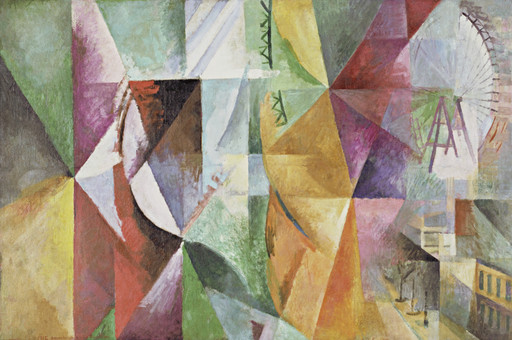
The artist and theorist Robert Delaunay used the term "simultaneous contrast" in 1912 to describe the sensations of depth, motion, and harmony he achieved through color effects and a Cubist fragmentation of space. The poet Guillaume Apollinaire referred to the musicality implied in Delaunay's style when he deemed it "Orphic Cubism" or "Orphism," a reference to the Greek god Orpheus, who tamed beasts with his mythical lyre playing.
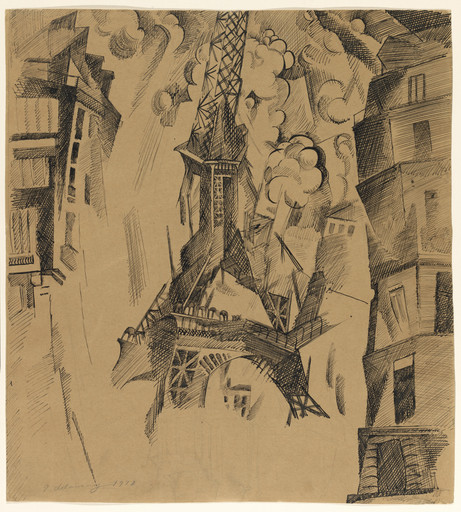
Between 1922 and 1928, Delaunay executed five lithographs based on earlier paintings. The prints, like the paintings, exemplify Delaunay's engagement with the dynamism of Paris, as embodied primarily in its architecture. Favoring monochromatic drawings and prints over the brilliant color for which he was best known, the artist relied instead on chiaroscuro effects in concert with rhythmically placed lines and patterns. Delaunay drew throughout his career with the liquid tusche and greasy black crayon commonly used for lithography, so the process of making prints was not a great departure for him. In all, he made approximately thirty-five lithographs, most of which were book illustrations. A Parisian publisher had planned to include The Eiffel Tower in a portfolio of lithographs by Delaunay, with a text by French novelist Joris-Karl Huysmans, but the project was never completed.
As the world's tallest monument at the time, the Eiffel Tower was for Delaunay a symbol of both modernity and masculinity, and he depicted it time and again. He was among the first artists to focus on this landmark as a subject, and it appears throughout his illustrated book Allo! Paris, with text by Joseph Delteil. Delaunay's more well-known, purely abstract imagery, comprising concentric, curved, and segmented bands, appears only rarely in his prints.
an essay by Jennifer Roberts, in Deborah Wye, Artists and Prints: Masterworks from The Museum of Modern Art, New York: The Museum of Modern Art, 2004, p. 70.
Explore more



From MoMA Design Store


Installation views
We have identified this work in the following photos from our exhibition history.
Licensing
Artwork or archival images
If you would like to reproduce an image of a work of art in MoMA's collection, or an image of a MoMA publication or archival material (including installation views, checklists, and press releases), please contact Art Resource (publication in North America) or Scala Archives (publication in all other geographic locations).
Audio and film clips
MoMA licenses archival audio and select out of copyright film clips from our film collection. At this time, MoMA produced video cannot be licensed by MoMA/Scala. All requests to license archival audio or out of copyright film clips should be addressed to Scala Archives at [email protected]. Motion picture film stills cannot be licensed by MoMA/Scala. For access to motion picture film stills for research purposes, please contact the Film Study Center at [email protected]. For more information about film loans and our Circulating Film and Video Library, please visit Circulating Film and Video Library.
Text from a publication or the archives
If you would like to reproduce text from a MoMA publication, please email [email protected]. If you would like to publish text from MoMA's archival materials, please fill out this permission form and send to [email protected].
Feedback
This record is a work in progress. If you have additional information or spotted an error, please fill out this feedback form.