Paul Klee
Queen of Hearts (Herzdame) from the periodical Der Ararat. Glossen, Skizzen und Notizen zur Neuen Kunst vol. 2, no. 4 (April 1921)
1921
Lithograph
Not on view
Humor, lyricism, and intimacy are some of the qualities that define the imaginative body of work created by Paul Klee. In addition to paintings, Klee made more than one hundred prints, most of which were etchings and lithographs. His interest in printmaking began in his mid-twenties when he returned to his hometown of Bern after studying art at the Munich Academy and in Italy. Determined to make his first independent artistic statement, Klee found that etching provided the structure he needed at a moment when he was discouraged by his unsuccessful efforts at painting.
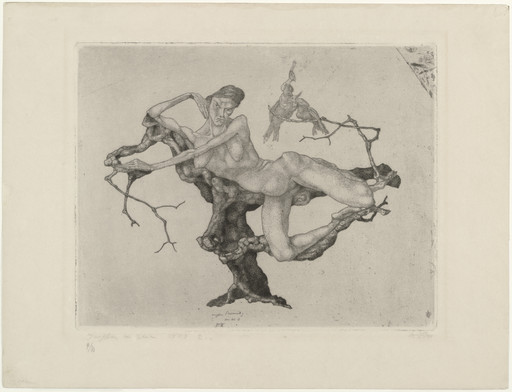
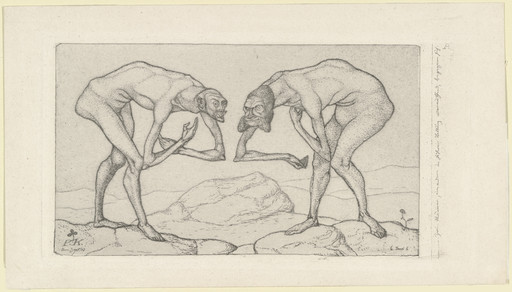
Between 1903 and 1905 Klee made a series of twelve etchings he called Inventions, which he considered his first significant body of work. Rebelling against the classical training he had received at art school, he radically distorted the anatomy of the female nude in this series. By parodying the typically allegorical treatment of women's bodies, he expressed his alienation from the bourgeois conservatism of mainstream art and his desire to retreat into his imagination. In this example, the woman, draped over a gnarled tree and grotesquely misshapen, is portrayed as the antithesis of a romantic, idealized nude.
This early series of etchings established Klee as an artist and launched his career. Although he later devoted himself to painting, he continued to make prints in which he incorporated ideas from Cubism and the art of children and of the mentally ill. A trip to Tunisia in 1914 awakened a passion for color, which he incorporated in his paintings and prints. It was at the Bauhaus, the famed German school of modern design, where he was invited to teach in 1920, that he developed his more familiar abstract geometric style, utilizing signs and symbols in simplified yet whimsical compositions such as Queen of Hearts.
an essay by Harper Montgomery and Sarah Suzuki, in Deborah Wye, Artists and Prints: Masterworks from The Museum of Modern Art, New York: The Museum of Modern Art, 2004, p. 50.
Explore more
![Paul Klee. Perseus (Wit Has Triumphed over Grief) (Perseus [Der Witz hat über das Leid gesiegt]) from the series Inventions (Inventionen)](https://www.moma.org/media/W1siZiIsIjEyOTI4OSJdLFsicCIsImNvbnZlcnQiLCItcXVhbGl0eSA5MCAtcmVzaXplIDUxMng1MTJcdTAwM2UiXV0.jpg?sha=8f6cf0f49a9d17ea)

From MoMA Design Store


Licensing
Artwork or archival images
If you would like to reproduce an image of a work of art in MoMA's collection, or an image of a MoMA publication or archival material (including installation views, checklists, and press releases), please contact Art Resource (publication in North America) or Scala Archives (publication in all other geographic locations).
Audio and film clips
MoMA licenses archival audio and select out of copyright film clips from our film collection. At this time, MoMA produced video cannot be licensed by MoMA/Scala. All requests to license archival audio or out of copyright film clips should be addressed to Scala Archives at [email protected]. Motion picture film stills cannot be licensed by MoMA/Scala. For access to motion picture film stills for research purposes, please contact the Film Study Center at [email protected]. For more information about film loans and our Circulating Film and Video Library, please visit Circulating Film and Video Library.
Text from a publication or the archives
If you would like to reproduce text from a MoMA publication, please email [email protected]. If you would like to publish text from MoMA's archival materials, please fill out this permission form and send to [email protected].
Feedback
This record is a work in progress. If you have additional information or spotted an error, please fill out this feedback form.