Gum bichromate over platinum and ferroprusiate print
Not on view
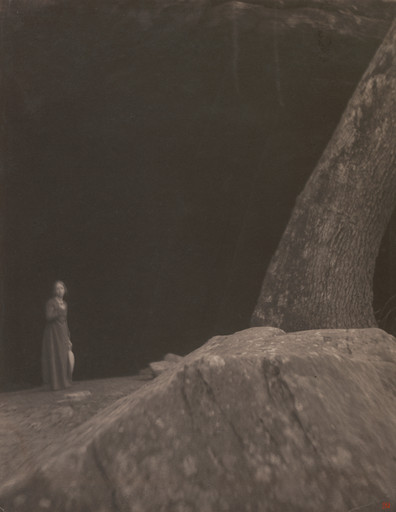
Moonrise—Mamaroneck, New York, evocative of mystical landscape paintings, is among Edward Steichen’s most iconic pictorial photographs. In this print, one of only three made of this composition, Steichen purposefully blurred the line between photography and painting. His efforts epitomize the pictorialist impulse to champion photography as an art form, rather than merely a direct record of reality. Steichen achieved the print’s luminosity by using the same negative with different photographic processes. He then rubbed away portions of the image to expose the bright paper in the moon and between the trees. This mysterious, other-worldly composition speaks to the artist’s life-long reverence for nature.
504: A Little Gallery of the Photo-Secession, 2025
Gallery label from Time Travelers: Photographs from the Gayle Greenhill Collection , Oct 31, 2025–Feb 16, 2026
Steichen built up this artwork in layers: Beginning with a monochromatic platinum print, he reprinted the image multiple times in different colors—each printing made on top of the previous one—using the gum bichromate process. Three unique versions of Moonrise exist; another example is on view in Gallery 504.
Time Travelers: Photographs from the Gayle Greenhill Collection, Oct 31, 2025–Feb 16, 2026
Publication excerpt from MoMA Highlights: 375 Works from The Museum of Modern Art, New York (New York: The Museum of Modern Art, 2019)
The colors in this photograph were not captured by the camera but were concocted later by Steichen in the darkroom, where he also sketched the reeds and grasses in the foreground. These marks of the artist’s hand were the young photographer’s way of showing that the picture was not an ordinary photograph—it was, rather, a work of art.
Raised in Wisconsin, in 1900 Steichen made his way to New York, where he met the older and more seasoned photographer Alfred Stieglitz and soon joined him in a vigorous campaign to establish photography as a fine art. Although at first they failed to impress a broad public, they encouraged many talented young photographers to think of themselves as artists and so initiated a rich tradition that flourished for more than half a century.
For Stieglitz and Steichen, pursuing the artistic potential of photography meant rejecting its practical functions in the modern industrialized world. They retreated into an aesthetic realm of refinement that venerated, for example, the purity of nature. Pure as it was, however, the nature that they photographed was rarely wild. Mamaroneck surely was more peaceful a century ago than it is today, but it was already a suburb of New York to which Steichen often went to escape from the rigors of city life.
MoMA Highlights: 375 Works from The Museum of Modern Art, New York (New York: The Museum of Modern Art, 2019)
Explore more
From MoMA Design Store


Licensing
Artwork or archival images
If you would like to reproduce an image of a work of art in MoMA's collection, or an image of a MoMA publication or archival material (including installation views, checklists, and press releases), please contact Art Resource (publication in North America) or Scala Archives (publication in all other geographic locations).
Audio and film clips
MoMA licenses archival audio and select out of copyright film clips from our film collection. At this time, MoMA produced video cannot be licensed by MoMA/Scala. All requests to license archival audio or out of copyright film clips should be addressed to Scala Archives at [email protected]. Motion picture film stills cannot be licensed by MoMA/Scala. For access to motion picture film stills for research purposes, please contact the Film Study Center at [email protected]. For more information about film loans and our Circulating Film and Video Library, please visit Circulating Film and Video Library.
Text from a publication or the archives
If you would like to reproduce text from a MoMA publication, please email [email protected]. If you would like to publish text from MoMA's archival materials, please fill out this permission form and send to [email protected].
Feedback
This record is a work in progress. If you have additional information or spotted an error, please fill out this feedback form.