Watercolor, graphite, and photocopy on paper, thirteen sheets
Not on view
These paper dolls critique the history of the forced removal and attempted cultural assimilation of Native Americans by the US government. Informed by the lives and experiences of the artist’s Salish ancestors, the drawings depict a fictional family named the Plenty Horses, who appear alongside a Jesuit priest. From 1864 to 1972, Jesuits operated a Federal Indian Boarding School at the St. Ignatius Mission on the Flathead Reservation in Montana, where Smith was born. It was one of more than four hundred schools that sought to eradicate Indigenous cultures. Invoking the types of play associated with the Barbie doll franchise, Smith uses a seemingly lighthearted and humorous approach in her critique of this dark history.
2026
Explore more

Jaune Quick-to-See Smith
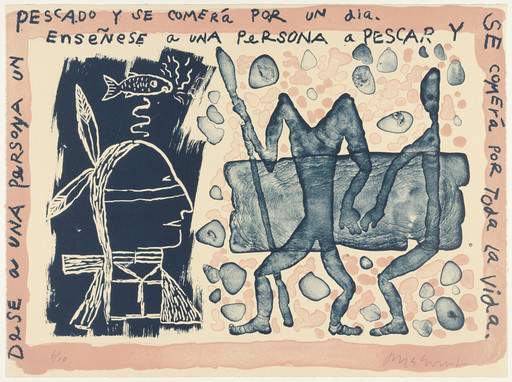
Citizen of the Confederated Salish and Kootenai Nation, 1940–2025 3 works onlineWhen Jaune Quick-to-See Smith was 13 years old, she went to see a John Huston film. This was a rare outing for a child for whom schoolwork came second to laboring in canneries and on farms, like so many other Native American and migrant youth in the Pacific Northwest.
Learn more →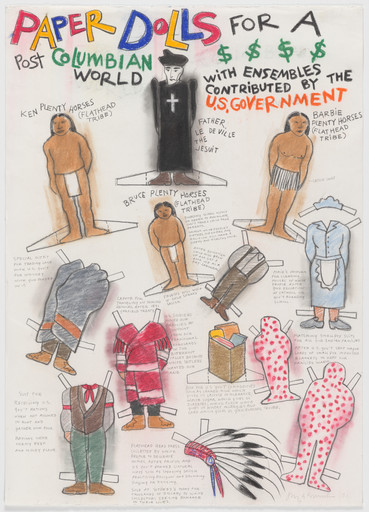


Audio
Audio from the playlist Art & Society
From MoMA Design Store


Licensing
Artwork or archival images
If you would like to reproduce an image of a work of art in MoMA's collection, or an image of a MoMA publication or archival material (including installation views, checklists, and press releases), please contact Art Resource (publication in North America) or Scala Archives (publication in all other geographic locations).
Audio and film clips
MoMA licenses archival audio and select out of copyright film clips from our film collection. At this time, MoMA produced video cannot be licensed by MoMA/Scala. All requests to license archival audio or out of copyright film clips should be addressed to Scala Archives at [email protected]. Motion picture film stills cannot be licensed by MoMA/Scala. For access to motion picture film stills for research purposes, please contact the Film Study Center at [email protected]. For more information about film loans and our Circulating Film and Video Library, please visit Circulating Film and Video Library.
Text from a publication or the archives
If you would like to reproduce text from a MoMA publication, please email [email protected]. If you would like to publish text from MoMA's archival materials, please fill out this permission form and send to [email protected].
Feedback
This record is a work in progress. If you have additional information or spotted an error, please fill out this feedback form.