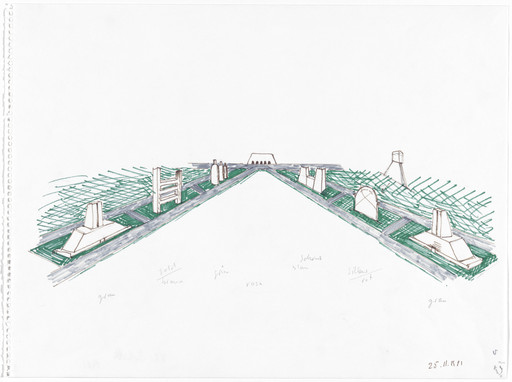
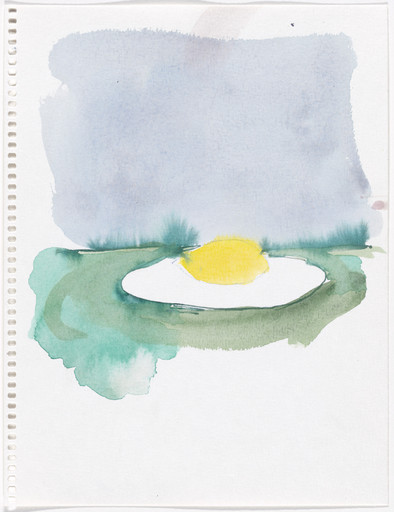
.a and .e) Watercolor, felt-tip pen, gouache and pencil on paper .b and .c) Watercolor, felt-tip pen and gouache on paper .d and .f) Watercolor and ink on paper .g) Watercolor, ink and pencil on paper
Not on view
Through a multifaceted practice that embraces sculpture, installation, painting, and drawing, Schütte continually explores aspects of the human condition. Emerging a generation after Anselm Kiefer, Gerhard Richter, and Sigmar Polke, German artists who mined their country’s fascist past, Schütte taps into history in more subtle ways.
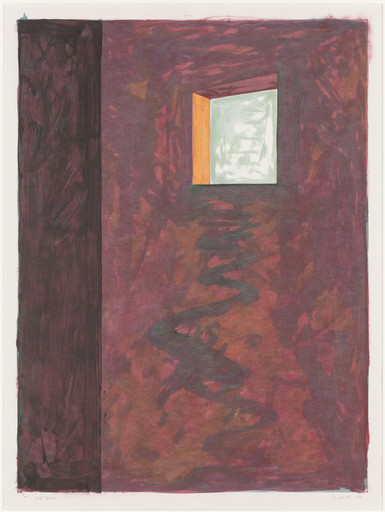
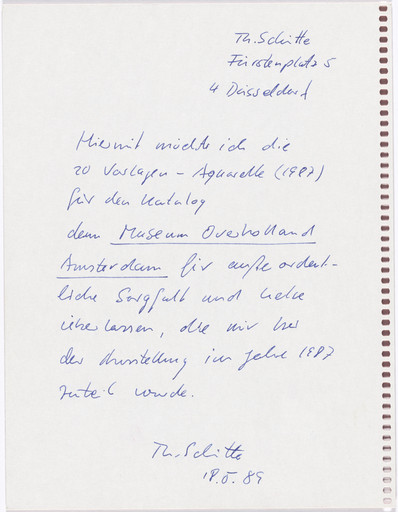
These drawings illustrate the concept for Schütte’s 1990 exhibition Seven Fields, and they appeared on the show's promotional material. The seven images each correspond to one of the seven spaces in the exhibition. In each of these spaces, Schütte investigated a different field of inquiry, emblematized in the drawings by a lemon, rings, an architectural model, and a portrait of Alain Colas—the French sailor who never returned from his 1978 attempt to cross the Atlantic Ocean alone—among others. That these fields of investigation appear random and disconnected is part of Schütte's message; what drives his art is the notion that images no longer support universal meaning as they once could. Instead of constructing monuments glorifying universal experience, Schütte creates anti-monuments to everyday life and the complexities of human existence—our disappointments as well as our hopes.
The Museum of Modern Art, MoMA Highlights since 1980, New York: The Museum of Modern Art, 2007, p. 94.
Explore more
Thomas Schütte
German, born 1954 271 works onlineWhen Thomas Schütte made his first figurative sculpture, he discovered it couldn’t stand on its own. He might have built a simple base to anchor the feet and keep it upright, but instead Schütte melted wax in a plastic bucket and sunk the figurine up to its knees.
Learn more →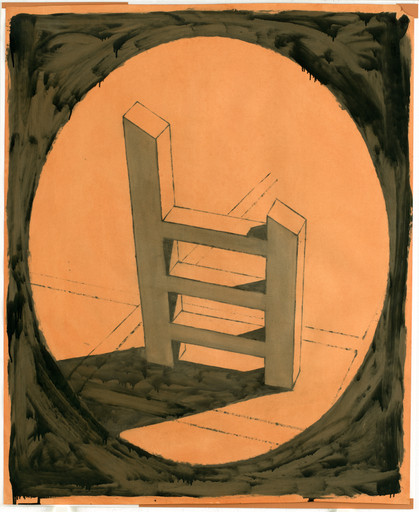

From MoMA Design Store


Licensing
Artwork or archival images
If you would like to reproduce an image of a work of art in MoMA's collection, or an image of a MoMA publication or archival material (including installation views, checklists, and press releases), please contact Art Resource (publication in North America) or Scala Archives (publication in all other geographic locations).
Audio and film clips
MoMA licenses archival audio and select out of copyright film clips from our film collection. At this time, MoMA produced video cannot be licensed by MoMA/Scala. All requests to license archival audio or out of copyright film clips should be addressed to Scala Archives at [email protected]. Motion picture film stills cannot be licensed by MoMA/Scala. For access to motion picture film stills for research purposes, please contact the Film Study Center at [email protected]. For more information about film loans and our Circulating Film and Video Library, please visit Circulating Film and Video Library.
Text from a publication or the archives
If you would like to reproduce text from a MoMA publication, please email [email protected]. If you would like to publish text from MoMA's archival materials, please fill out this permission form and send to [email protected].
Feedback
This record is a work in progress. If you have additional information or spotted an error, please fill out this feedback form.