Cut-and-pasted colored paper, printed paper, and painted paper, pencil, and gouache on prepared board
Not on view
In Pipe, Glass, Bottle of Rum, Pablo Picasso used collage to reimagine a frequent subject in traditional still lifes: a cluttered tabletop. The table itself is described with strokes of pencil, while the objects arranged on top of it are partly drawn and partly collaged. The black pipe at left, for instance, consists of cut-and-pasted pieces of colored paper surrounded by graphite shading. Similarly, the bottle at right is a hand-drawn vessel topped with a French-language newspaper clipping that reads “RHUM” (in English, “rum”). By combining different materials and techniques in a single composition, Picasso helped develop what came to be called Synthetic Cubism. In addition, he challenged the conventional notion that the aim of still life is to represent real things realistically.
2026
Explore more
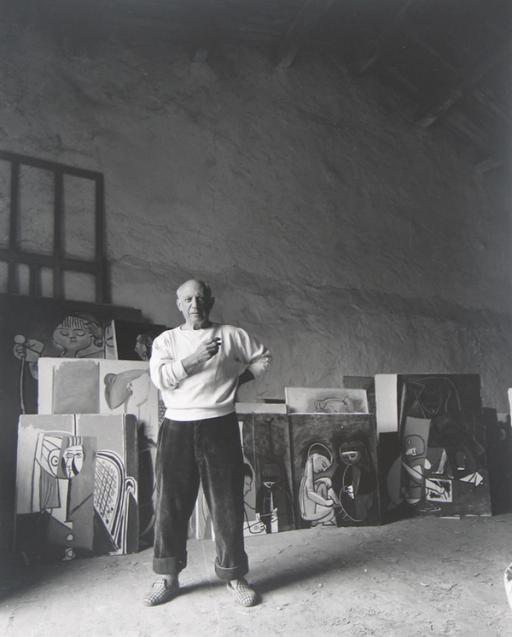
Pablo Picasso
Spanish, 1881–1973 1251 works onlineWith these words, Picasso shed light on two central principles of his artistic production over nearly 80 years: his openness to a diverse range of styles, subject matters, and mediums, and his resistance to the notion that change in art necessarily corresponds to improvement or progress.
Learn more →


From MoMA Design Store


Installation views
We have identified this work in the following photos from our exhibition history.
Licensing
Artwork or archival images
If you would like to reproduce an image of a work of art in MoMA's collection, or an image of a MoMA publication or archival material (including installation views, checklists, and press releases), please contact Art Resource (publication in North America) or Scala Archives (publication in all other geographic locations).
Audio and film clips
MoMA licenses archival audio and select out of copyright film clips from our film collection. At this time, MoMA produced video cannot be licensed by MoMA/Scala. All requests to license archival audio or out of copyright film clips should be addressed to Scala Archives at [email protected]. Motion picture film stills cannot be licensed by MoMA/Scala. For access to motion picture film stills for research purposes, please contact the Film Study Center at [email protected]. For more information about film loans and our Circulating Film and Video Library, please visit Circulating Film and Video Library.
Text from a publication or the archives
If you would like to reproduce text from a MoMA publication, please email [email protected]. If you would like to publish text from MoMA's archival materials, please fill out this permission form and send to [email protected].
Feedback
This record is a work in progress. If you have additional information or spotted an error, please fill out this feedback form.