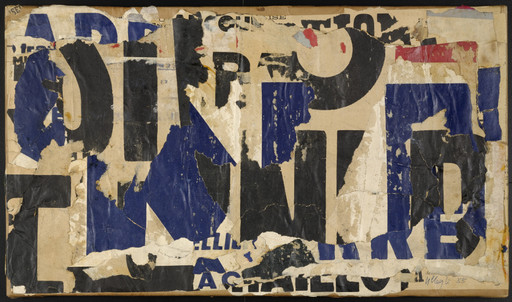
The title of this work derives from the street in Paris from which these torn posters were taken. The layers of fragmentary color, words, and images of faces were pasted onto linen in a technique called décollage (literally, un-collage). In this technique, posters or other promotional materials are torn up to create new compositions, with one image often superimposed over another. Villeglé stated that 122 rue du Temple, a combination of movie posters and political advertisements for a legislative election instigated by the events of May 1968 in Paris, is a reflection of reality. Thus, not only is he interested in the visual impact and pictorial construction of his works, but he also confers upon them a sociological status.
Villeglé has devoted his entire career to décollage. He was affiliated with Nouveau Réalisme, a French art movement of the late 1950s and early 1960s devoted to transforming everyday objects and detritus into art in the belief that painting was incapable of conveying the actuality of postwar society. Villeglé sees the street as a repository of ready-made art. He invented the persona of the anonymous passerby, or common man, whose random tears are "discovered" by the artist and thereby poeticized. Through this incorporation of chance and choice, Villeglé assumes the role of a conservator of works of art unconsciously created by others.
The Museum of Modern Art, MoMA Highlights, New York: The Museum of Modern Art, revised 2004, originally published 1999.
Gallery label from 2011.
The title of this work is the Paris address from which the artist removed these torn movie posters and political notices (related to the city’s May 1968 student and worker demonstrations). He pasted the layers of fragmentary color, words, and images onto canvas. This work is exemplary of Nouveau Réalisme, a European movement of the 1950s and 1960s devoted to transforming everyday objects into art.
2011.
Gallery label from 2020.
122 rue du Temple is the Paris address from which Villeglé detached many of the movie posters and political notices he used to make this work. After tearing fragments of the original images, he pasted these passages of color, text, and image into a chance composition. Many of the fliers used here announced the city’s May 1968 student and worker demonstrations, and the artist considered the people who had posted them to be his collaborators, understanding their use of advertising billboards as a precursor for his process.
2020.
Gallery label from "Collection 1940s—1970s", 2019
112 rue de temple is the Paris address from which Villeglé detached many of the movie posters and political notices he used to make this work. After tearing fragments of the original images, he pasted these passages of color, text, and image into a chance composition. Many of the fliers used here announced the city’s May 1968 student and worker demonstrations, and the artist considered the people who had posted them to be his collaborators, understanding their use of advertising billboards as a precursor for his process.
"Collection 1940s—1970s", 2019
Explore more

From MoMA Design Store


Installation views
We have identified this work in the following photos from our exhibition history.
Licensing
Artwork or archival images
If you would like to reproduce an image of a work of art in MoMA's collection, or an image of a MoMA publication or archival material (including installation views, checklists, and press releases), please contact Art Resource (publication in North America) or Scala Archives (publication in all other geographic locations).
Audio and film clips
MoMA licenses archival audio and select out of copyright film clips from our film collection. At this time, MoMA produced video cannot be licensed by MoMA/Scala. All requests to license archival audio or out of copyright film clips should be addressed to Scala Archives at [email protected]. Motion picture film stills cannot be licensed by MoMA/Scala. For access to motion picture film stills for research purposes, please contact the Film Study Center at [email protected]. For more information about film loans and our Circulating Film and Video Library, please visit Circulating Film and Video Library.
Text from a publication or the archives
If you would like to reproduce text from a MoMA publication, please email [email protected]. If you would like to publish text from MoMA's archival materials, please fill out this permission form and send to [email protected].
Feedback
This record is a work in progress. If you have additional information or spotted an error, please fill out this feedback form.