Basquiat was a self–taught artist whose experience in New York City in the 1970s and 1980s helped define the rawness and aggression of his work. This untitled drawing, composed of expressive lines, vivid colors, accidental marks, figures, and symbols, exemplifies his visual aesthetic. In it three schematic, blank–faced male figures, their body parts and expressions depicted with simple, gestural lines, carry weapons at their sides and exude a mystical aura that is reinforced by the halos hovering around their heads. Crownlike imagery is a trademark of Basquiat's oeuvre; for him it symbolized what he saw as the spiritual superiority of African American men in modern society.
The landscape surrounding the figures is composed of prehistoric symbols and Egyptian hieroglyphs depicting natural elements such as the sun, the moon, stars, and water. The two central animals—one vicious and feral, the other decomposed and almost skeletal—represent death and mortality. Through masterful manipulation of line, color, and symbol, Basquiat explores life, death, the spiritual, the supernatural, and the physical in a concrete, visual space.
The Museum of Modern Art, MoMA Highlights since 1980, New York: The Museum of Modern Art, 2007, p. 22.
Explore more
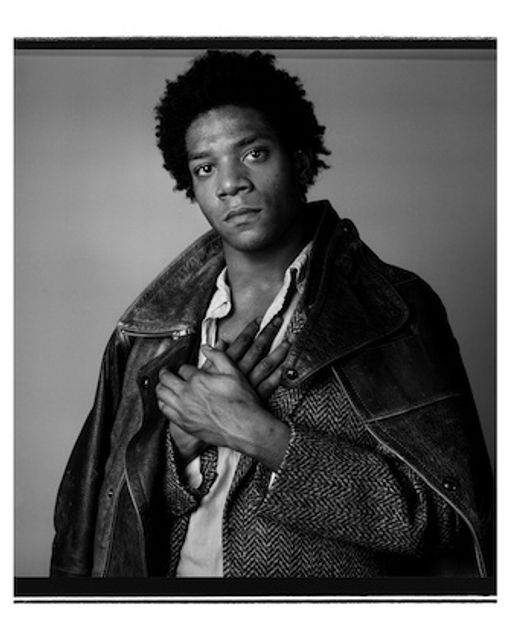
Jean-Michel Basquiat
American, 1960–1988 12 works onlineWhen asked to describe his art, Jean-Michel Basquiat responded with customary aplomb: “royalty, heroism, and the streets.” A high school dropout, Basquiat found his true calling hanging out in the streets and inserting himself in the bustling urban milieu, ultimately becoming an influential figure in New York City’s Downtown, especially the East Village club scene.
Learn more →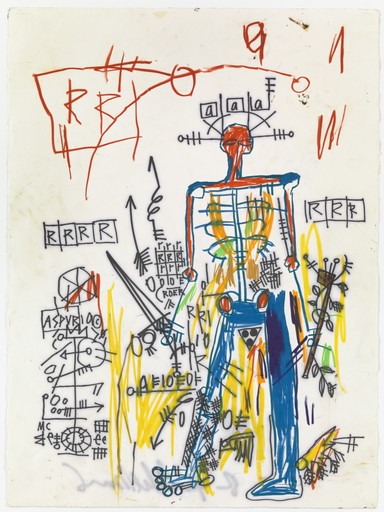
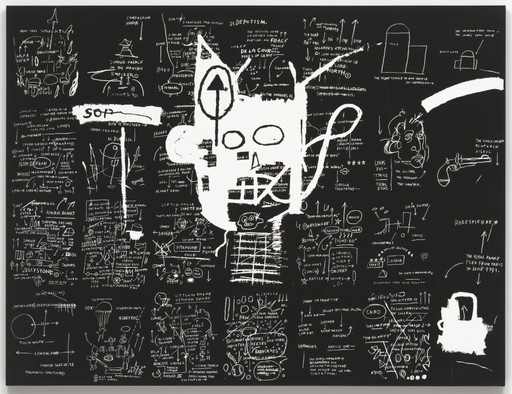
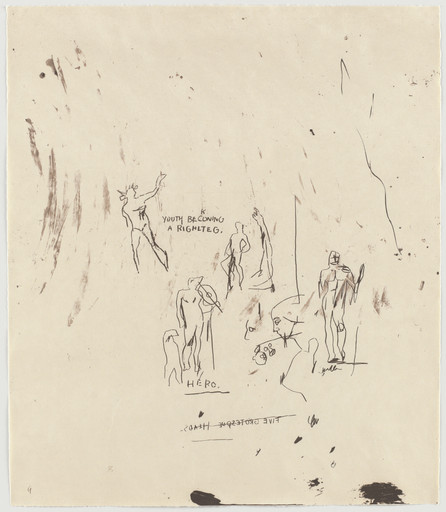


From MoMA Design Store


Installation views
We have identified this work in the following photos from our exhibition history.
Licensing
Artwork or archival images
If you would like to reproduce an image of a work of art in MoMA's collection, or an image of a MoMA publication or archival material (including installation views, checklists, and press releases), please contact Art Resource (publication in North America) or Scala Archives (publication in all other geographic locations).
Audio and film clips
MoMA licenses archival audio and select out of copyright film clips from our film collection. At this time, MoMA produced video cannot be licensed by MoMA/Scala. All requests to license archival audio or out of copyright film clips should be addressed to Scala Archives at [email protected]. Motion picture film stills cannot be licensed by MoMA/Scala. For access to motion picture film stills for research purposes, please contact the Film Study Center at [email protected]. For more information about film loans and our Circulating Film and Video Library, please visit Circulating Film and Video Library.
Text from a publication or the archives
If you would like to reproduce text from a MoMA publication, please email [email protected]. If you would like to publish text from MoMA's archival materials, please fill out this permission form and send to [email protected].
Feedback
This record is a work in progress. If you have additional information or spotted an error, please fill out this feedback form.