Pencil and color pencil on tracing paper
Not on view
The design of these apartment towers for St. Mark's-in-the-Bouwerie in New York City stemmed from Wright's vision for Usonia, a new American culture based on the synthesis of architecture and landscape. The organic "tap-root" structural system resembles a tree, with a central concrete and steel load-bearing core rooted in the earth, from which floor plates are cantilevered like branches. This system frees the building of load-bearing interior partitions and supports a modulated glass curtain wall for increased natural illumination. Floor plates are rotated axially to generate variation from one level to the next and to distinguish between living and sleeping spaces in the duplex apartments. The three towers on the triangular park site are positioned apart from other tall buildings to avoid creating the dark urban canyons that Wright detested. Although the St. Mark's project was never realized, its concepts were materialized thirty years later in Wright's H. C. Price Company Tower in Bartlesville, Oklahoma.
75 Years of Architecture at MoMA, 2007.
Explore more
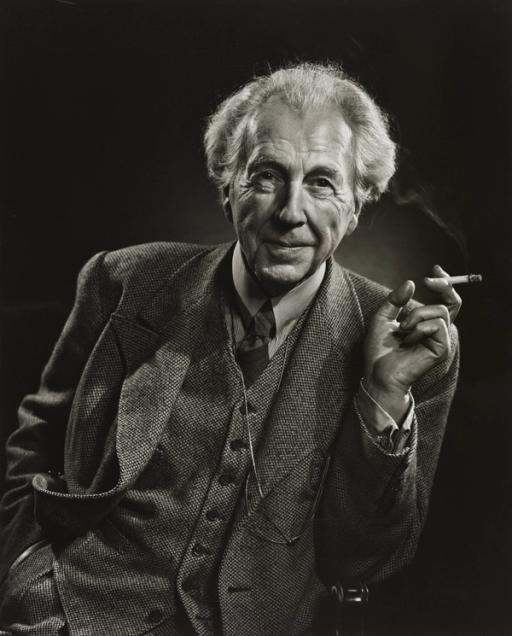
Frank Lloyd Wright
American, 1867–1959 124 works onlineA pragmatist, technical innovator, and independent thinker, Frank Lloyd Wright designed cities and buildings and their interior furnishings across a prolific 72-year career, reflecting his vision of an ideal American society.
Learn more →

From MoMA Design Store


Installation views
We have identified this work in the following photos from our exhibition history.
Licensing
Artwork or archival images
If you would like to reproduce an image of a work of art in MoMA's collection, or an image of a MoMA publication or archival material (including installation views, checklists, and press releases), please contact Art Resource (publication in North America) or Scala Archives (publication in all other geographic locations).
Audio and film clips
MoMA licenses archival audio and select out of copyright film clips from our film collection. At this time, MoMA produced video cannot be licensed by MoMA/Scala. All requests to license archival audio or out of copyright film clips should be addressed to Scala Archives at [email protected]. Motion picture film stills cannot be licensed by MoMA/Scala. For access to motion picture film stills for research purposes, please contact the Film Study Center at [email protected]. For more information about film loans and our Circulating Film and Video Library, please visit Circulating Film and Video Library.
Text from a publication or the archives
If you would like to reproduce text from a MoMA publication, please email [email protected]. If you would like to publish text from MoMA's archival materials, please fill out this permission form and send to [email protected].
Feedback
This record is a work in progress. If you have additional information or spotted an error, please fill out this feedback form.