Morphosis, Santa Monica, CA, Thom Mayne, Andrew Zago
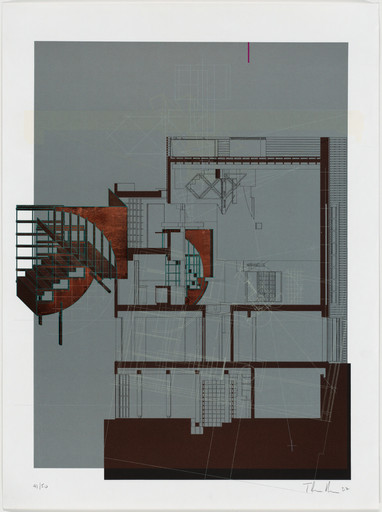
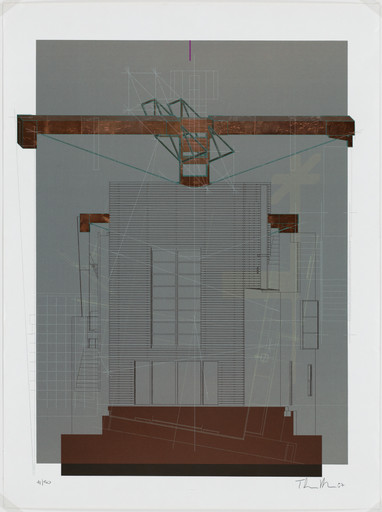
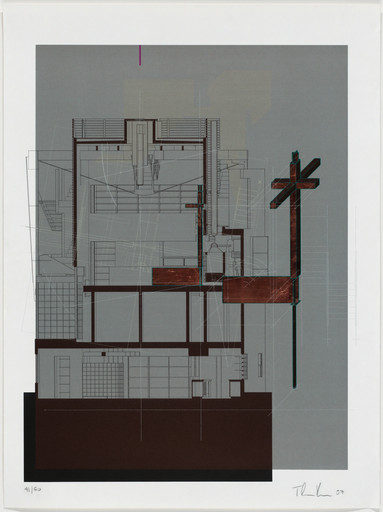
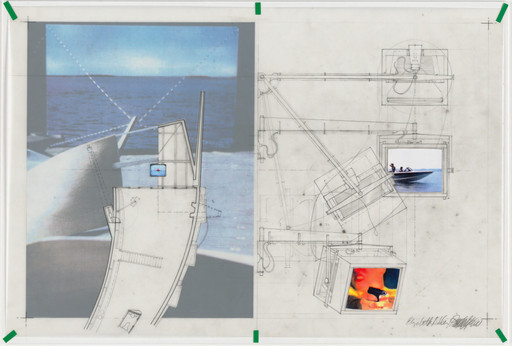
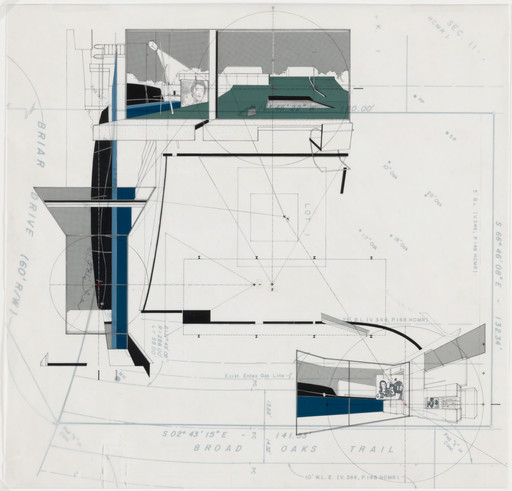
Sixth Street House project, Santa Monica, CA (Isometrics and plan)
1990
Screenprint with metal foil on paper
Not on view
Mayne’s drawings for Sixth Street House invoke architectural conventions only to surpass their limitations. By collapsing plan, elevation, and detail through juxtapositions of scale, oblique angles, projection, and rotation, Mayne challenges the historical view of drawing as a passive medium at the service of architecture. The design involves the insertion of eleven found machinery parts into the shell of a preexisting bungalow. Reworked as functional elements—staircase, fireplace, shower—these innovative elements embody an imagined prehistory or archeology of the site. The complex operations characteristic of this and other early works by Mayne resonate with deconstruction’s philosophical goals, destabilizing normative procedures and producing new interpretations of cultural objects. As Mayne has said, his decontextualization of these different parts affirms “the presence of an artistic intervention” just as it “distorts scale, subverts typological expectations, and asserts functional neologisms.” Ultimately, they create an awareness of architecture’s potential to shift our perception of reality—opening up the possibility for transformation.
9 + 1 Ways of Being Political: 50 Years of Political Stances in Architecture and Urban Design, September 12, 2012–March 25, 2013.
Publication excerpt from an essay by Tina di Carlo, in Matilda McQuaid, ed., Envisioning Architecture: Drawings from The Museum of Modern Art , New York: The Museum of Modern Art, 2002, p. 238.
Thom Mayne's drawing for the Sixth Street House invokes architectural conventions only to surpass their limitations. By collapsing plan, elevation, and detail through juxtapositions of scale, obliquity, projection, and rotation, Mayne challenges the historical view of drawing as a passive medium at the service of architecture.
Mayne's design involves inserting eleven found machinery parts into a shell wrapping a preexisting bungalow (his own). Reworked into functional elements—staircase, fireplace, shower—these parts, Mayne claims, would bring invention to the site and have "the capacity to embody in built form an imagined prehistory of a place, a contemporary archaeology (past and future) and its subsequent transmission across time." This drawing, which layers a 1:24 detail and a 1:16 elevation or section over a 1:16 plan, functions similarly. The steel parts—represented by cutouts of metallic foil—appear as if unearthed, pulled out one by one, rotated, examined, and set aside, leaving behind the gray traces of their impression. Reassembled like cogs in a wheel, they become constructions of reinvented form.
Mayne is a founding member of both the Santa Monica architectural firm Morphosis and the Southern California Institute of Architecture. His work recalls the machine aesthetic of the early-twentieth-century avant-garde and the archaeological and genealogical methods of Michel Foucault. Originally conceived as the terminus of his investigation—that is, as architecture—Mayne's drawings mimic the parts (found objects) that he reappropriates—each of them, as Mayne says, something "simultaneously 'a part of' its context . . . while isolated, detached, disquieting, critical, and untrustful of the world 'as it exists.'"
an essay by Tina di Carlo, in Matilda McQuaid, ed., Envisioning Architecture: Drawings from The Museum of Modern Art, New York: The Museum of Modern Art, 2002, p. 238.
Explore more
Architectural drawing
Also called a rendering, an architectural drawing is used to illustrate a building or portion of a building. These renderings can be done by hand or using computer software , and can represent different visual perspectives by showing buildings or a portion of a building straight on (e.
Learn more →


From MoMA Design Store


Installation views
We have identified this work in the following photos from our exhibition history.
Licensing
Artwork or archival images
If you would like to reproduce an image of a work of art in MoMA's collection, or an image of a MoMA publication or archival material (including installation views, checklists, and press releases), please contact Art Resource (publication in North America) or Scala Archives (publication in all other geographic locations).
Audio and film clips
MoMA licenses archival audio and select out of copyright film clips from our film collection. At this time, MoMA produced video cannot be licensed by MoMA/Scala. All requests to license archival audio or out of copyright film clips should be addressed to Scala Archives at [email protected]. Motion picture film stills cannot be licensed by MoMA/Scala. For access to motion picture film stills for research purposes, please contact the Film Study Center at [email protected]. For more information about film loans and our Circulating Film and Video Library, please visit Circulating Film and Video Library.
Text from a publication or the archives
If you would like to reproduce text from a MoMA publication, please email [email protected]. If you would like to publish text from MoMA's archival materials, please fill out this permission form and send to [email protected].
Feedback
This record is a work in progress. If you have additional information or spotted an error, please fill out this feedback form.