Le Corbusier (Charles-Édouard Jeanneret), Pierre Jeanneret
Swiss Pavilion, Cité internationale universitaire de Paris, France, Perspective of north and west elevations
1932
Not on view
This serene lateral perspective of Le Corbusier's and Pierre Jeanneret's Swiss Pavilion conceals the difficulty of the conditions in which the building was realized. The Cité internationale universitaire de Paris had been founded in 1921 to accommodate foreign students in the city. Architecturally it had grown rapidly into a collection of often sappy, overstyled buildings, each associated with one of the nations represented at the university. Le Corbusier and his cousin and associate Pierre Jeanneret at first refused the commission for the Swiss Pavilion, which was offered to them in 1930 by the Comité des Universités suisses. The president of the Cité universitaire himself felt that the allotted budget was inadequate; in addition, the building was to sit on soft, unsteady soil that would make the foundations hard to calculate and build. Yet Le Corbusier and Jeanneret finally accepted the commission.
Charles-Édouard Jeanneret—Le Corbusier—was among the most innovative and revolutionary architects of the twentieth century. Even before adopting his famous pseudonym, in 1920, he had set out to revise the creative relationships between engineering and architecture and between architecture and art. His and Pierre Jeanneret's manifesto essay 5 Points d'une architecture nouvelle (1926), only one among his many opinionated contributions to the field, laid out five features he considered basic to the new architecture, and all of these features but one, the roof garden, appear in the scheme for the Swiss Pavilion: the pilotis elevating the building off the ground; the free plan, in which the weight of the building is born by columns separated from the building's outer walls, allowing a flexible interior space; the free facade, a consequence of the free plan; and the long horizontal windows.
Not only is the finished Swiss Pavilion beautiful in its efficiency, it also anticipated a new way of building entire city neighborhoods. This presentation drawing shows a building that could indeed be a proud element of Le Corbusier's Ville Radieuse, the model of the ideal city that the architect was developing and that he would first publicize in 1933. Le Corbusier's signature pilotis, transformed here into sturdier pylons, provide an intuitive and fluid solution to pedestrian circulation. The orientation of the building to absorb as much healthy sunlight as possible, and the disposition of the public and private spaces, testify to Le Corbusier's idealistic belief in the power of architecture to organize and uplift individuals and whole communities.
an essay by Paola Antonelli, in Matilda McQuaid, ed., Envisioning Architecture: Drawings from The Museum of Modern Art, New York: The Museum of Modern Art, 2002, p. 74.
Explore more
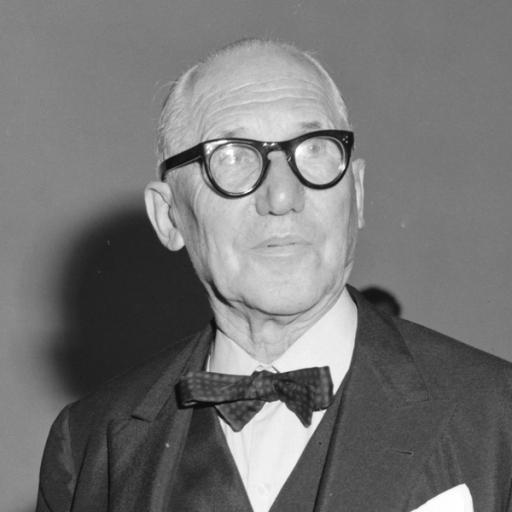
Le Corbusier (Charles-Édouard Jeanneret)
French, born Switzerland. 1887–1965 210 works onlineIn 1923, in his book Vers une architecture ( Towards a New Architecture ), architect and designer Le Corbusier declared houses to be “machines for living in.
Learn more →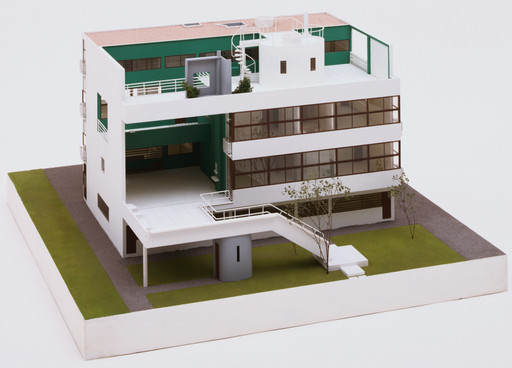
Elevation drawing
An elevation or elevation drawing is a two-dimensional representation of one side of a building or space. It can depict one of the building’s facades or an interior surface from a straight-on viewpoint.
Learn more →


From MoMA Design Store


Installation views
We have identified this work in the following photos from our exhibition history.
Licensing
Artwork or archival images
If you would like to reproduce an image of a work of art in MoMA's collection, or an image of a MoMA publication or archival material (including installation views, checklists, and press releases), please contact Art Resource (publication in North America) or Scala Archives (publication in all other geographic locations).
Audio and film clips
MoMA licenses archival audio and select out of copyright film clips from our film collection. At this time, MoMA produced video cannot be licensed by MoMA/Scala. All requests to license archival audio or out of copyright film clips should be addressed to Scala Archives at [email protected]. Motion picture film stills cannot be licensed by MoMA/Scala. For access to motion picture film stills for research purposes, please contact the Film Study Center at [email protected]. For more information about film loans and our Circulating Film and Video Library, please visit Circulating Film and Video Library.
Text from a publication or the archives
If you would like to reproduce text from a MoMA publication, please email [email protected]. If you would like to publish text from MoMA's archival materials, please fill out this permission form and send to [email protected].
Feedback
This record is a work in progress. If you have additional information or spotted an error, please fill out this feedback form.