This mosaic of more than 100 panels imagines the daily life of a resident of Buenos Aires. In 1952, the Argentine architect Clorindo Testa participated in a government study that sought to implement modernist urban planning techniques in a working-class area known as the Avellaneda District.
Inspired by a functionalist code for city building called the Athens Charter (1933), put forth by the influential Congrès Internationaux d’Architecture Moderne (CIAM), the new plan proposed separating the district into four basic functions: living, circulation (transportation), work, and recreation. Twenty-two years later, Testa returned to the project, reimagining the life of a boy he had met and drawn playing on the city streets.
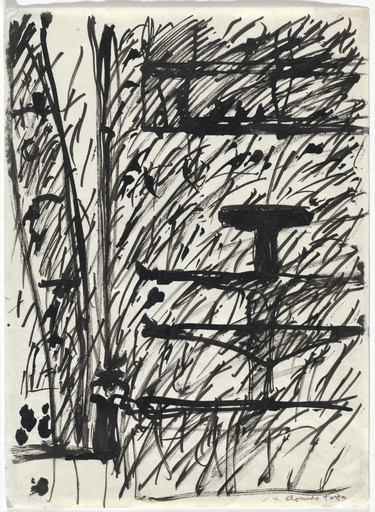
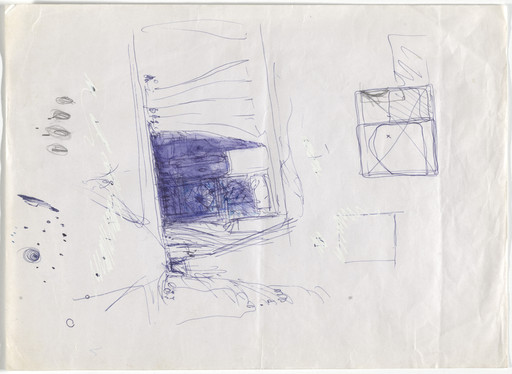
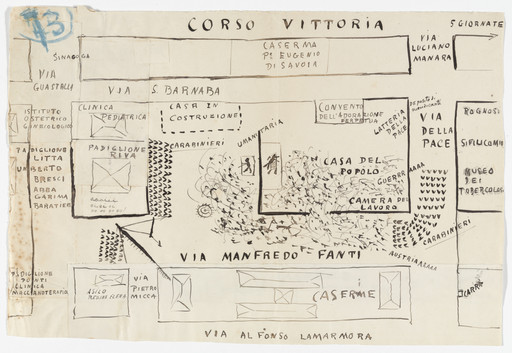
The first three panels, made during the study, document the existing urban conditions. The following panels, made in 1974, show the boy, now grown-up, inhabiting an overcrowded Buenos Aires that has suffered successive modernizing efforts. Broad, gestural strokes, referencing street art or graffiti, combine plan and elevation views in nearly life-size images that follow the sequence of his day: at rest, rising to bathe and eat, commuting aboard a crowded bus, returning home in the evening to his living room and television. These spaces are compact and oppressive, illustrating how the problems that the Athens Charter sought to eradicate, and potentially aggravated, remained in place in the contemporary city. The commanding scale of the mural coupled with its intimate portrait of ordinary life powerfully critique modernism’s functional city, while the juxtaposition of presentation styles highlights Testa’s background as both an architect and a painter.
Inbox: Clorindo Testa, 2016.
Publication excerpt from MoMA Highlights: 375 Works from The Museum of Modern Art, New York (New York: The Museum of Modern Art, 2019)
A 1952 architectural competition launched by the Argentine government sought to implement modernist urban planning techniques in a working-class area of Buenos Aires known as Avellaneda. Testa and his collaborators’ proposal, which divided the city into spaces for four basic functions—living (habitar), transportation (circular), work (trabajar), and recreation (recrearse)—was inspired by the Athens Charter, a proposal for city planning put forth in 1933 by the influential International Congresses of Modern Architecture (Congrès Internationaux d’Architecture Moderne, or CIAM).
Testa returned to this proposal twenty-two years later, producing this large-scale drawing installation of more than one hundred panels that imagines the daily life of a resident of Avellaneda. The first three panels, made in 1952, document existing urban conditions as seen through the eyes of a young boy. The following panels, made in 1974, show him, now grown up, inhabiting an overcrowded city that has suffered successive modernization efforts. Broad, gestural strokes combine plan, section, and elevation views in nearly life-size images that follow the sequence of his day: at rest, rising to bathe and eat, commuting aboard a crowded bus, and returning home in the evening to watch television.
The juxtaposition of scales and presentation styles highlights Testa’s background as both an architect and a painter. The work’s commanding scale coupled with its intimate portrayal of ordinary life in a compact and oppressive urban environment present a powerful critique of the functional city and the modernist architecture advocated by the Athens Charter.
MoMA Highlights: 375 Works from The Museum of Modern Art, New York (New York: The Museum of Modern Art, 2019)
Explore more
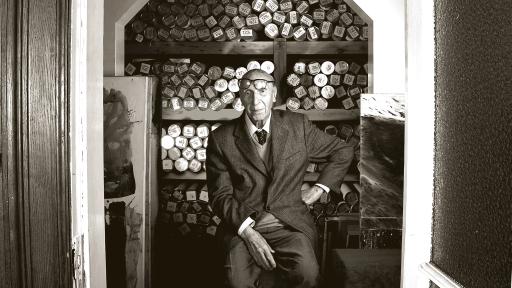
Clorindo Testa
Argentine, born Italy. 1923–2013 6 works onlineClorindo Testa is among the most renowned figures of modern architecture in Latin America. A pioneer of mid-20th-century Brutalist architecture, he instilled his work with a dramatic, expressive quality that challenged the moralizing attitudes of functionalism.
Learn more →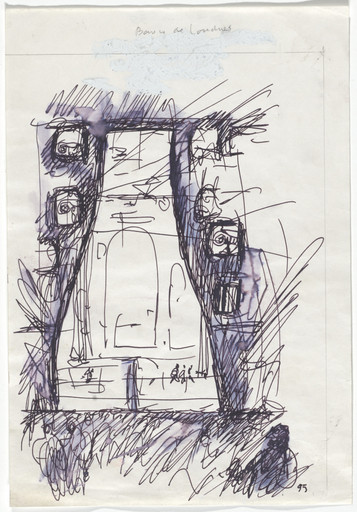

From MoMA Design Store


Licensing
Artwork or archival images
If you would like to reproduce an image of a work of art in MoMA's collection, or an image of a MoMA publication or archival material (including installation views, checklists, and press releases), please contact Art Resource (publication in North America) or Scala Archives (publication in all other geographic locations).
Audio and film clips
MoMA licenses archival audio and select out of copyright film clips from our film collection. At this time, MoMA produced video cannot be licensed by MoMA/Scala. All requests to license archival audio or out of copyright film clips should be addressed to Scala Archives at [email protected]. Motion picture film stills cannot be licensed by MoMA/Scala. For access to motion picture film stills for research purposes, please contact the Film Study Center at [email protected]. For more information about film loans and our Circulating Film and Video Library, please visit Circulating Film and Video Library.
Text from a publication or the archives
If you would like to reproduce text from a MoMA publication, please email [email protected]. If you would like to publish text from MoMA's archival materials, please fill out this permission form and send to [email protected].
Feedback
This record is a work in progress. If you have additional information or spotted an error, please fill out this feedback form.