Tullio d'Albisola (Tullio Spartaco Mazzotti)
Parole in libertà futuriste, tattili-termiche olfattive (Words in Futurist, Olfactory, Tactile, Thermal Freedom)
1932
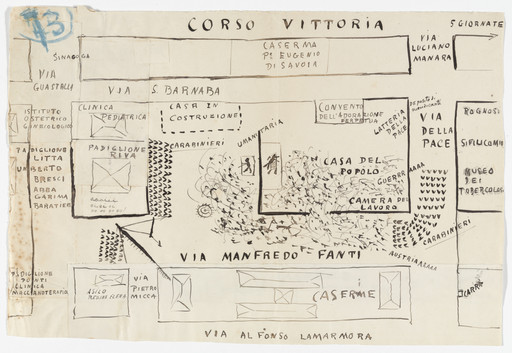
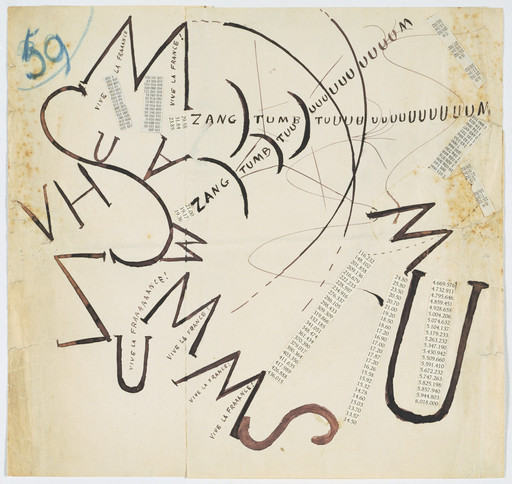
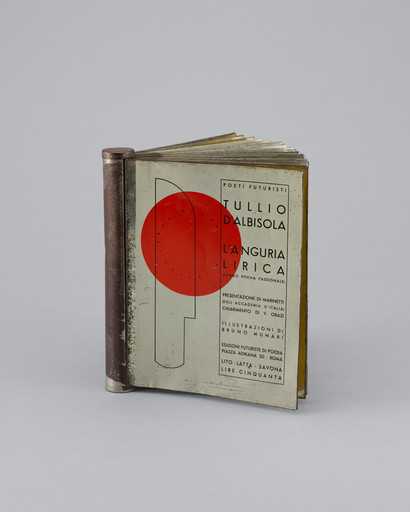
Book with lithographed illustrations, text, and typographic designs on 15 tin-plated iron leaves, bound with a cylindrical metal spine
This illustrated book is a remarkable collaboration of poet, artist, and artisans. Filippo Marinetti, the poet and theorist who was the driving force behind Futurism from the time of the movement’s emergence in 1909, contributed a selection of his earlier writings, including examples of the radically innovative visual poetry he called “words in freedom” ( parole in libertà). D’Albisola, a second-generation Futurist sculptor and ceramist, designed the page layouts, responding to Marinetti’s texts by highlighting selected phrases in dynamic compositions that combine crisp geometric shapes with sleek modern typefaces in playfully exaggerated sizes. Most extraordinary, however, is that the book is made entirely of tin, with the texts and designs printed on the metal pages via lithography and a cylindrical mechanism with ball bearings used for the binding. To achieve this unprecedented feat, Marinetti and d’Albisola turned to the technicians at Lito-Latta (Litho-Tin), a factory in Savona, Italy, that produced sheet-metal products.
With its industrial construction, the book exemplifies the Futurists’ exaltation of the machine as a symbol of the speed and dynamism of the modern age. As the title indicates, it also embodies their interest in the multisensory experience, including the olfactory (the scent of printing inks) and tactile (the texture of the metal, which brings an awareness of its thermal properties) in addition to the visual and verbal.
MoMA Highlights: 375 Works from The Museum of Modern Art, New York (New York: The Museum of Modern Art, 2019)
Explore more
Living in the Age of the Machine
Gallery 505Artists across Europe, Russia, and the United States responded in various ways to this period’s increasing mechanization, industrialization, and public awareness of the machine’s destructive potential.
Learn more →
From MoMA Design Store


Licensing
Artwork or archival images
If you would like to reproduce an image of a work of art in MoMA's collection, or an image of a MoMA publication or archival material (including installation views, checklists, and press releases), please contact Art Resource (publication in North America) or Scala Archives (publication in all other geographic locations).
Audio and film clips
MoMA licenses archival audio and select out of copyright film clips from our film collection. At this time, MoMA produced video cannot be licensed by MoMA/Scala. All requests to license archival audio or out of copyright film clips should be addressed to Scala Archives at [email protected]. Motion picture film stills cannot be licensed by MoMA/Scala. For access to motion picture film stills for research purposes, please contact the Film Study Center at [email protected]. For more information about film loans and our Circulating Film and Video Library, please visit Circulating Film and Video Library.
Text from a publication or the archives
If you would like to reproduce text from a MoMA publication, please email [email protected]. If you would like to publish text from MoMA's archival materials, please fill out this permission form and send to [email protected].
Feedback
This record is a work in progress. If you have additional information or spotted an error, please fill out this feedback form.