Not on view
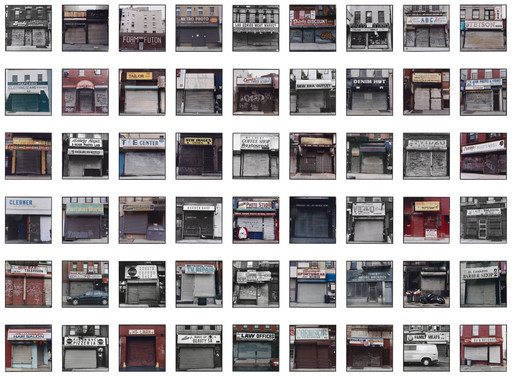
This set of four photographs depicting outdoor carts selling Kodak products is part of Analogue, a decade-long landmark project by Leonard comprising 412 pictures. Displayed in serial grids and organized into twenty-five chapters, Analogue documents the eclipsed texture of twentieth-century urban life as seen in New York’s vanishing mom-and-pop stores and the emerging global recycling trade. Leonard began the project near her home in Manhattan’s Lower East Side. She then followed certain products—used clothing, discarded advertisements, and outdated photographic supplies—as they circulated to far-flung markets in Africa, eastern Europe, Cuba, Mexico, and the Middle East.
The obsolescence of these products is echoed by the obsolete technology the artist used to reproduce them: a 1940s Rolleiflex camera, film, and gelatin silver and chromogenic printing processes—choices made visible in the final prints by the exposed edges of the negatives. The title Analogue refers to this analog photographic apparatus and to the fact that her pictures are analogues of reality. Leonard’s project is both an urgent document and a poetic allegory of globalization. Drawing on the documentary tradition of street photography and the display methods of Conceptual art, it contributes to the genealogy of grand urban visual archives that can be traced back to the compendium of Paris and its surroundings made by the French photographer Eugène Atget more than a century ago.
MoMA Highlights: 375 Works from The Museum of Modern Art, New York (New York: The Museum of Modern Art, 2019)
Additional text from Seeing Through Photographs online course, Coursera, 2016
Zoe Leonard inflected this sweeping documentary project with poetry and personal meaning. Titled to evoke a bygone era, Analogue consists of 412 individual photographs arranged in grids and organized into a loose narrative that unfolds in 25 chapters. Though the individual photographs stand on their own, Leonard used ordering and repetition to extend and enrich their meaning. Together, they reveal the changing character of her neighborhood on Manhattan’s Lower East Side while witnessing the emergence of the global rag trade and the boom in the recycled merchandise business.
Seeing Through Photographs online course, Coursera, 2016
Explore more
From MoMA Design Store


Licensing
Artwork or archival images
If you would like to reproduce an image of a work of art in MoMA's collection, or an image of a MoMA publication or archival material (including installation views, checklists, and press releases), please contact Art Resource (publication in North America) or Scala Archives (publication in all other geographic locations).
Audio and film clips
MoMA licenses archival audio and select out of copyright film clips from our film collection. At this time, MoMA produced video cannot be licensed by MoMA/Scala. All requests to license archival audio or out of copyright film clips should be addressed to Scala Archives at [email protected]. Motion picture film stills cannot be licensed by MoMA/Scala. For access to motion picture film stills for research purposes, please contact the Film Study Center at [email protected]. For more information about film loans and our Circulating Film and Video Library, please visit Circulating Film and Video Library.
Text from a publication or the archives
If you would like to reproduce text from a MoMA publication, please email [email protected]. If you would like to publish text from MoMA's archival materials, please fill out this permission form and send to [email protected].
Feedback
This record is a work in progress. If you have additional information or spotted an error, please fill out this feedback form.