4'33" (In Proportional Notation) is one of three versions of the score for Cage’s “silent piece,” a musical composition first performed by the pianist David Tudor in Woodstock, New York, in 1952. While the lost original score used conventional musical notation to signify three periods of silence, this version is composed of a series of vertical lines that visually represent the duration of four minutes and thirty-three seconds of silence.
During the piece’s premiere, Tudor sat quietly at his piano, opening and closing the keyboard lid to mark the progression of the three movements. The audience waited in anticipation of the performance, but their expectations of a conventional concert were shattered. Cage recounted, “You could hear the wind stirring outside during the first movement. During the second, raindrops began pattering the roof, and during the third people themselves made all kinds of interesting sounds as they talked or walked out.” Cage saw silence as a way to attune audiences to the soundtrack of everyday life, to bring them to consider all the sounds around them as music, thus undoing the idea of a hierarchy of sound, opening up the infinite possibilities of ambient sound, and rethinking the very notion of what music is. As a piece of music that cannot be controlled by the composer and which is necessarily different every time it is performed, 4'33" also exemplifies Cage’s interest in using chance as a compositional strategy.
MoMA Highlights: 375 Works from The Museum of Modern Art, New York (New York: The Museum of Modern Art, 2019)
Gallery label from There Will Never Be Silence: Scoring John Cage’s 4’33” , October 12, 2013–June 22, 2014.
4’33” (In Proportional Notation) is the earliest surviving score for Cage’s “silent piece,” first performed by the pianist David Tudor in Woodstock, New York, on August 29, 1952. Whereas the lost original score used conventional musical notation to signify three periods of silence, this score is composed of a series of vertical lines. The duration of the three movements corresponds to the distance between the lines, equating spatial and temporal measurements.
During the premiere, Tudor sat quietly at his piano, opening and closing the keyboard lid to mark the progression of the three movements. The audience waited in anticipation of the performance: their expectations of a conventional concert were shattered, but music was made. Cage recounted, “You could hear the wind stirring outside during the first movement. During the second, raindrops began pattering the roof, and during the third people themselves made all kinds of interesting sounds as they talked or walked out.” Cage saw silence as a way to plug the audience into the sound track of everyday life, to open them up to the infinite possibilities of ambient sound.
Cage dedicated 4’33” (In Proportional Notation), the second iteration of his “silent” piece, to his friend Irwin Kremen and gave it to him on his twenty–eighth birthday, in 1953.
There Will Never Be Silence: Scoring John Cage’s 4’33”, October 12, 2013–June 22, 2014.
Explore more
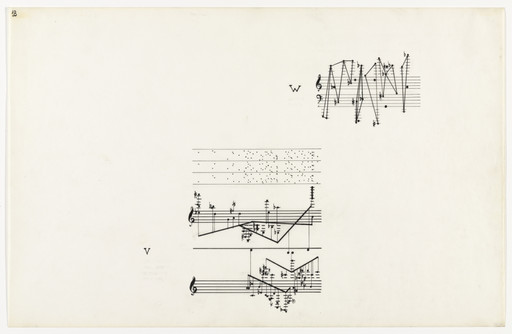
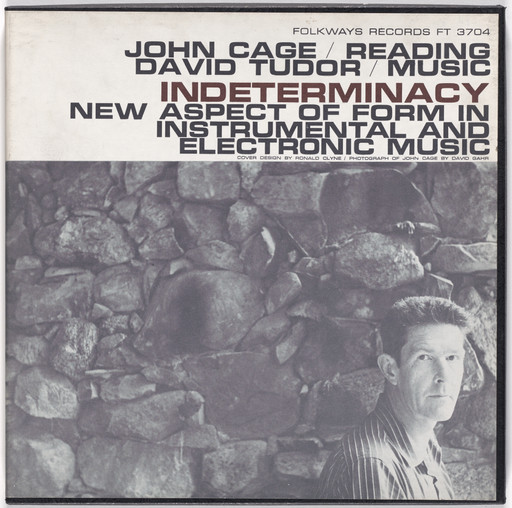
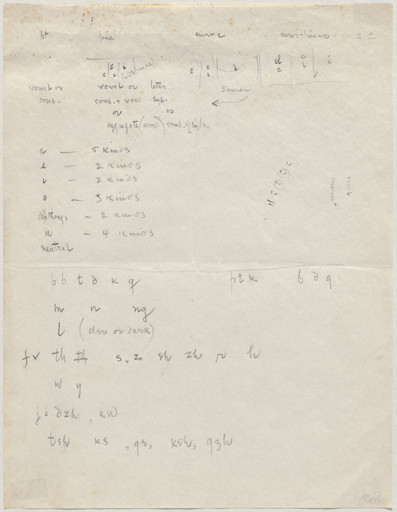
Black Mountain College
A small liberal arts college founded in 1933 by John Rice on a farm in Asheville, North Carolina, and continued under changing leadership until 1957.
Learn more →



From MoMA Design Store


Installation views
We have identified this work in the following photos from our exhibition history.
Licensing
Artwork or archival images
If you would like to reproduce an image of a work of art in MoMA's collection, or an image of a MoMA publication or archival material (including installation views, checklists, and press releases), please contact Art Resource (publication in North America) or Scala Archives (publication in all other geographic locations).
Audio and film clips
MoMA licenses archival audio and select out of copyright film clips from our film collection. At this time, MoMA produced video cannot be licensed by MoMA/Scala. All requests to license archival audio or out of copyright film clips should be addressed to Scala Archives at [email protected]. Motion picture film stills cannot be licensed by MoMA/Scala. For access to motion picture film stills for research purposes, please contact the Film Study Center at [email protected]. For more information about film loans and our Circulating Film and Video Library, please visit Circulating Film and Video Library.
Text from a publication or the archives
If you would like to reproduce text from a MoMA publication, please email [email protected]. If you would like to publish text from MoMA's archival materials, please fill out this permission form and send to [email protected].
Feedback
This record is a work in progress. If you have additional information or spotted an error, please fill out this feedback form.