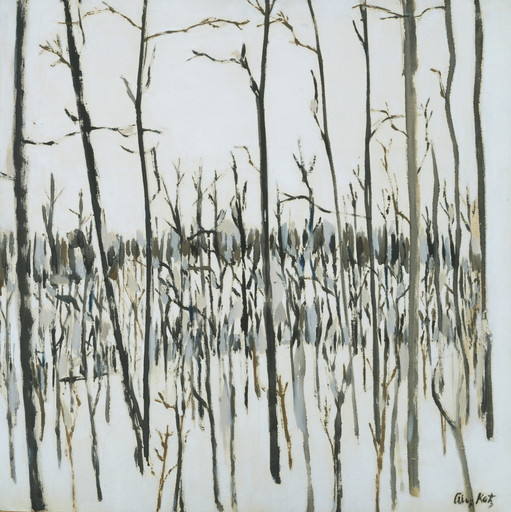
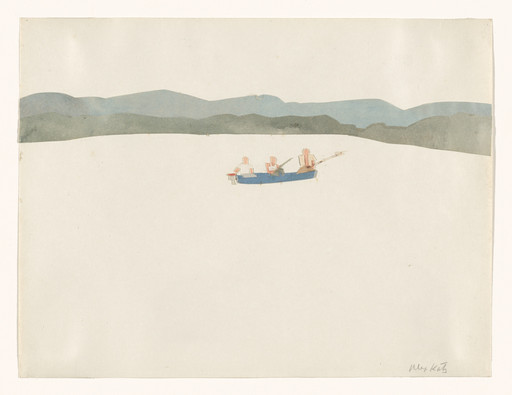
According to Alex Katz, appearance and style are the subjects of his artworks, which are decidedly cool, aloof, and detached faces and figures. These individuals serve as matrices for his explorations of scale, color, light, form, and composition. Yet the often distant expressions of their faces—primarily depicting family members, friends, and art-world figures he knows personally—combined with his selective documentation of their up-to-date clothes and hairstyles, make him, de facto, an interpreter of contemporary life.
For Katz, printmaking has served as both an opportunity to refine his imagery and as a springboard to further work. In the 1950s, he made linoleum cuts and stencils that influenced his move into collage and his use of flat, static colors in his paintings. Since the mid-1960s, he has collaborated with numerous printers and publishers to produce more than two hundred prints in a variety of techniques.
The aquatints shown here are from an illustrated book containing fourteen portraits of second-generation New York School poets, interleaved with a poem about contemporary life contributed by each. These poets are among Katz's circle of friends, who became acquainted at parties, poetry readings, and art openings in the 1960s and 1970s. For this project he first painted the portraits on aluminum in a hybrid format he called "cutouts" that silhouettes the figures. He then traced the outlines of these portraits onto copperplates, cutting them out to serve as shaped printing surfaces. The soft tonal quality of the aquatint technique he used lends an intimacy to his characterizations, while the book format allowed Katz to juxtapose each portrait with that poet's verse.
an essay by Jennifer Roberts, in Deborah Wye, Artists and Prints: Masterworks from The Museum of Modern Art, New York: The Museum of Modern Art, 2004, p. 240.
Explore more
From MoMA Design Store


Licensing
Artwork or archival images
If you would like to reproduce an image of a work of art in MoMA's collection, or an image of a MoMA publication or archival material (including installation views, checklists, and press releases), please contact Art Resource (publication in North America) or Scala Archives (publication in all other geographic locations).
Audio and film clips
MoMA licenses archival audio and select out of copyright film clips from our film collection. At this time, MoMA produced video cannot be licensed by MoMA/Scala. All requests to license archival audio or out of copyright film clips should be addressed to Scala Archives at [email protected]. Motion picture film stills cannot be licensed by MoMA/Scala. For access to motion picture film stills for research purposes, please contact the Film Study Center at [email protected]. For more information about film loans and our Circulating Film and Video Library, please visit Circulating Film and Video Library.
Text from a publication or the archives
If you would like to reproduce text from a MoMA publication, please email [email protected]. If you would like to publish text from MoMA's archival materials, please fill out this permission form and send to [email protected].
Feedback
This record is a work in progress. If you have additional information or spotted an error, please fill out this feedback form.