Louise Bourgeois
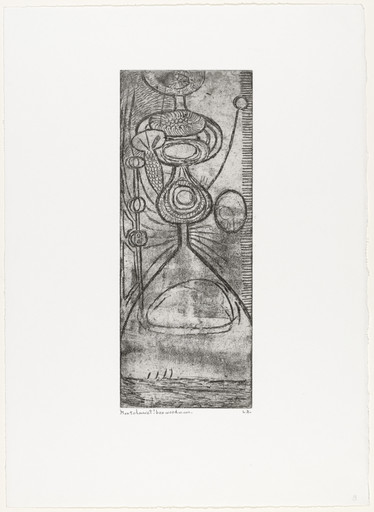
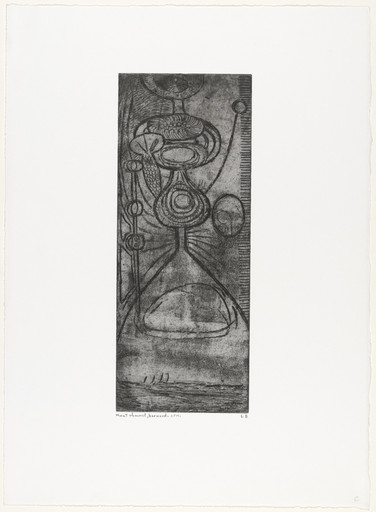
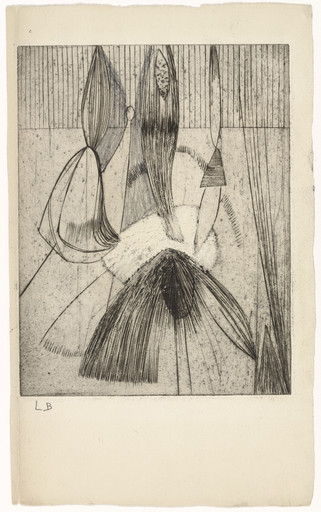
Untitled, plate 5 of 5 state IV of V, from the illustrated book, The Laws of Nature
2003
Drypoint
Not on view
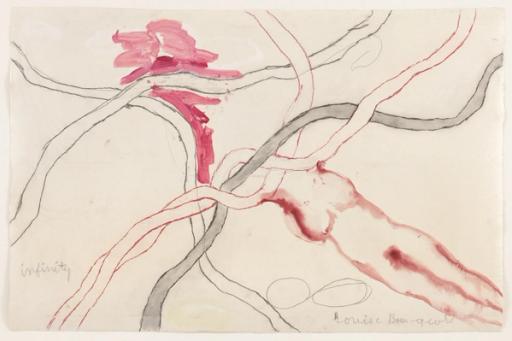
Desire challenges the laws of nature. It defies the rules of anatomy, gravity, time, and language. In the encounter between the body and desire, muscles and tissues gain elasticity and tonus, migrating beyond the logic of corporeal boundaries. Body language is the utterance of the unspeakable.
There is silence in desire. In the melody of the pas de deux, the bodies write themselves. One is inscribed in the other. The dance of desire is the calligraphy of seduction.
The language of the body is a topological choreography similar to a Moebius strip, where the actual continuity of One and the Other is a surface without inside and outside. What estrangement is possible? Fusion fears separation while phantoms anticipate it, leading lovers to melancholic fantasies of incorporation. It is the eve of loss. One body nourishes while one is nourished.
A print is the memory of the body of the Other in our body. The act of turning a page reiterates the action of lightly touching the Other. The dance of love passes through our fingers. Closing this book is wrapping the body in the memory of a precious moment.
Desire wants no end. Lovers experience suspended time. Amor fugit. The only fragile defense against time is the poetical belief in the imaginary quality of love as being eternal. The lovers hold each other and will not be separated. At the end, the world is totally upside-down.
Paulo Herkenhoff, Notes on the Laws of Nature, 2003.
Explore more
Louise Bourgeois
American, born France. 1911–2010 3040 works onlineBorn in Paris in 1911, Louise Bourgeois was raised by parents who ran a tapestry restoration business. A gifted student, she also helped out in the workshop by drawing missing elements in the scenes depicted on the tapestries.
Learn more →
From MoMA Design Store


Licensing
Artwork or archival images
If you would like to reproduce an image of a work of art in MoMA's collection, or an image of a MoMA publication or archival material (including installation views, checklists, and press releases), please contact Art Resource (publication in North America) or Scala Archives (publication in all other geographic locations).
Audio and film clips
MoMA licenses archival audio and select out of copyright film clips from our film collection. At this time, MoMA produced video cannot be licensed by MoMA/Scala. All requests to license archival audio or out of copyright film clips should be addressed to Scala Archives at [email protected]. Motion picture film stills cannot be licensed by MoMA/Scala. For access to motion picture film stills for research purposes, please contact the Film Study Center at [email protected]. For more information about film loans and our Circulating Film and Video Library, please visit Circulating Film and Video Library.
Text from a publication or the archives
If you would like to reproduce text from a MoMA publication, please email [email protected]. If you would like to publish text from MoMA's archival materials, please fill out this permission form and send to [email protected].
Feedback
This record is a work in progress. If you have additional information or spotted an error, please fill out this feedback form.