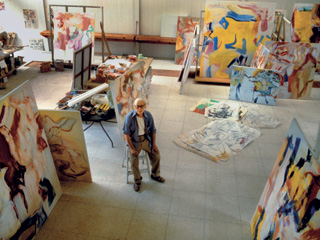
“Full Arm Sweep”
1956–1957
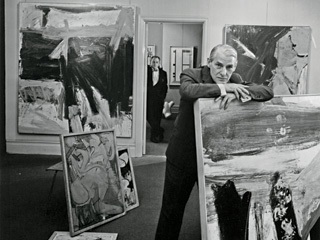
De Kooning with Sidney Janis in Janis's gallery, New York City, June 15, 1959. Photograph by Arnold Newman. Arnold Newman Collection/Getty Images
- Previous Period:
Woman to Landscape (1950–1956) - Next Period:
Starting Over in Springs (1964–1969)
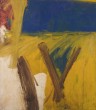
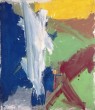
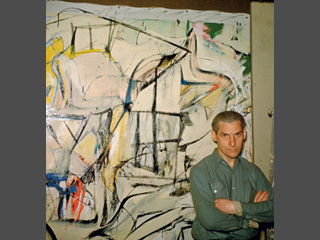
In 1956, de Kooning began to increase the loose painterliness of his canvases and to further prise apart their scaffoldings of brushstrokes, conveying a more expansive sense of pictorial space. The works that ensued were the most expressively painted of any he had made, and were largely confined to variants of blue, brown, green, and yellow ocher. He exhibited these so-called “abstract parkway landscapes” at the Sidney Janis Gallery in the spring of 1959, in the most popular gallery exhibition of his career. Such was de Kooning’s acclaim and influence that, as one critic put it, “the phrase ‘abstract expressionist’ is now seen to mean ‘paintings of the school of de Kooning.’”
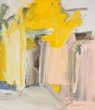
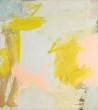
In 1960, he began a series of “abstract pastoral landscapes” that, like the preceding series, were restricted in palette, but now in rococo hues of pink, yellow, and blue, influenced by time spent in East Hampton, where he would move permanently in 1963.