 |
|
Not surprisingly, as the culture became inundated with images of famous people in the 1960s, the notion began to percolate that each of us might be just as special, as idiosyncratic and worthy of fame, as the people we were seeing in the media. Anti-heroes and ethnic characters who looked nothing like the glamorous movie stars but more like the person down the street came to dominate movie plots. Persistent images of youthful counterculture heroes and protesters helped shift cultural and political tides when they appeared on network nightly news, on front pages of local newspapers, on posters tacked up on bedroom and dormitory walls, on record covers, buttons, and tee-shirts. After an intense decade of social upheaval, including the Vietnam War, Watergate, and women's liberation, the rise of youth culture, and the sexual revolution, Americans were ready to lighten up and they did it by indulging in a revitalized celebrity culture with a new cast of characters and a new set of values. When People magazine was published in 1974, the unspoken but firm distinctions that separated fame from celebrity, leaders from followers, and stars from their audiences began to erode. The personal and cultural narcissism that characterized the "me decade" of the 1970s, the popularity of pop anthems like "Everybody Is a Star," and the implicit promise of success in movies like Fame and Saturday Night Fever hinted at the preoccupations and the tenor of the new celebrity culture.
  |
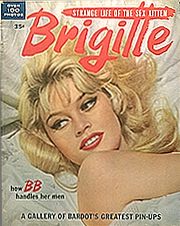
| Peter Basch. Front cover of Brigitte: Strange Life of
the Sex Kitten Brigitte. Vol. 1, no. . 1958. Offset lithograph. 10 x 8". Dell Publishing Co., Inc. select image for enlarged view |