|
| |
bantustan: An ethnic "homeland" in which Africans were given a measure of self-government.
National Party: The Afrikaner political party which grew out of the Purified National Party formed in 1933; it governed the country from 1948 until 1994 and was responsible for the introduction of apartheid.
Africans: Dark-skinned people indigenous to Africa.
|
|
|
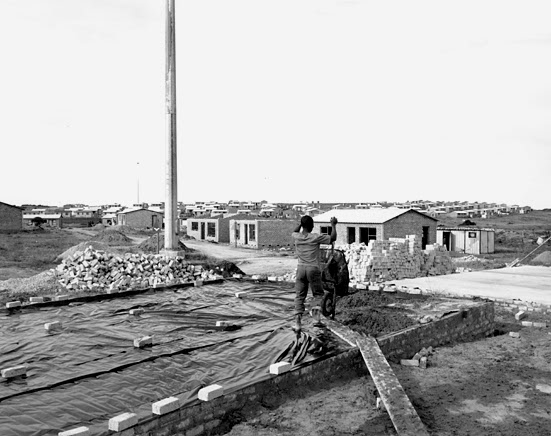
This home builder was enjoying the fruits of a privilege he had only been recently granted: the right to own fixed property. Between 1954 and 1989, except in certain parts of the bantustans, the right to own land was denied to Africans under the apartheid legislation of the National Party. In 1978, in a major admission of the failure of apartheid, the government acknowledged that Africans were a permanent part of the urban population and offered township African 99-year leases on their houses. In Western Cape this concession was made only in 1984. Freehold title in proclaimed African townships became possible in 1986. These clear-cut dates belie the complexity of local situations: changes were not always immediately and uniformly applied.
During the apartheid years the prohibition on freehold title by Africans was qualified: for those who knew the right people it was in some circumstances possible to do legally what was otherwise illegal by means of a permit issued by the government. The denial of rights in fixed property to Africans effectively ensured their inability to provide acceptable collateral to financial institutions and thus greatly inhibited their independent economic development.
Under an assisted housing scheme this man owned the plot on which he was working; he had pledged the land to raise the loan to buy the materials with which he was building his house.
|