 |
|
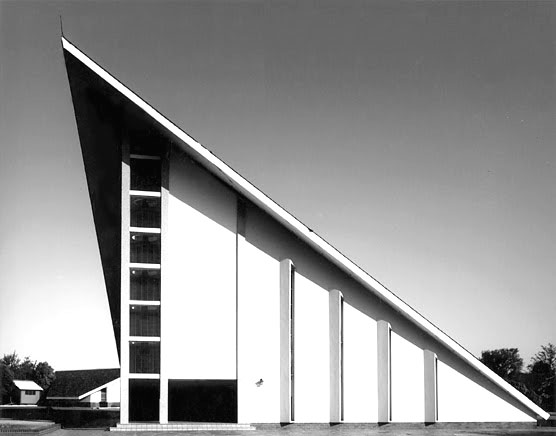
When a leading theologian of the Dopper Church, Willem Postma, was told in 1918 that the Doppers were behind the times, he declared, "[this] doesn't reflect on the Doppers but on the times." Thus did he encapsulate the world view of the most conservative of the three Afrikaner Protestant Churches. Paradoxically however Dopper churches were architecturally the most radical in the great wave of church building engaged in by the Afrikaner Protestant Churches between the 1940s and the late 1980s. Several of the archetypal Dopper churches, including this one, were by Johan de Ridder. Himself a Dopper, he explained his approach to me in 1994: "The Dopper Church took the lead because of the strength of its doctrine. I could approach the design of the church as the community did, trying to incorporate our beliefs in it. It was not a style. The church was a visual symbol of aspects of our faith, while simultaneously retaining the basic idea of the Reformation that all external symbols should be avoided. I couldn't accept a complicated architecture. I wanted simple wall surfaces, big roof surfaces, a plain, striking building with height and unity between interior and exterior... The triangle is essentially religious with a very vertical and spiritual character. Preaching of the Word is not confined to four walls. It must go out through big windows at the top and front of the church which is like a megaphone with the preacher at its apex." The foundation stone of this church was laid on 13 June 1959. |
||||
 |
|||||
 | |
  |
 |
©1998 The Museum of Modern Art, New York