"No work of art can be true to nature in the objective sense. The nearer it
approximates the natural appearance of objects the more it is likely to be far
away from art." Stuart Davis, from "The Process of Painting," April 20,
1923.
The novelties mass-produced and
marketed in the 1920s—cigarettes, razors,
pens, mouthwash—were presented in advertising as icons of a modern society,
and indeed as "objects of desire." The punchy visual vernacular of these
promotions interested a number of artists including Stuart Davis, Fernand
Léger, and Gerald Murphy, whose Razor, 1924, projects the
flat, frontal, and scaleless aura of a billboard. These radically
self-referential works are grouped here with paintings by Hannah Höch,
Joan Miró, Iwan Babij, and Salvador Dalí of the same period.
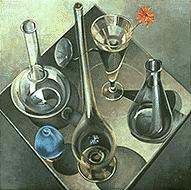
Making obvious references to earlier styles and subjects within the still life
genre, these artists—whether associated with the German
Neue Sachlichkeit ("New Objectivity") group or with French and Spanish
Surrealism—produced works that share a sense of uncanny realism, attaining
"objectivity" through a strikingly concrete, precise, and deliberate
articulation of forms.