The Unité d’Habitation was a landmark in modern architecture and design, and one of the first attempts to create highly designed spaces for low-income families. Along with apartments, the building included a half floor reserved for merchants, a pre-school, and a rooftop playground with wading pool and gymnasium. Le Corbusier was extremely efficient in the use of space, modeling his design on that of cruise ships,


Posts tagged ‘Conservation’

March 13, 2013
|
Behind the Scenes,
Collection & Exhibitions,
Conservation,
Le Corbusier Kitchen Conservation
Le Corbusier Kitchen Conservation: Focus on Design

February 7, 2013
|
Behind the Scenes,
Collection & Exhibitions,
Conservation,
Le Corbusier Kitchen Conservation
Le Corbusier Kitchen Conservation: Getting Resourceful
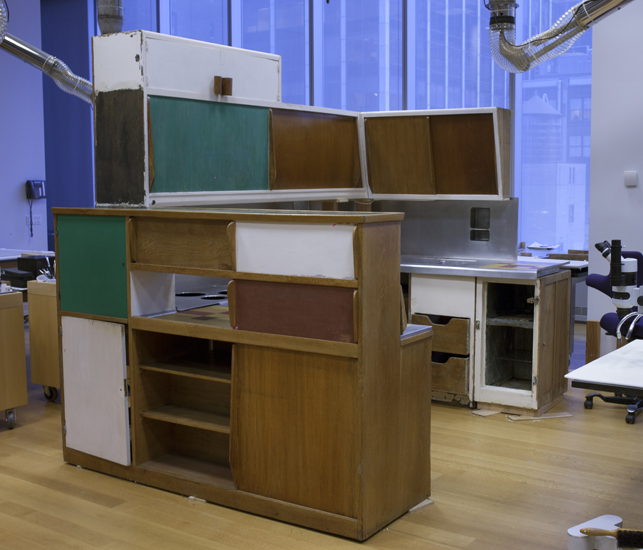
Charlotte Perriand and Le Corbusier. Kitchen from the Unité d’Habitation, Boulevard Michelet, Marseilles, France
One of the initial challenges in conserving a design piece that has been in use for over 60 years is assessing where the work has been modified over the years by the owners, and if it is truly complete. Like in our own homes, parts of this Le Corbusier kitchen have been replaced, painted over, lost, and damaged.

January 7, 2013
|
Artists,
Collection & Exhibitions,
Conservation,
Le Corbusier Kitchen Conservation
Le Corbusier Kitchen Conservation: Dismantle, Reconstruct, and Conserve
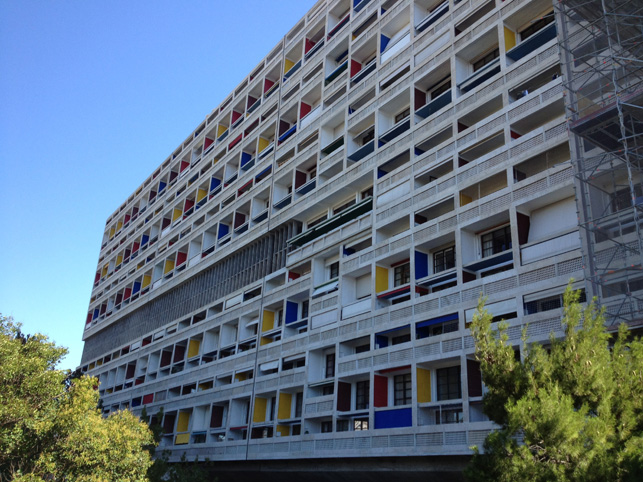
Unité d’Habitation, Boulevard Michelet, Marseilles, France
In the fall of 2011, we traveled to a leafy suburb of Munich, Germany, to examine a kitchen that the Department of Architecture and Design hoped to purchase. When we arrived, there in the garage of a collector we found an assembled kitchen from Unité d’Habitation, Le Corbusier’s famous apartment building in Marseille.

November 9, 2012
|
Conservation,
Hurricane Sandy Aftermath - Tips for Artists
Dealing with Wet Contemporary Paintings: Tips for Artists—Introduction
The following tips are suggestions from conservators, but please realize that every painting and circumstance is different, and that these are general guidelines. A conservator may choose very different treatment options from those presented below upon seeing the painting’s condition.
November 9, 2012
|
Conservation,
Hurricane Sandy Aftermath - Tips for Artists
Dealing with Wet Contemporary Paintings: Tips for Artists—Water Damage to Paintings
Watch for water that has collected between the stretcher and the reverse of the painting. If a lot of water has accumulated, tip the painting so that the water can run out and away from the painting (i.e., tip the painting bottom face upwards and the top reverse downwards, so the water runs off the stretcher and not into the canvas).
November 9, 2012
|
Conservation,
Hurricane Sandy Aftermath - Tips for Artists
Dealing with Wet Contemporary Paintings: Tips for Artists—Wet Paintings: Structural Issues
Never remove a wet painting from its stretcher bars. The stretcher bars are keeping the canvas from shrinking. The painting is apt to generate enormous tension in the wet canvas—somewhat less so with salt or brackish water—as the fibers swell with the water.
November 9, 2012
|
Conservation,
Hurricane Sandy Aftermath - Tips for Artists
Dealing with Wet Contemporary Paintings: Tips for Artists—Frames
Dealing with paintings in their frames poses a difficult set of tradeoffs. First remove all backing materials—paper, cardboard, Foam Core Board, or plastics.
Remove paper or cardboard backings from the reverse of the painting.
November 9, 2012
|
Conservation,
Hurricane Sandy Aftermath - Tips for Artists
Dealing with Wet Contemporary Paintings: Tips for Artists—Mold and Paintings
Never wrap a wet painting in plastic, as this will promote mold growth. Also, the surface may be quite fragile and nothing should come in contact with the surface until it has been thoroughly dried and inspected.
Paintings wrapped in plastic should be removed from the plastic to prevent mold growth if they were in a damp environment
November 9, 2012
|
Conservation,
Hurricane Sandy Aftermath - Tips for Artists
Dealing with Wet Contemporary Paintings: Tips for Artists—Health and Safety
First and foremost, be safe. In wet environments, if the power has been restored, be particularly careful with electricity and electrical appliances. Using a plug-in GFCI (Ground Fault Circuit Interrupter) on any electrical appliance you are using is strongly recommended.
October 2, 2012
|
Artists,
Behind the Scenes,
Collection & Exhibitions,
Conservation,
Jackson Pollock Project
MoMA’s Jackson Pollock Conservation Project, Post 3: Documentation and Treatment
We left off in our last post having explained the research and assessment that precedes any conservation treatment. Using Echo as our object of study, we examined questions that arise after looking closely at a painting. Let’s delve into one such question.
If you are interested in reproducing images from The Museum of Modern Art web site, please visit the Image Permissions page (www.moma.org/permissions). For additional information about using content from MoMA.org, please visit About this Site (www.moma.org/site).
© Copyright 2016 The Museum of Modern Art
Welcome to MoMA.org. To take full advantage of all the site’s features, including the option to save works in the collection, please upgrade your browser to Firefox,
Google Chrome, Safari, or Internet Explorer 9.
See our help page for more information.
To take full advantage of all of the features on MoMA.org, please upgrade your browser to Firefox, Google Chrome,
Safari, or Internet Explorer 9.