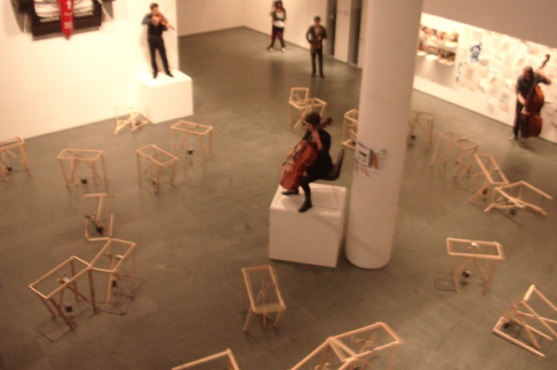
In planning the programs for MoMA’s Bauhaus Lab, we wanted to give the public the opportunity not only to experience original Bauhaus curricula, but also to meet contemporary artists with multidisciplinary practices in an experimental spirit similar to the Bauhaus. The L.A.-based collective Machine Project most definitely falls into this category. (Machine’s approach to pedagogy as performance was previously presented this year at MoMA during the symposium Transpedagogy: Contemporary Art and the Vehicles of Education.)
Posts in ‘Collection & Exhibitions’
Q&A with Carter Mull for New Photography 2009

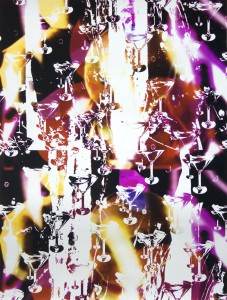
Carter Mull. Los Angeles Times, Monday February 23, 2009. 2009. Chromogenic process print, 49 x 37" (124.5 x 94 cm). Collection Dr. Dana Beth Ardi, New York. Courtesy Marc Foxx, Los Angeles. © 2009 Carter Mull
Carter Mull‘s work in New Photography 2009 is full of vibrant color and patterns. Beyond the surface is a body of work that explores language, our relationship to images in an image-saturated world, and the spectre of the death of print media and chemical photography. In the following Q&A, Carter talks to me in detail about his work.
Eva Respini: How did you become interested in the Los Angeles Times as the starting point for the body of work on view in New Photography 2009?
Carter Mull: Initially, I was drawn to a question about the psychological impact of an image. Journalism and the media had been in the background of my thinking for a number of years—and I was curious about the question of how one responds to an image of distant trauma, contextualized within the framework of the local newspaper. Also, the very material—the literal placement of advertising next to news—was an intriguing reality.
ER: The title for this series is Triggers for Everyday Fiction, and you refer to these photographs as “triggers” and “responses.” I like thinking about the relationship between the pictures as a kind of call and response. Can you talk a little bit more about that?
CM: The project began about two years ago with the initial program of considering a media site, in this case the Los Angeles Times, as a point of departure. I wanted to treat the lead image of the paper as a generator of sorts—and the output of the works as a whole as somehow governed by the grammar of the idea. The terms you refer to work as a nomenclature to designate points within the body of work. At the moment, I think about the images taken together as a series of passages—and as an active cognitive process.

The Tim Burton Website: As Beetlejuice said, “Nice [bleeping] model!”
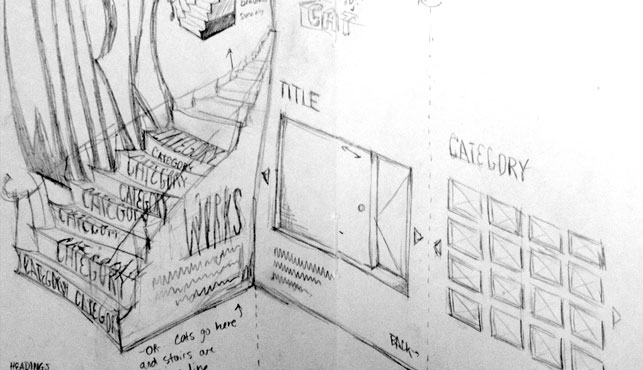
A couple weeks back we previewed the Tim Burton exhibition site. Now that you’ve seen the initial directions that Big Spaceship proposed for the site, let’s see how they created the final product.

Process sketch from Big Spaceship
A Close Look: Frida Kahlo’s Fulang-Chang and I
When curators Leah Dickerman, Luis Pérez-Oramas, and I began to discuss our plans for creating a new gallery dedicated to Mexican Modernist art made in the 1930s and 1940s—which opened in May of this year—Frida Kahlo’s Fulang-Chang and I was one of the works we were determined to include. We were intent not only to show the painting, but also to display it alongside the mirror that Kahlo made to accompany it, for reasons I’ll elaborate on a bit later.
Midnight at the Movies with Tim Burton
Sleepy Hollow. 1999. USA. Directed by Tim Burton. Courtesy of Paramount Pictures
Whenever Ron (Magliozzi, my co-organizer) recounts his “eureka” moment that spurred him to curate an exhibition on the work of Tim Burton—while watching Charlie and the Chocolate Factory on a Sunday in 2005, as described in Ron’s first Burton post—it always takes me back to that Monday, when he excitedly approached my desk to chat about his weekend. The first thing he said to me that morning was, “You know who we should do next? Tim Burton!”
Sara VanDerBeek in New Photography 2009
Like many of the works in New Photography 2009, Sara VanDerBeek’s photographs are made entirely in the studio. She collects pictures from various sources, including art history books, archives, magazines, and newspapers, and incorporates them into sculptures that are made only to be photographed. After Sara photographs her sculptures, they are immediately dismantled, and her picture is the only remaining evidence of the temporary structure.
Bauhaus Lab: The Secret Ingredient?

Bauhaus Lab: Johannes Itten and Paul Klee Curricula Workshops, The Lewis B. and Dorothy Cullman Education and Research Building
In MoMA’s Cullman Education and Research Building, you’ll find visitors sitting at clover-like Bauhaus tables (based on the original workshop photographs) working on drawing exercises devised by Bauhaus masters Johannes Itten and Paul Klee. Interestingly, Klee and Itten themselves were actually not so happy sharing a table—the dinner table, that is.
Daniel Gordon in New Photography 2009
“Oh! No mortal could support the horror of that countenance. A mummy again endued with animation could not be so hideous as that wretch. I had gazed on her while unfinished; she was ugly then, but when those muscles and joints were rendered capable of motion, it became a thing such as even Dante could not have conceived.” —excerpt from Mary Shelley’s Frankenstein
Daniel Gordon‘s photographs elicit attraction and repulsion. They are irresistibly vibrant and tactile, but also surreal and grotesque. His works are not what they appear to be at first glance. They look like collages, but upon further inspection the photographs reveal themselves to be pictures of sculptures. The female figures in the photographs are cobbled together from found images on the Internet that the artist prints out and constructs into three-dimensional tableaus. The sculptures are photographed and then immediately disassembled so that the artist can use the body parts for new works. The works are made alive and exist only through the act of photography.
The Tim Burton Website: It’s Aliiiiiive!
Months before an exhibition opens we meet to plan out any related online features. Since we’re a small team we often get developers or designers to help for bigger sites. For the Tim Burton exhibition, we worked with the Brooklyn company Big Spaceship, who built the site for our Contemporary Voices exhibition in 2005.

The Big Spaceship offices. No, they don't eat astronaut ice cream.
Having nearly broken my VHS copy of Beetlejuice from overuse while growing up, I knew the project would be an exciting one for a design firm to sink their teeth into. In the words of Big Spaceship, “Having the opportunity to work with MoMA for an artist as admirable as Tim Burton was amazing. The quality and imagination inherent to his art speak for themselves—we’re particularly inspired by his breadth of work and desire to experiment.”
One of the most exciting parts of the process is the concept meeting with the designers. After an initial meeting to discuss the exhibition, the crew from Big Spaceship put together three different directions for the site, and we sat down together with the curators to pick a design to build out. We asked them to talk about the three directions they proposed.
Musical MoMA: The TENORI-ON by Toshio Iwai and Yamaha
One of the greatest parts of my job is getting to geek out over the many brilliant examples of design that are considered for the Museum’s collection. Among the most exciting (and drop-dead gorgeous) works we acquired last year is the TENORI-ON, by the Japanese artist Toshio Iwai, manufactured by Yamaha. Promoted by Yamaha as “a digital musical instrument for the twenty-first century,” the TENORI-ON’s “visible music” interface is suitable for both serious musicians and beginners to electronic music.
“In days gone by, a musical instrument had to have a beauty, of shape as well as of sound, and had to fit the player almost organically…. Modern electronic instruments don’t have this inevitable relationship between the shape, the sound, and the player. What I have done is to try to bring back these…elements and build them in to a true musical instrument for the digital age.” —Toshio Iwai
Iwai is an established multimedia artist, musician, and inventor, who seeks “the feeling of childhood in the digital world.” He has worked in television and created a number of computer and video games, including the acclaimed (and addictive) Electroplankton (2005) for the Nintendo DS, in which players generate atmospheric music by manipulating sea creatures.
If you are interested in reproducing images from The Museum of Modern Art web site, please visit the Image Permissions page (www.moma.org/permissions). For additional information about using content from MoMA.org, please visit About this Site (www.moma.org/site).
© Copyright 2016 The Museum of Modern Art