
MoMA
Posts in ‘Collection & Exhibitions’
November 27, 2013  |  Collection & Exhibitions
Setting a Thanksgiving Table, MoMA-Style

How you set your holiday table can be just as fraught as the great Thanksgiving food debates—canned cranberry sauce vs. real, sweet potato pie vs. pumpkin pie, stuffing cooked in the bird or in a pan. In my family, the size of our group prohibits the formal elegance of a matched dinner service, and instead every pan, dish, and utensil is put to use. The hodgepodge is really quite charming, and what I love in particular are the pieces that only grace us with their presence at these official family gatherings—my grandmother’s aluminum roasting pan, for instance, which has probably seen at least twice as many Thanksgiving dinners as I have. To celebrate this annual showcase of dining accoutrements I’ve selected some pieces from MoMA’s Architecture and Design collection that would enhance any Thanksgiving table.
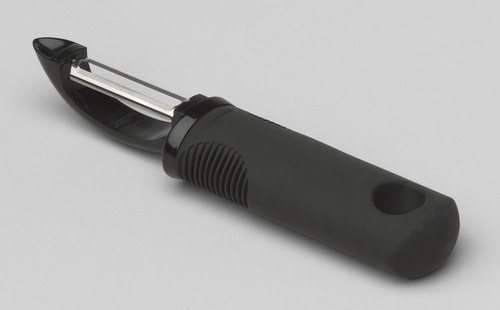
 
CRI_211261
Smart Design, New York. Good Grips Peeler. 1989. Stainless steel and rubber. Manufactured by Oxo International
A behind-the-scenes workhorse—how many potatoes, yams, and carrots did you peel today?—this vegetable peeler has become a standard fixture in kitchens around the world. Sam Faber, a retired kitchenware manufacturer, was inspired to create a line of comfort-grip kitchen tools after his wife developed arthritis. Working with Smart Design Inc., Faber launched the original 15-piece Good Grips collection, with handles based on gardening tools and prototyped using bicycle handlebar grips, through Oxo International.
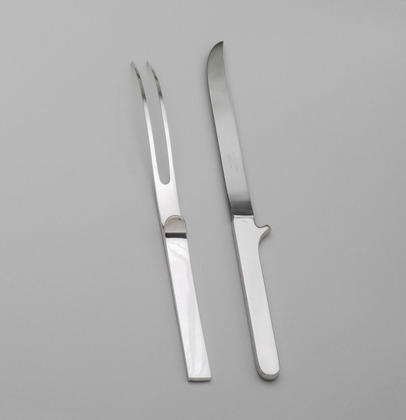
 
CRI_211742
Vico Magistretti. Two-Piece Carving Set, 1980. Sterling silver. Manufactured by Cleto Munari, Venice
Whoever has the honor of carving the bird at your table would probably appreciate this sterling-silver set by Italian deisgner Vico Magistretti. (You may also be familiar with his iconic Eclisse Table Lamp). The minimalistic design, with only a curved thumb-piece interrupting the sleek lines of the handle, reflects the architectural influence that was prevalent throughout the 1980s.
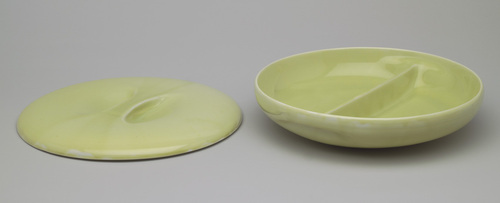
 
CRI_157241
Russel Wright. Casual China Casserole Dish. 1946. Glazed vitreous china. Manufactured by Iroquois China Co.
Russel Wright was a successful American industrial designer; his American Modern dinnerware was the best-selling line ever created, with over 80 million pieces sold from 1939 to 1959. Wright, along with his wife Mary, not only designed clean-lined, colorful ceramics that were a major change from traditional porcelain services, but also excelled at marketing his products for modern, casual lifestyles. The couple even wrote a how-to book that promoted easy entertaining tips like buffet-style dinners. A stove-to-table casserole dish like this one—in a period-appropriate shade of chartreuse—would be just the thing for baking and serving a green bean casserole.
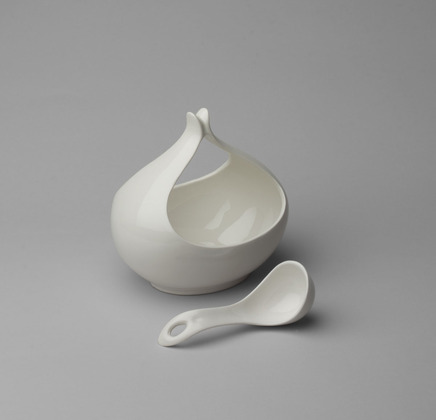
 
CRI_211268
Eva Zeisel. Hallcraft/Tomorrow’s Classic Sauce Boat with Ladle. c. 1949–50. Glazed earthenware. Manufactured by Hall China Co.
The sculptural, organic lines and pure white of this sauce boat and ladle are the perfect embodiment of designer Eva Zeisel’s style (in contrast to Russel Wright’s colorful mix-and-match serving pieces). Beloved by the design world, Zeisel’s work never seems to look dated—which might explain why so many of her pieces are still in production today.
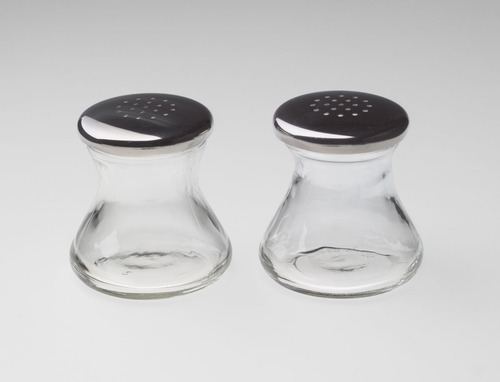
 
CRI_212099
Wilhelm Wagenfeld. Salt and Pepper Shakers. 1953. Manufactured by Württembergische Metallwarenfabrik
Bauhuas-trained designer Wilhelm Wagenfeld promoted standardized, functional forms in order to elevate mass produced goods. The thoughtful proportions of these salt and pepper shakers are accentuated by the minimal design (somewhat reminiscent of a scientific beaker) and use of industrial materials (stainless steel and glass). And best of all, they’re for sale at MoMAstore.org.
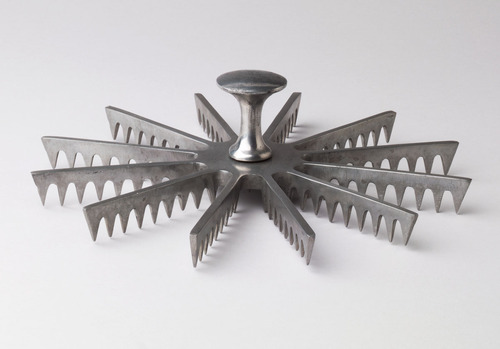
 
CRI_211572
12-Cut Pie Marker. 1950s. Cast aluminum. Unknown Italian Manufacturer
This round-up ends exactly where it should: with dessert. Ensuring that everyone gets an equal slice? If you value Thanksgiving-table harmony, you should probably considering getting one of these. Now you just have to decide what type of pie it’s going to be? Apple? Pumpkin? Sweet potato? Personally, I’m going with pecan.

Happy Thanksgiving!
November 25, 2013  |  Artists, Collection & Exhibitions
Behind the Screens:
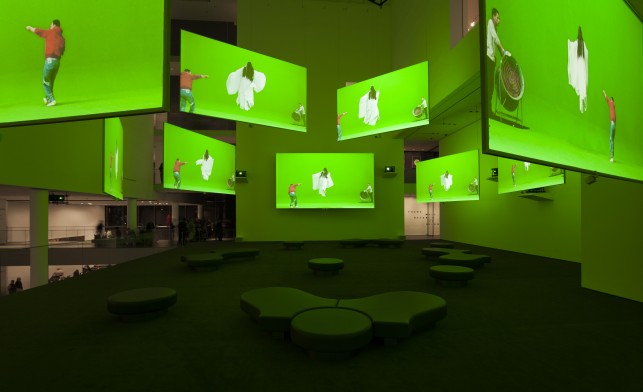
Installing Isaac Julien’s Ten Thousand Waves
Installation view of Isaac Julien: Ten Thousand Waves at The Museum of Modern Art. Photo: Jonathan Muzikar

Installation view of Isaac Julien: Ten Thousand Waves at The Museum of Modern Art. Photo: Jonathan Muzikar

Isaac Julien (British, b. 1960) is one of the most innovative artists working at the intersection of media art and cinema today. With his vivid multi-screen works—fractured narratives that fuse breathtaking images with immersive sonic elements—Julien is internationally regarded as a key figure in the vitalization of the gallery space through new exhibition strategies of time-based art.

Magritte’s The Menaced Assassin, 1927—Treatment and Research

As indicated in the previous posts in this series, MoMA paintings conservators Cindy Albertson, Anny Aviram, and Michael Duffy have been studying five Magritte paintings for the past two years in preparation for Magritte: The Mystery of the Ordinary, 1926–1938.

November 20, 2013  |  Artists, Collection & Exhibitions
Writing on Isa Genzken
Genzken_cover

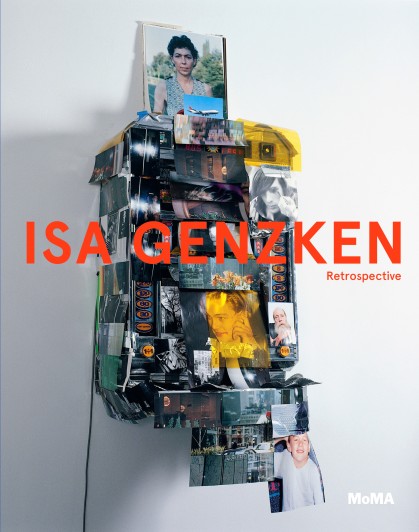
Cover of the publication Isa Genzken: Retrospective published by The Museum of Modern Art

Isa Genzken is arguably one of the most influential female artists of the past few decades, her impact visible in the work of young sculpture and assemblage artists worldwide. MoMA’s upcoming exhibition Isa Genzken: Retrospective is the first comprehensive survey of her career in the United States, and the largest exhibition of her work to date. The accompanying catalogue explores her unique and decidedly diverse career through illustrated-plate sections and essays spanning a more than 40-year period. Genzken’s artwork is markedly varied and the narrative of her career is unconventional. She’s worked in nearly every imaginable medium, including sculpture, photography, film, assemblage and collage. The catalogue’s essays offer new insights on her aesthetic outlook and approach.

Curator Sabine Breitwieser’s essay covers Genzken’s artistic output from 1970 to 1996, discussing her early geometric drawings and sculptures, and her presence in the art centers of West Germany as a student at the Düsseldorf Academy and in Cologne. In the 1990s, Genzken moved away from post-Minimalism and began to make her first collage works.

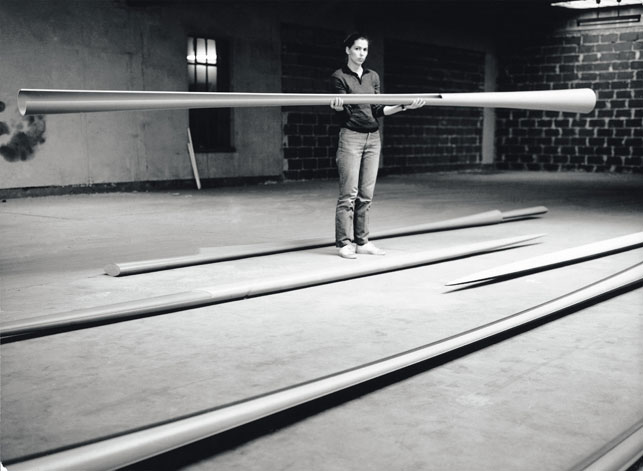
Isa Genzken in her studio in Düsseldorf, 1982. Image courtesy the artist and Galerie Buchholz, Cologne/Berlin

Isa Genzken in her studio in Düsseldorf, 1982. Image courtesy the artist and Galerie Buchholz, Cologne/Berlin

Laura Hoptman, curator in MoMA’s Department of Painting and Sculpture, explores this career break and later parts of Genzken’s career—from 1993 to the present—when her collage and sculptural assemblages and installations grew in scale and conceptual complexity.

bh 8

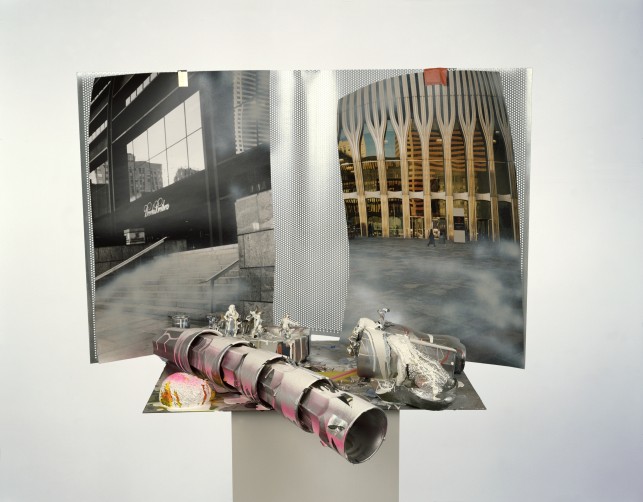
Isa Genzken. Empire/Vampire III, 13. 2004. Spray paint on metal and glass, chromogenic color prints, and plastic on wood pedestal, 65 3/4 x 23 5/8 x 18 1/8″ (167 x 60 x 46 cm). neugerriemschneider gallery, Berlin. © Isa Genzken

The book also includes focused thematic essays. Scholar Lisa Lee writes on Genzken’s relationship with architecture and public sculpture in “Isa Genzken: Model Citizen,” considering her experiments with scale, perception and even mutiny, with projects like Fuck the Bauhaus.  In “Isa Genzken: Himmel und Erde (Heaven and Earth),” Michael Darling argues for a thematic consistency in Genzken’s variegated oeuvre, positing that she “has married radical formal experimentation and variety to themes that are timeless, poignant and deeply humanistic, rooting her inquiries in the material facts of our world but offering pathways to topics, experiences, and concepts that, by definition, escape the grasp of easy resolution.” Jeffrey Grove’s essay, “Isa Genzken’s Homage to Herself” discusses motifs of autobiography and self-representation in her work, particularly in photography and film. An illustrated chronology by Stephanie Weber, Curatorial Assistant in the Department of Media & Performance Art at MoMA guides readers through the exciting trajectory of Genzken’s career, from birth to her first American retrospective at MoMA.

Isa Genzken: Retrospective is on view from November 23, 2013–March 10, 2014 in the The Joan and Preston Robert Tisch Exhibition Gallery on the Museum’s sixth floor. A preview of the catalogue can be downloaded here.

November 18, 2013  |  Collection & Exhibitions
Reading John Cage
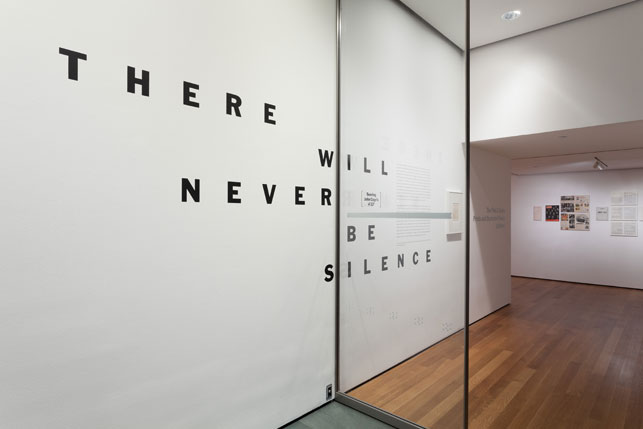
Installation view of There Will Never Be Silence: Scoring John Cage's 4'33", The Museum of Modern Art, New York, October 12, 2013–June 22, 2014

Installation view of There Will Never Be Silence: Scoring John Cage’s 4’33”, The Museum of Modern Art, New York, October 12, 2013–June 22, 2014

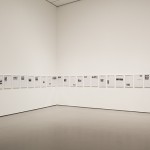
Though the exhibition There Will Never Be Silence: Scoring John Cage’s 4′33" primarily draws upon works from MoMA’s collection, with a few key outside loans, the voice of John Cage himself was instrumental in guiding the selection of artists, and, in some cases, the specific works on view.

November 15, 2013  |  Collection & Exhibitions
Unwriting: Sarah Charlesworth

“This is real time, it is modern history in the making.”—Sarah Charlesworth on her work, Movie-Television-News-History, June 21, 1979

MoMA Celebrates 1913: Henri Matisse’s The Blue Window

MoMA’s celebration of the landmark year 1913 continues with the 21st installment in our series of videos highlighting important works from 1913 in the Museum’s collection.

MoMA Celebrates 1913: Ludwig Hohlwein’s Schiess-Dusseldorf Poster

MoMA’s celebration of the landmark year 1913 continues with the 20th installment in our series of videos highlighting important works from 1913 in the Museum’s collection.

November 6, 2013  |  Collection & Exhibitions
Uneven Growth: Tactical Urbanisms for Expanding Megacities
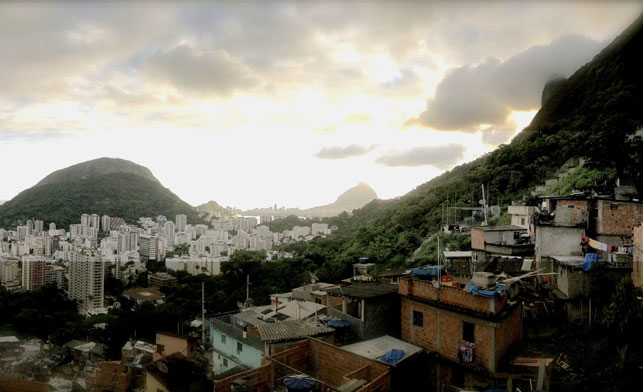
Rio de Janeiro, 2013. Photograph by Pedro Gadanho

Rio de Janeiro, 2013. Photograph by Pedro Gadanho

Uneven Growth: Tactical Urbanisms for Expanding Megacities, the third iteration in MoMA’s Issues in Contemporary Architecture series, has just launched with a lively public conversation in MoMA PS1’s VW Dome.

November 4, 2013  |  Collection & Exhibitions, Film
New Acquisitions in MoMA’s Circulating Film and Video Library
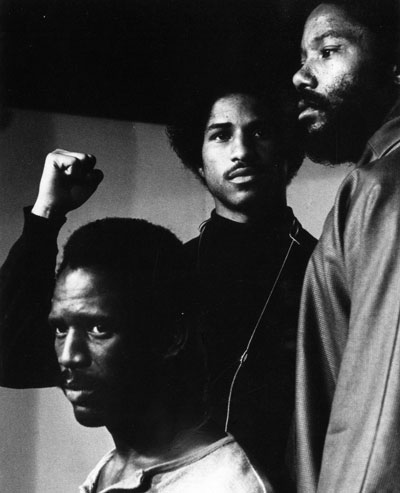
Right On! 1970. USA. Directed by Herbert Danska

Right On! 1970. USA. Directed by Herbert Danska

Many people are not aware that tucked away within the MoMA organization is a film distributor. The Film Library was actually the original department, founded in 1935 to celebrate film as the art form of the 20th century.